




List of Contents


What is the Intelligent Platform Management Interface Market Size?
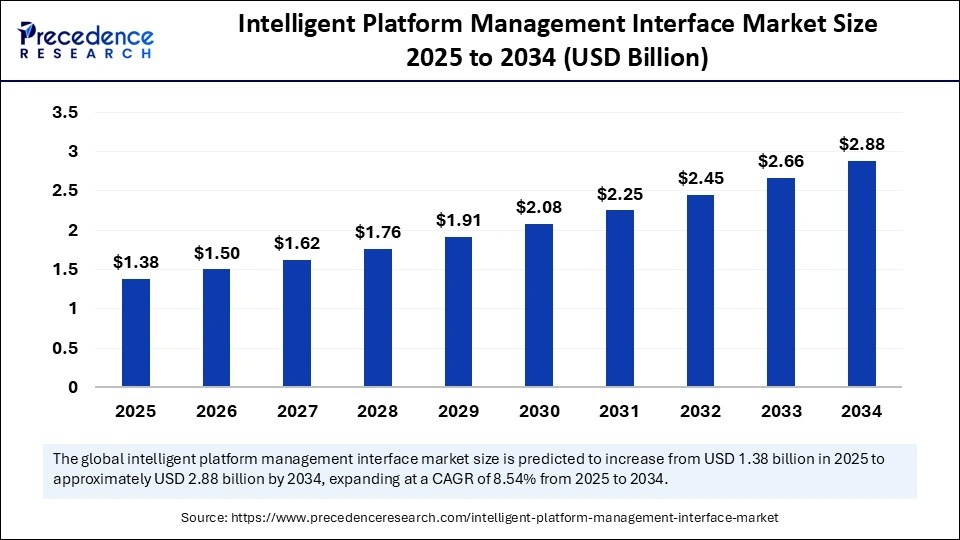
The global intelligent platform management interface market size is valued at USD 1.38 billion in 2025 and is predicted to increase from USD 1.50 billion in 2026 to approximately USD 2.88 billion by 2034, expanding at a CAGR of 8.54% from 2025 to 2034. The market is driven by the rising demand for remote server management, increasing data center deployments, and the growing need for enhanced system reliability and security.
Intelligent Platform Management Interface Market Key Takeaways
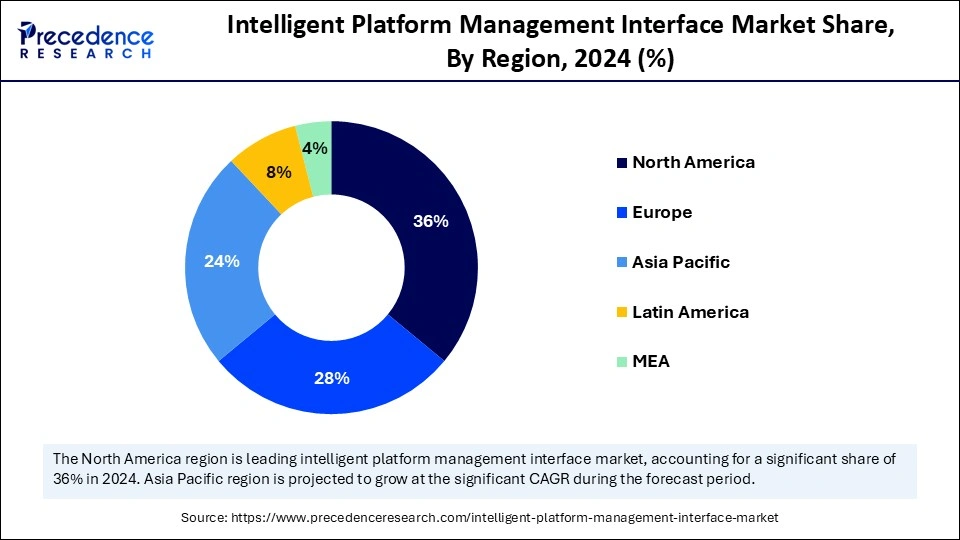
- North America dominated the intelligent platform management interface market with the largest market share of 36% in 2024.
- Asia Pacific is anticipated to witness the fastest growth during the forecasted years.
- By component, the baseboard management controllers (BMCs) segment held the biggest market share in 2024.
- By component, the IPMI firmware and software stacks segment is anticipated to show considerable growth over the forecast period.
- By product type, the embedded IPMI solutions segment led the market in 2024.
- By product type, the modular IPMI solutions for edge and compact systems segment is anticipated to show considerable growth over the forecast period.
- By deployment type, the on-premises data centers segment captured the highest market share in 2024.
- By deployment type, the hyperscale cloud data centers segment is anticipated to show considerable growth over the forecast period.
- By application, the server management segment held a significant share in 2024.
- By application, the high-performance computing (HPC) infrastructure segment is anticipated to show considerable growth over the forecast period.
- By distribution channel, the direct OEM sales segment generated the major market share in 2024.
- By distribution channel, the system integrators/IT service providers segment is anticipated to show considerable growth over the forecast period.
What is an Intelligent Platform Management Interface?
The intelligent platform management interface market is a strategic ecosystem of hardware, firmware, and software that facilitates standardized, out-of-band management of servers, monitoring, and control of a wide range of IT infrastructures. IPMI is integrated into Baseboard Management Controllers (BMCs) and embedded into server platforms to offer remote monitoring of system health, power conditions, fan speed, temperature, and event logs. IPMI, which was originally developed by Dell, HP, and Intel, has become an industry standard in server management, such that it is compatible in multi-vendor environments.
The market includes IPMI controllers, management software, APIs, and integrated solutions that are broadly used in hyperscale cloud systems, telecom networks, industrial automation, and new edge computing infrastructure. The growing use of applications that are data-intensive, AI workloads, and cloud-based services has caused a large-scale deployment of data centers globally, which has strained the need for effective and solid server management solutions. Also, IPMI is an essential way of increasing system reliability and security as it allows proactive monitoring and predictive maintenance by minimizing downtime and operational costs.
How is AI Integration Transforming the Intelligent Platform Management Interface Market?
The market is being influenced by the introduction of the intelligent platform management interface being replaced by the adoption of artificial intelligence to offer predictive maintenance and advanced analytics. IPMI provides data on monitoring of the system, such as temperature, voltage, fan speed, and power state. Machine learning algorithms analyze past trends and sensor data in real-time to detect anomalies to empower administrators to actively regulate the health and downtime of the system. The use of AI also gives better use of the energy since it can be dynamically altered in cooling and power distribution as per the workload needs. Even though IPMI already allows remote control and monitoring, AI algorithms may be applied to make decisions optimally, such as, but not limited to, adjusting power allocation, rebooting a malfunctioning system, or reassigned workloads.
Market Outlook
- Industry Growth Overview:
The intelligent platform management interface market is growing, driven by the rising requirement for remote server management and monitoring. Quick technological developments and the growing adoption of AI and ML for automated management. - Global Expansion:
Market growth is expanding due to growing demand from the banking, financial services, and insurance (BFSI) sector is the largest end-user in this market, with an important share, as the high demand for hardware maintenance and digitalization. North America is dominant in the market due to widespread IT and telecommunication infrastructure and increasing government guidelines supporting technology. - Major investors:
Major investors and organizations in the intelligent platform management interface (IPMI) market, such as large technology and hardware firms like Intel, HPE, Dell Technologies, Cisco, and Microsoft.
What Factors Are Fueling the Rapid Expansion of the Intelligent Platform Management Interface Market?
- Trend of Growing Data Center Implementations: The fast growth of cloud computing, AI workloads, and big data analytics has increased the global implementation of data centers. IPMI solutions enable simple monitoring, remote control, and dependability of scaled servers and are required by hyperscale and enterprise information centers to ensure uptime, energy efficiency, and resource allocation efficiency.
- Enhancing Remote Server Management: IPMI helps the administrator to manage, reboot boot or observe the systems at a distance even when it is offline, hence ensuring that operations continue. This feature minimizes dependency on the site, optimizes performance, and is suitable for the increasing demand to offer secure remote management of infrastructure.
- System Reliability and Security: Organizations are paying attention to system reliability and cyber-resilience. Predictive maintenance and automated event recording, as well as health monitoring that IPMI encourages, maintain the consistency of operations and eliminate the possibility of downtime.
Market Scope
| Report Coverage | Details |
| Market Size by 2034 | USD 2.88 Billion |
| Market Size in 2026 | USD 1.50 Billion |
| Market Size in 2025 | USD 1.38 Billion |
| Market Growth Rate from 2025 to 2034 | CAGR of 8.54% |
| Dominating Region | North America |
| Fastest Growing Region | Asia Pacific |
| Base Year | 2024 |
| Forecast Period | 2025 to 2034 |
| Segments Covered | Component, Product Type, Deployment Type, Application, Distribution Channel, and Region |
| Regions Covered | North America, Europe, Asia-Pacific, Latin America, and Middle East & Africa |
Market Dynamics
Drivers
Increasing Adoption of Cloud Computing
The trend towards the increasing use of cloud-based infrastructure is one of the largest contributors to the intelligent platform management interface market. The necessity to have workloads in remote systems that can be managed remotely and have resilience is essential as enterprises move their workloads to cloud infrastructures. There is out-of-band management with IPMI, which enables the IT administrators to monitor, control, and troubleshoot servers whether powered on or offline. IPMI provides the ability to cycle power remotely, control temperature, monitor health, and log events that ensure maximum uptime and provide a quick time to recover.
Cloud providers also have the advantage of lower operational expenses with IPMI, reducing the requirements of on-site interventions in the maintenance of servers and automating server management. As agility, scalability, and reliability become key concerns in businesses' cloud approaches, the uptake of IPMI solutions is rapidly gaining momentum and is emerging as a backbone technology of the smooth running of contemporary cloud ecosystems.
Growing Data Center Infrastructure
Increasing output of data by businesses, governments, the Internet of Things, and individuals has created pressure to ensure that a robust infrastructure is in place to handle large workloads. The solution to this problem provided by IPMI will be the possibility for administrators to monitor health indicators of the server in real-time temperature, fan speed, voltage, and power consumption. The remote control features like power cycling and rebooting encourage efficiency with the operations and minimize downtimes.
As energy-efficient and green operations become increasingly utilized in data centers, IPMI can be used to monitor and perform predictive maintenance and to optimize the resources in this way. The IPMI scalability and automation are particularly in support of the increasing use of hyperscale and colocation data centres. With the growing digital transformation of industries, there is also a growing need to possess advanced tools of management like IPMI, according to the worldwide data center infrastructure.
Restraint
Security Vulnerabilities in IPMI and Compatibility Challenges
The servers can be subjected to unauthorized access and exploitation by vulnerabilities in IPMI firmware, misconfigurations, and ineffective authentication protocols. An attack on out-of-band management systems may cause serious interference or breach of data or even complete loss of control. With increasingly distributed and remote IT infrastructure by enterprises, the attack surface grows, and IPMI security becomes even more of an issue. Compatibility and interoperability are also key issues holding back the market. Although IPMI is a standard protocol, hardware vendors may deviate or differ in their implementations, resulting in different devices not necessarily acting in the same way.
Opportunity
Rising Demand for Energy-Efficient Solutions
Organizations are under pressure to make sure they can fully utilize the energy used in their IT infrastructure to limit the cost of operation and carbon emissions. Through proactive energy management, IPMI could be applied to balance the power loads, to control cooling systems, to extend hardware lives, and to reduce the total costs of energy. As businesses and service providers turn to green IT, demand is increasing at an accelerated rate, with the increased popularity of IPMI solutions with complex energy-monitoring and optimization features. This has further been increased by the governments and regulatory bodies, which support energy efficiency technologies, and thus IPMI becomes an industry in a position to facilitate the efficiency of the operations in the industry as well as the sustainability of the environment.
Component Insights
Why Does the Baseboard Management Controllers Segment Lead the Intelligent Platform Management Interface Market?
The baseboard management controllers (BMCs) segment led the intelligent platform management interface market and accounted for the largest revenue share in 2024. BMCs are the microcontrollers on the servers that enable the administrators to administer the out-of-band monitoring, remote management, and troubleshooting techniques even when the system is down or non-responsive. Their use in data centre and enterprise environments since they enable basic IPMI features such as power control, fan speed control, temperature control, and event monitoring. With the increase in the pace at which cloud computing and hyperscale data centers, and edge infrastructure have been developed, the necessity to buy trusted, secure, and high-performance BMCs has also increased. Besides, BMC innovations are also focused on greater power security and AI-based surveillance, which makes them more applicable to the present IT infrastructure.
The IPMI firmware and software stacks segment is expected to grow at a significant CAGR over the forecast period, powered by the growing significance of smart, software-defined infrastructure management. Stacks of firmware and management software are then used to expand their capabilities, allowing highly automated systems, like predictive analytics, real-time observability, and automatic warning of system abnormalities. As the hybrid and multi-cloud environments continue to proliferate, businesses need scalable, flexible, and remotely managed management solutions, opening the market to robust growth in this segment. Also, API and cloud-native management platforms are expanding accessibility, which enables IT teams to consolidate control over infrastructures spread across various locations.
Product Type Insights
Why Did Embedded IPMI Solutions Contribute the Most Revenue in the Intelligent Platform Management Interface Market?
The embedded IPMI solutions contributed the most revenue in 2024 and are expected to dominate throughout the projected period. Baseboard management controllers have these solutions built into servers and storage, and this enables hardware-level control and monitoring. The rapid embrace of enterprise IT, hyperscale cloud infrastructures, and large-scale data centers is the urgency to attain sustained system observability, remote troubleshooting, and proactive fault management. Embedded IPMI solutions provide a level of reliability never before seen, reducing downtime and enabling automated response to failure in systems-they are fundamental in vital missions. The combination of efficiency and cost effectiveness, and standardizing the management of servers at scale, are the reasons embedded IPMI solutions are the revenue leader in the embedded market.
The modular IPMI solutions for the edge and compact systems segment are expected to grow substantially in the intelligent platform management interface market, mainly as a result of increasing adoption of micro data centers and edge computing. With the movement of workloads towards the edge by organizations, which contain latency-sensitive workloads such as IoT, 5G, and AI at the edge, modular IPMI solutions offer lightweight and scalable management capabilities. They can be deployed with ease in a smaller infrastructure footprint, enabling businesses to sustain cost-efficient operations without compromise on remote monitoring and control. In addition, the increasing demand in such areas as telecom, industrial automation, and smart cities is driving the rapid adoption of modular IPMI as decentralized IT infrastructures grow exponentially.
Deployment Type Insights
Why Did the On-Premises Data Centers Segment Lead the Intelligent Platform Management Interface Market in 2024?
The on-premises data centers segment led the intelligent platform management interface market and accounted for the largest revenue share in 2024. These facilities are well integrated with IPMI, and an administrator can remotely monitor power, temperature, and fan speed, and the general well-being of the system, without having to physically access the system. Companies invest in hybrid IT solutions with mission-critical workloads remaining on-premises to have more control and compliance and to provide enhanced security to the data. IPMI is also used in colocation facilities to provide operational resiliency, minimize downtimes, and conserve energy in multi-tenant environments.
The hyperscale cloud data centers segment is expected to grow at a significant CAGR over the forecast period, as the demand increases for cloud-native, artificial intelligence, and machine learning workloads. Increasing global infrastructure is being constructed by hyperscale providers such as AWS, Microsoft Azure, and Google Cloud, and these need an advanced IPMI solution to manage millions of servers efficiently and safely. IPMI offers hyperscale infrastructure environments with automated monitoring, predictive failure detection, and remote recovery features, which are essential in supporting continuity of service provision over a distributed cloud network. With the expansion of the data centers and an increase in the complexity of the workloads, hyperscale operators shift to more sophisticated IPMI firmware and software stacks to achieve better observability, energy efficiency, and resiliency.
Application Insights
Why Did Server Management Contribute the Most Revenue in the Intelligent Platform Management Interface Market?
The server management contributed the most revenue in 2024 and is expected to dominate throughout the projected period. Server management, which is the foundation of IT ecosystems, represents the biggest base of deployment of IPMI being used to monitor, diagnose, and control deployments in real time in enterprise, colocation, and hyperscale settings. Companies and service providers use IPMI to reduce downtimes and maintenance expenses and ensure that the SLA is met. Besides, the increased use of hybrid cloud and virtual environments is a further factor that boosts the need to have powerful server management solutions. As IT infrastructures continue to become increasingly complex and the need to guarantee reliable server performance to make digital transformation a reality, IPMI-enabled server management is likely to be the most lucrative type of application.
The high-performance computing (HPC) infrastructure segment is expected to grow substantially in the intelligent platform management interface market. HPC clusters in general, including those powering AI, ML, big data analytics, and scientific simulations, need sophisticated monitoring and competent resource usage, the latter of which IPMI provides in the form of predictive analytics and thermal optimization. With the rapid increase in the size and complexity of HPC workloads and the increasingly challenging resiliency and uptime needs of industrial IoT systems, organizations are investing in more advanced IPMI firmware and modular management software. The HPC and industrial computing will experience a high growth phase as they will be the most rapidly growing section of applications in the IPMI market.
Distribution Channel Insights
Why Did Direct OEM Sales Contribute the Most Revenue in the Intelligent Platform Management Interface Market?
The direct OEM sales contributed the most revenue in 2024 and are expected to dominate throughout the projected period. IPMI capabilities are built in as a default feature of the hardware provided by major vendors of servers, including Dell, HPE, Lenovo, and Supermicro, and are standard in enterprise and hyperscale deployments. The OEM-direct sales also offer its customers certified and factory-tested IPMI functions that are easily integrated into the overall server management environment. Additionally, OEMs offering IPMI with sophisticated management suites as well as firmware updates, enterprises are provided with improved remote observability and predictive analytics by default. As mission-critical workloads become increasingly dependent on OEM-certified systems, direct OEM sales will be the most dominant in the distribution channel and will earn the largest share of revenue in 2024.
The system integrators/IT service providers segment is expected to grow substantially in the intelligent platform management interface market. This rise is enabled by the requirement of implementing purpose-built solutions in various IT environments, such as edge computation, hybrid cloud, and industry-specific applications. Unlike standardized OEM products, system integrators and VARS have the opportunity to provide custom solutions through the integration of IPMI-enabled hardware with advanced monitoring software, automation systems, and third-party software. They also favor the business organizations that use multi-vendor hardware, where integration and interoperability play a critical role. This segment will experience the quickest growth with the increased demand for flexible, cost-efficient, and scalable IT infrastructures to meet the special deployment and support requirements.
Regional Insights
U.S. Intelligent Platform Management Interface Market Size and Growth 2025 to 2034
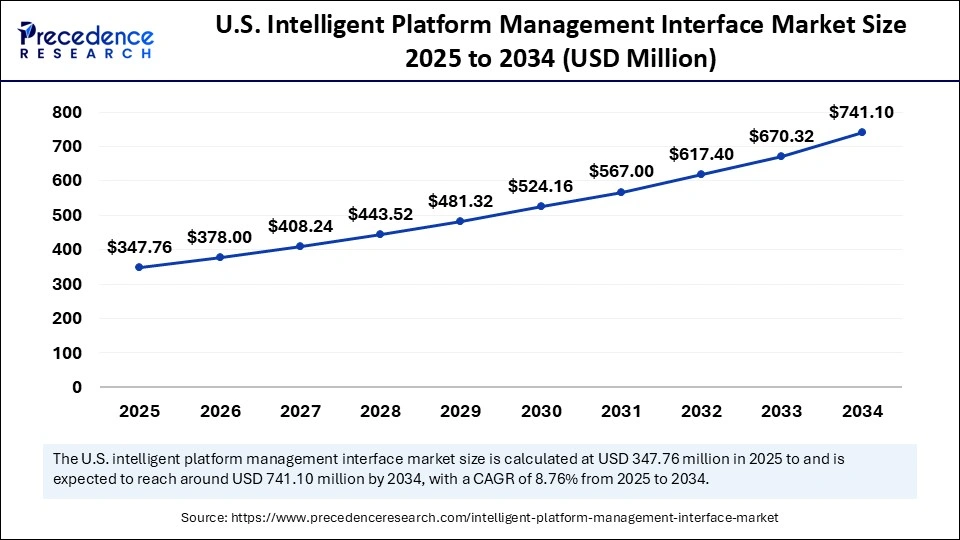
The U.S. intelligent platform management interface market size is evaluated at USD 347.76 million in 2024 and is projected to be worth around USD 741.10 million by 2034, growing at a CAGR of 8.76% from 2025 to 2034.
Why Did North America Dominate the Intelligent Platform Management Interface Market in 2024?
North America held the dominating share of the intelligent platform management interface market in 2024, due to the high density of hyperscale data centers and well-developed enterprise IT infrastructure in the region. The establishment of major technology companies, cloud service providers, and colocation facilities has made a high demand for server management solutions, such as IPMI, that provide high reliability of operation, remote monitoring, and efficient out-of-band manageability. The emphasis of digital transformation programs prevalent in the region, coupled with the use of hybrid architecture and multi-cloud architectures, further makes the use of IPMI-based infrastructure more imperative. Furthermore, well-developed IT service models, the early introduction of new technologies, and high-quality enterprise data management are the factors that help to maintain the leading position in the market of North America.
U.S. Dominance in Intelligent Platform Management
The United States is the key player in spearheading the IPMI market. Technology companies in the U.S. are focusing on efficient server monitoring, predictive maintenance, and energy optimization functions afforded by IPMI to ensure high uptime and capacity to support computing workloads on a large scale. The modernization of the digital infrastructure as a government initiative and investments in AI, big data analytics, and edge computing by the private sector, in turn, contribute to an acceleration in the use of IPMI. The availability of large OEMs, BMC vendors, and software providers based in the United States also ensures that the most recent IPMI technologies are initially presented on the home market.
Why is Asia Pacific Undergoing the Fastest Growth in the Intelligent Platform Management Interface Market?
Asia Pacific is estimated to grow at the fastest CAGR during the forecast period, driven by rapid industrialization, massive digital transformation programs, and the growth of cloud and data center infrastructure. ECC and 5G deployments in the region, along with AI/ML workloads, compound the necessity of an efficient remote server management and out-of-band control. The major areas where growth has been spurred are in IT and telecom, manufacturing, and industrial automation, where organizations need dependable, energy-saving saving and cost-effective systems of monitoring and managing server environments. It is also enabled by the establishment of local manufacturing facilities of IPMI parts and increased investments in smart infrastructure that promote market expansion.
Asia-Pacific IPMI Market: China Leads the Charge
China has been positioned as one of the major contributors to the rapid growth of IPMI in the Asian Pacific, due to the huge investments in data centres and cloud computing, and edge computing infrastructures. The telecom and IT sector in the country is also bigger, also the efforts of digital transformation and building of smart cities by the government are making people have more reasons to utilize advanced server management solutions more rapidly. Local OEMs and component vendors increasingly use IPMI-enabled systems to enable high-scale applications of hyperscale and enterprise data centers. The fastest-growing part of the IPMI marketplace in the Asia Pacific is expected to remain driven by China as the cloud services, 5G networks, and AI-based workloads continue to expand.
Europe: Strong industrial base
Europe is significantly growing in the market as it has a significant industrial base, strong automation and cloud computing acceptance, and compliance-driven demand for energy efficiency and sustainability. Europe increases in enterprise software, manufacturing automation, and professional solutions, which drives demand for the infrastructure management capabilities that IPMI provides.
UK: Increasing need for efficient management
In the UK, increasing adoption in enterprise data centers, finance, and government fields. This demand is increased by the requirement for effective server management, remote monitoring, and automated warnings to ensure high availability, with significant factors including the expansion of data centers and the incorporation of IPMI with AI and IoT.
South America: Rapid adoption of cloud and AI
South America is significantly increasing the market as the region is seeing a swift growth in the use of cloud computing and AI, which requires modern and efficient data center infrastructure management. Major investment organizations are injecting capital into the region's data center infrastructure, which drives the growth of the market.
Brazil: Technological leadership
Brazil is an important player in regions such as AI-driven advancement, cloud computing, and digital banking, driven by factors such as government support, a massive consumer base, and a strong startup environment. Brazil's recent tech success is often credited to regulatory investment in AI, adoption of advanced computing in sectors such as finance and agribusiness, and its role as a regional tech gateway.
Top Vendors in the Intelligent Platform Management Interface Market & Their Offerings
|
Company |
Headquarters |
Key Strengths |
Latest Info (2025) |
|
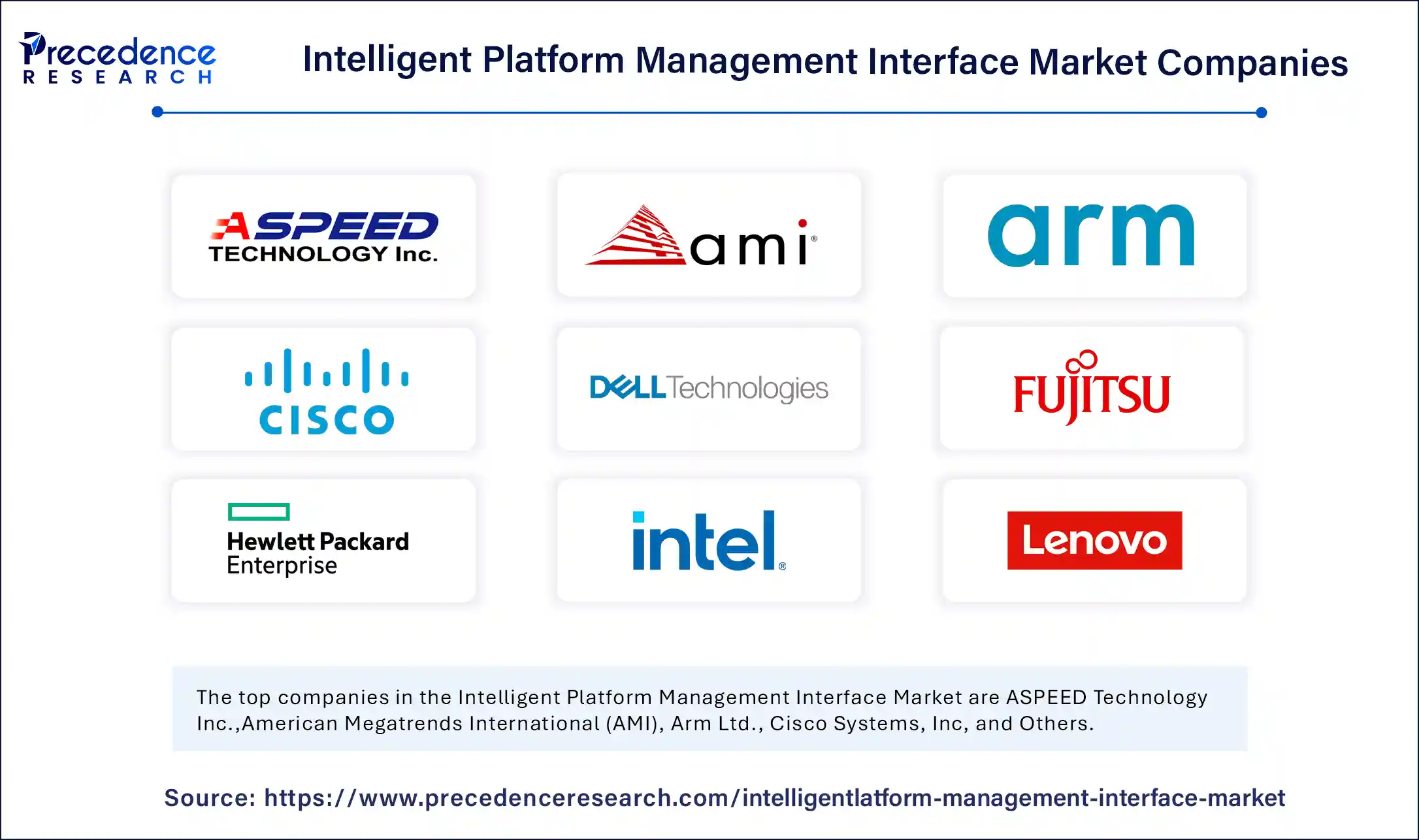
ASPEED Technology Inc. |
Taiwan |
Technological and R&D innovation |
In September 2025, ASPEED Technology announced the spin-off of its reality remote management business to 100% owned subsidiary, Cupola360 Inc. |
|
American Megatrends International (AMI) |
Georgia |
Pioneering Innovation |
In September 2025, AMI, the worldwide leader in silicon firmware for Arm platforms, announces complete out-of-band management services for Arm Neoverse CSS-based solutions, leveraging its SatMC controller interface and AMI OnSil host silicon firmware. |
|
Arm Ltd. |
United Kingdom |
Profitable licensing model |
It delivers performance, scalability, and efficiency for intelligent, AI-driven technologies. |
|
Cisco Systems |
United States |
Diverse Product and Service Portfolio |
Cisco Unified Edge extends data center power and scale to the edge, enabling real-time applications and AI inferencing where data is generated. |
|
Lenovo Group Ltd. |
United States |
Leadership in the PC market |
The Lenovo QHD Webcam provides intelligent AI features such as participant tracking and enhanced lighting adjustments, making video conferencing seamless and professional. |
Other Key Players
- Hewlett Packard Enterprise (HPE)
- Dell Technologies
- Fujitsu Ltd.
- Intel Corporation
- Microchip Technology Inc.
- NEC Corporation
- NVIDIA Corporation (Mellanox IPMI solutions)
- Supermicro Computer Inc.
- Synopsys Inc. (IP cores for IPMI integration)
- Tyan Computer Corporation
Recent Developments
- In March 2025, Super Micro Computer, Inc. announced a new server management package, which possessed high-level IPMI. The intensification of remote monitoring and control is a concern for the new solution, which will enable enterprise data centers to achieve greater efficiency, security, and uptime.
(Source: https://ir.supermicro.com) - In January 2025, Intel released its latest baseboard management controller (BMC) and updated IPMI support. The innovation enhances safe and effective out-of-band administration for server vendors to serve next-generation data center requirements.
(Source: https://newsroom.intel.com) - In April 2025, HPE and ARM collaborated to jointly develop new, improved IPMI products. Their collaboration aims to deliver greater scalability and enhanced security features unique to cloud and edge computing environments.
(Source: https://www.hpe.com)
Segment Covered in the Report
By Component
- Baseboard Management Controllers (BMCs)
- IPMI Firmware and Software Stacks
- Integrated IPMI Solutions in Servers and Storage
- Management Utilities and APIs
- Services (Installation, Integration, Support)
By Product Type
- Standalone IPMI Controllers and Expansion Cards
- Embedded IPMI Solutions (integrated within server boards)
- Modular IPMI Solutions for Edge and Compact Systems
- IPMI-over-LAN/Remote Management Cards
By Deployment Type
- On-Premises Data Centers
- Colocation Facilities
- Hyperscale Cloud Data Centers
- Edge and Micro Data Centers
- Industrial and Ruggedized Deployments
By Application
- Server Management
- Storage Management
- Network Equipment Monitoring
- Industrial Computing Platforms
- High-Performance Computing (HPC) Infrastructure
By Distribution Channel
- Direct OEM Sales (Server Vendors)
- Authorized Distributors and Value-Added Resellers (VARs)
- System Integrators/IT Service Providers
- Online Channels/E-Commerce Platforms
By Region
- North America
- Europe
- Asia-Pacific
- Latin America
- Middle East and Africa
For inquiries regarding discounts, bulk purchases, or customization requests, please contact us at sales@precedenceresearch.com
Frequently Asked Questions





Ask For Sample
No cookie-cutter, only authentic analysis – take the 1st step to become a Precedence Research client