




List of Contents


What is U.S. Herbal Extract Market Size?
The U.S. herbal extract market size accounted for USD 4.17 billion in 2025 and is predicted to increase from USD 4.52 billion in 2026 to approximately USD 8.54 billion by 2034, expanding at a CAGR of 8.28% from 2025 to 2034.
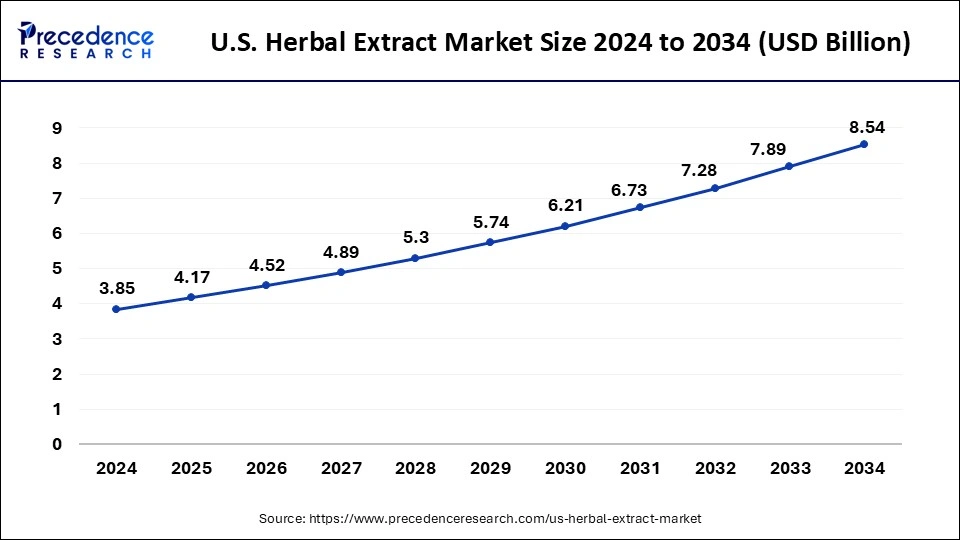
Market Highlights
- By product, the dried crops segment held the largest share of the market in 2024. The segment is observed to contribute a significant share during the forecast period.
- By product, the essential oil segment is observed to witness the fastest rate of expansion during the forecast period.
- By application, the food & beverages segment dominated the market in 2024. The segment is observed to sustain the dominance throughout the forecast period.
- By application, the personal care & cosmetics segment is expected to grow at a significant rate over the forecast period.
What are the Widespread Applications of the Herbal Extract?
The U.S. herbal extract market offers herbal extract that is a concentrated substance derived from plant material, such as leaves, flowers, stems, roots, or seeds, using a solvent or extraction method. The purpose of herbal extraction is to isolate and preserve the active compounds or constituents of the plant that are believed to have medicinal, therapeutic, or flavoring properties. Herbal extracts can be used in various forms, including liquid tinctures, capsules, powders, or incorporated into creams and lotions. They are popular in traditional and alternative medicine practices worldwide and are believed to offer natural therapeutic benefits.
U.S. Herbal Extract MarketGrowth Factors
- The U.S. herbal extract market for natural and plant-based goods has expanded as a result of growing consumer awareness of the possible health advantages of herbal extracts. The growing popularity of herbal extracts can be attributed to consumers' constant search for substitutes for synthetic or chemical-based goods.
- Consumers are increasingly investigating natural and herbal remedies as a result of the focus on wellness and preventative healthcare. Higher use of herbal extracts can be attributed to the perception that they can promote overall wellness and health.
- Herbal extracts are used in many different industries, such as nutritional supplements, food and beverage, cosmetics, and medicines. Herbal extracts are widely used in various goods due to their adaptability, which propels market expansion.
U.S. Herbal Extract Market Outlook:
- Industry Overview: Specifically, it is known for a competitive framework with both large and small companies, an emphasis on clean labels, and a rise in interest in traditional medicine systems, particularly Ayurveda.
- Major Investor: In July 2025, BioVivo Science invested $70 million in a new U.S. facility and introduced water-soluble American Ginseng Extract at IFT FIRST 2025.
- Startup Ecosystem: Botanic Tonics, a startup that facilitates herbal products, comprising a popular "feel free" tonic, which emphasizes mood and energy enhancement.
Market Scope
| Report Coverage | Details |
| Market Size in 2025 | USD 4.17 Billion |
| Market Size in 2026 | USD 4.52 Billion |
| Market Size by 2034 | USD 8.54 Billion |
| Growth Rate from 2025 to 2034 | CAGR of 8.28% |
| Base Year | 2024 |
| Forecast Period | 2025 to 2034 |
| Segments Covered | Product and Application |
Market Dynamics
Drivers
Growing customer preference for natural ingredients and clean labels
The U.S. herbal extract market is expected to grow as consumers' preferences for natural ingredients and clear labeling grow. Today's consumers want clean labels and are more aware of the components utilized in every product they purchase. Consumers are turning more and more toward goods with identifiable, natural constituents rather than synthetic chemicals or artificial additions. This customer's desire for natural ingredients and simple labeling is exactly what basil extract offers. It is made from the leaves of the basil plant, a well-known herb with a lengthy culinary and medical history. It provides a natural way to improve the taste, scent, and possible health advantages of different items.Manufacturers may meet customer requests for products devoid of artificial flavors, colors, and preservatives by using the extract. It offers a natural substitute for artificial additives, enabling businesses to develop clean-label products that appeal to customers who are concerned about their health.
The trend toward natural ingredients and clean labeling is not limited to the food business; it also permeates other consumer items including home care and personal care products. These industries can also benefit from the extract's natural scent, antibacterial qualities, and possible skincare advantages. Its use in household and personal care products satisfies customer needs for natural, safe, and environmentally responsible substitutes.
Restraint
High production cost
The main issue with herbal extracts is getting and processing the botanical constituents, which may take a lot of time and resources and raise manufacturing prices. For instance, the methods used for extracting and purifying rare or speciality herbs are the primary cause of the rising cost of production. In addition, additional manufacturing-related considerations including labor, energy, and equipment all drive up production costs. Furthermore, several businesses must follow stringent legal requirements like Good Manufacturing Practices (GMP), which can increase expenses even further. Thus, these elements may have an adverse impact on the U.S. herbal extract market, which would impede its expansion.
Opportunity
Rising consumer awareness
The developing food and beverage industry in the United States, which has been driven by rising food consumption and population growth, is what is propelling the worldwide herbal extract market's expansion. A hectic lifestyle, excessive labor, growing living standards, and climate change are all making Americans more health-conscious. Customers may now choose natural and organic food items to maintain their health and fitness, which raises the need for herbal extracts and their constituents. The increase in consumer spending power on natural, organic, and health-conscious food and beverage products accompanied by growing disposable incomes had a significant role in the expansion of the U.S. herbal extract market.
Segment Insights
Product Insights
The dried crops segment held the largest share of the U.S. herbal extract market in 2024, the segment is observed to witness a significant growth rate throughout the forecast period. The segment growth is attributed to the growing demand from various industries such as cosmetics, pharmaceuticals, and others. The dried turmeric whole sub-segment is expected to capture a significant market share during the forecast period.
The primary bioactive compound in turmeric is curcumin, known for its antioxidant and anti-inflammatory properties. Dried turmeric serves as a key source for curcumin extraction in the herbal extract market. Dried turmeric extracts are commonly used in the production of dietary supplements.
Capsules, tablets, or liquid supplements containing turmeric extracts are popular in the health and wellness industry. Moreover, growing consumer awareness of the potential health benefits of curcumin has led to increased demand for products containing dried turmeric extracts. Anti-inflammatory and wellness trends have further fueled this demand.
The essential oil segment is expected to grow at a fastest rate during the forecast period. Essential oils are highly concentrated extracts obtained from aromatic plants, ensuring potency and effectiveness in therapeutic applications. Consumers perceive essential oils as pure, natural, and potent alternatives to synthetic drugs or chemical-based products.
Application Insights
The food & beverage segment held the dominating share of the U.S. herbal extract market in 2024, the segment is observed to sustain the position throughout the forecast period. Herbal extracts, derived from various plants, contribute natural flavors to food and beverages. They are often used as alternatives to artificial flavors and additives, aligning with the growing consumer preference for clean labels and natural ingredients.
Additionally, herbal extracts' antibacterial qualities aid in the long-term preservation of food items and drinks. This is anticipated to lead to a rise in the use of herbal extracts in food items and drinks to prolong their shelf life without sacrificing quality.
The personal care & cosmetics segment is expected to grow significantly over the forecast period because herbal extracts have anti-inflammatory, antibacterial, and other qualities. These qualities have increased consumer demand for herbal extracts used in cosmetics and personal care products. The U.S. herbal extract market for natural herbal extracts used in cosmetics and personal care products is predicted to grow as a result of continued product development and the rising use of organic ingredients like essential oils. Teeth cleansing is another application for these chemicals.
Shampoos, soaps, and baby items all contain them as well. One of the main uses of essential oils in the personal care and cosmetics business is in general hygiene. Furthermore, a lot of perfumes, body sprays, and air fresheners include essential oils. Thereby, driving the segment expansion.
Regional Insights
Day by day, many U.S. companies are focusing on the advancements in extraction methods, including supercritical CO2 extraction and cold-pressing, to enhance the purity and potency of botanical compounds. Whereas the US market is expanding with a raised emphasis on the production of high-purity CBD and THC extracts.
U.S. Herbal Extract Market: Value Chain Analysis
- Raw Material Procurement
The market leverages sourcing directly from farmers or through brokers, enforcing stricter quality control measures, including GMPs and organic certifications, and managing logistics and contract negotiations.
Key Players: Herbal Creations and ADM, Star Hi Herbs, etc. - Quality Testing and Certification
This prominently focuses on identification and purity testing for contaminants, such as heavy metals and pesticides, potency testing for active ingredients, and microbial and stability testing.
Key Players: Eurofins, Vitaquest, and third-party labs like Certified Laboratories, etc. - Waste Management and Recycling
Companies are widely using a combination of disposal and more sustainable methods, such as vermicomposting and composting, to convert it into nutrient-rich soil amendments.
Key Players: Clean Harbors, Republic Services, Waste Management, Inc., etc.
Key Players in U.S. Herbal Extract Market and Their Offerings
- Botanic Healthcare- They prominently explore Ashwagandha, Holy Basil (Tulsi), and Curcumin, as well as Green Coffee Bean and Bacopa Monnieri.
- Silverline Chemicals- A major company facilitates Ashwagandha Extract and Centella Asiatica Extract, along with essential oils, mint products, and castor oil.
- Natac- They usually encompass both conventional extracts, Full Spectrum ingredients, and branded, clinically-studied formulations.
- Extroil Naturals- A leading company offers Ashwagandha, Boswellia, Senna Leaf, Ginger, Bacopa, and other plant extracts, like Amla, Guggul, Centella, and Papain.
- Bio-Botanica- It introduced a huge portfolio of over 800 different botanical extracts and proprietary blends.
Recent Developments
- In April 2023, Herbalife, a global community and corporation focused on health and wellbeing, announced that 106 new product SKUs would be available in the first quarter of 2023 in all 95 of the regions it now serves. The introduction of these new items demonstrates the company's continued dedication to growing and improving the range of high-quality products it offers to better serve the requirements of customers in several wellness categories and to encourage active, healthy lifestyles globally.
Segments Covered in the Report
By Product
- Essential Oils
- Turmeric Oil
- Ginger Oil
- Peppermint Oil
- Davana Oil
- Cedarwood
- Cornmint
- Eucalyptus
- Lemon
- Lime
- Orange
- Vetiver
- Tea Tree
- Patchouli Oil
- Oleoresins
- Paprika
- Black Pepper
- Capsicum
- Turmeric
- Ginger
- Garlic
- Onion
- Others
- Herbal Extracts
- Capsaicin
- 95% Curcumin
- Ashwagandha
- Kale
- Natural Colors
- Paprika
- Natural Yellow Color
- Annatto Color
- Anthocyanin Color
- Dried Crops
- Dried Chili Whole
- Dried Ginger Whole
- Dried Turmeric Whole
By Application
- Personal Care & Cosmetics
- Food & Beverage
- Animal Feed
- Pharmaceuticals
- Nutraceuticals
- Others
For inquiries regarding discounts, bulk purchases, or customization requests, please contact us at sales@precedenceresearch.com
Frequently Asked Questions





Ask For Sample
No cookie-cutter, only authentic analysis – take the 1st step to become a Precedence Research client