




List of Contents


What is the Synthetic Fuel Market Size?
The global synthetic fuel market size is valued at USD 7.67 billion in 2025 and is predicted to increase from USD 9.39 billion in 2026 to approximately USD 47.30 billion by 2034, expanding at a CAGR of 22.40% from 2025 to 2034.
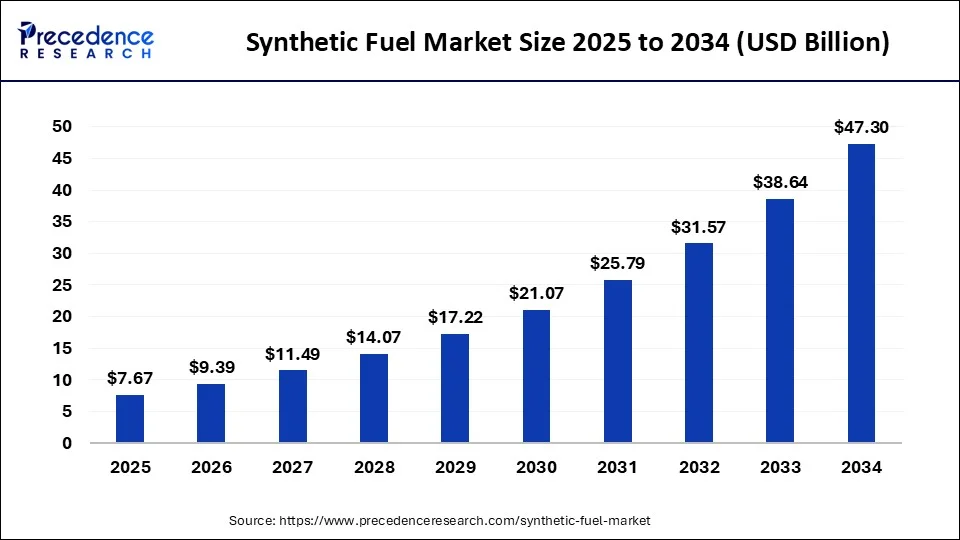
Synthetic Fuel Market Key Takeaways
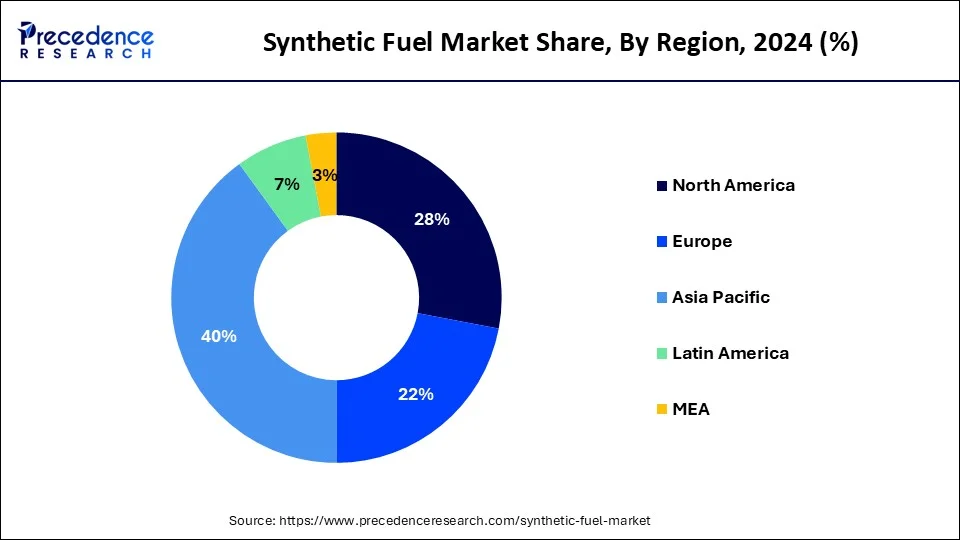
- Asia Pacific dominated market with the largest market share of 40% in 2024.
- By raw material, the coal segment dominated the market in 2024.
- By type, the extra-heavy oil segment shows notable growth during the forecast period.
Market Overview
Synthetic fuels are an alternative to the existing fuel market. Synthetic fuel is in the form of liquid and this fuel is not derived from crude oil. Synthetic fuels are obtained from a mixture of hydrogen and carbon monoxide which are the synthetic gases. This mixture of two gases is renewable source of energy. Due to the use of synthetic fuels the economies will become independent as they will not rely on crude oil. The crude oil market keeps fluctuating every now and then. The cost of fuel derived from crude oil also keeps on changing. With the use of synthetic fuels the economies will make use of green energy which has no harmful emissions. The process of manufacturing liquid fuel involves production of hydrogen from water. The produced hydrogen is then mixed with carbon in order to produce the liquid fuel. The combination of carbon dioxide and hydrogen results in the formation of synthetic fuels. The help of industrial processes carbon can be recycled and it can even be captured with the use of filters.
Revolutionizing Energy Efficiency: The Role of AI in Transforming the Synthetic Fuel Market
AI integration is revolutionizing the synthetic fuel market by optimizing production processes, improving feedstock utilization, and reducing carbon emissions. Through predictive analytics and real-time monitoring, AI enhances reaction efficiency, minimizes energy waste, and enables precise control over synthesis conditions. Machine learning algorithms accelerate catalyst discovery and process modelling, cutting research and operational costs. Additionally, AI-driven predictive maintenance extends equipment life and reduces downtime. By integrating smart automation, the industry can achieve sustainable fuel production with higher yields and lower environmental impact, driving scalability and competitiveness in next-generation clean energy solutions.
Market Outlook
- Industry Growth Overview: The synthetic fuel market is witnessing robust growth driven by the global transition toward carbon neutrality, rising investments in renewable energy technologies, and increasing government support for sustainable fuel alternatives across transportation, aviation, and industrial sectors, promoting reduced fossil fuel dependency.
- Sustainability Trends: There is a strong focus on carbon-neutral production using captured COâ‚‚ and green hydrogen, waste-to-fuel technologies, and circular energy systems, promoting cleaner fuel alternatives while aligning with global decarbonization goals and reducing reliance on conventional fossil fuels.
- Global Expansion:The synthetic fuel market is set to expand globally, driven by increased investments in renewable energy infrastructure, cross-border collaborations in clean fuel research, and supportive government policies. Regions like Europe and Asia-Pacific lead in scaling pilot projects into commercial production, enhancing global synthetic fuel adoption and trade opportunities.
- Major investors:Major investors in the market include energy giants such as ExxonMobil, Shell, and BP, as well as clean-tech investors such as Breakthrough Energy Ventures and Carbon Clean Solutions. These organizations are funding advanced carbon capture, hydrogen-based fuel synthesis, and large-scale pilot plants to accelerate commercialization and reduce reliance on fossil fuels.
- Startup Ecosystem: The startup ecosystem in the market is expanding, with innovators such as Synhelion, Carbon Recycling International, and Infinium advancing solar-to-fuel and carbon-to-liquid technologies. These startups focus on sustainable production, efficiency optimization, and decarbonization, supported by venture capital funding and collaborations with major energy and automotive corporations.
Synthetic Fuel Market Growth Factors
The market for the synthetic fuels is expected to grow well during the forecast. In the past the market has seen a good growth owing to a number of reasons. As the crude oil market fluctuates and the prices of oil rise on and off there is a growing demand for the use of synthetic fuels. The governments of various developing as well as developing economies are focusing on the use of synthetic fuels in order to meet the zero emissions target by the year 2050. The most important factor which is boosting the synthetic fuels market is the fear of depletion of natural resources. The political unrest among the oil producing countries and the other dependent countries across the globe is creating a major demand for synthetic fuels across the globe. The other most important factors leading to the growth of this market is that synthetic fuels are environment friendly. The use of synthetic fuels does not cause a great amount of pollution as compared to the other fuels existing in the market. The growing attention of various governments on the production of synthetic fuels and the increasing oil prices is also expected to boost the market growth during the forecast period.
The feedstock which is used in order to produce synthetic fuels or renewable and hence synthetic fuel is also known as a green fuel. As the fuel is available in the liquid format the storage and distribution of this fuel is similar to that of the petroleum based fuels. Synthetic fuels can be used with the already existing infrastructure in the market and this happens to be the nature driver for the growth of this market. Synthetic fuels are user friendly as they reduce the carbon emissions from the environment. The use of this fuel in the existing cars does not require any modification in the engines and therefore there is no need for a lot of expenditure or investment for new infrastructure. As compared to the petroleum fuels synthetic fuels are clean as the pollutants like metal and sulfur from the petroleum fuels it can be captured in the synthetic plants. Multiple feedstocks can be used in the production of synthetic fuels and this is another reason why the market is expected to grow during the forecast period.
Synthetic fumes can be generated from gas, biomass or coal. The energy density of synthetic fuels is very close to that of gasoline which means that the space taken by synthetic fuels is less but it will provide the same amount of output. Unlike the battery operated vehicles there is no new infrastructure required as the synthetic fuels can be used in the already existing vehicles as they are compatible. Synthetic fuels also operate in cold climates which makes them a suitable option for many countries across the globe.
Market Scope
| Report Coverage | Details |
| Market Size in 2025 | USD 7.67 Billion |
| Market Size in 2026 | USD 9.39 Billion |
| Market Size by 2034 | USD 47.30 Billion |
| Growth Rate from 2025 to 2034 | CAGR of 22.40% |
| Asia Pacific Market Share in 2024 | 40% |
| Base Year | 2024 |
| Forecast Period | 2025 to 2034 |
| Segments Covered | Raw Material, Type, Application, Geography |
| Regions Covered | North America, Europe, Asia-Pacific, Latin America, and Middle East & Africa |
Raw Material Insights
By raw material, the coal segment is expected to dominate the market during the forecast period. With the use of chemical conversion process which involves cool synthetic fuels are produced on a large scale. Due to the easy availability of coal across most of the countries you segment is expected to grow well during the forecast period. The political uncertainty across the globe it's creating a greater demand for synthetic fuels in the market.
Synthetic fuels manufactured from coal are a great alternative for them fuels derived from crude oil. The use of natural oil and gas can be substituted by the use of synthetic fuels. The amount of pollution caused due to the manufacturing of synthetic fuels could be one of the restraining factors for the growth of the market. Even though the cost of raw materials used for manufacturing synthetic fuels may not be extremely costly but the installation of the manufacturing plant is it expensive and it requires a large amount of investment. When the cost of manufacturing synthetic fuels which involves the installation of plants required for manufacturing are compared with the petroleum based fuels the cost of synthetic fuels is more. This shall inhibit the growth of the synthetic fuels market in the global scenario. Synthetic fuel it's compatible for use in the diesel engine as well as the gasoline engines.
Type Insights
By type, the extra heavy oil segment is expected to dominate the market during the forecast period. The extra heavy oil segment has done well in the past. Extra heavy oil is similar to crude oil and it is present inside the earth. This segment is expected to grow as it does not require any additional investment for the already existing vehicles running on the roads to use the synthetic fuel. The demand for this segment is expected to grow due to an increase in the sales of automobiles across the globe. Initiatives taken by government in order to generate pollution free fuels for use in the future the market for synthetic fuels is expected to go up. Due to the high content of octane in synthetic fuels the market is expected to grow well as the benefits of this octane are improved efficiency of the engine. Fuel can be stopped and distributed in a similar manner to the petroleum based fuels. The increasing cost of oil due to political unrest among many countries across the globe is creating more demand for synthetic fuels.
Depending on any type of the fuel used synthetic fuel can be used without any modifications to the diesel engines. Synthetic fuel it's compatible with the already existing vehicles running on the roads. Even though the use of synthetic fuels in the vehicles does not cause a lot of emissions but the production of synthetic fuels in a manufacturing plant leads to a lot of pollution which can be compared with the pollution caused by gasoline.
Regional Insights
Asia Pacific Synthetic Fuel Market Size and Growth 2025 to 2034
The Asia Pacific synthetic fuel market size is evaluated at USD 3.07 billion in 2025 and is predicted to be worth around USD 19.16 billion by 2034, rising at a CAGR of 22.53% from 2025 to 2034.
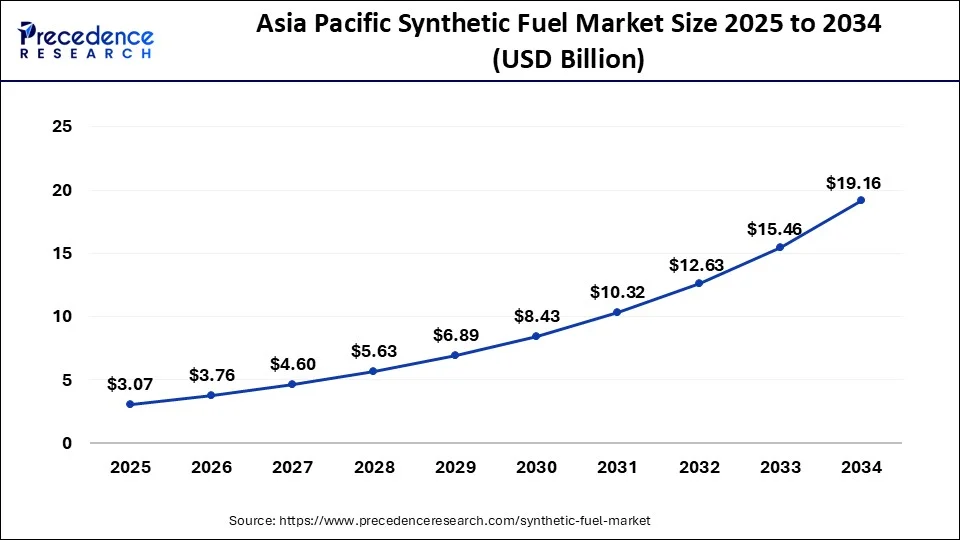
In 2024, Asia Pacific region had a largest market share of about 40% and is expected to have a significant growth during the forecast period. Due to a growing demand of automobiles in the Asia Pacific region specifically in India, China and Japan the market is expected to grow during the forecast period. Growing demand for automobiles is creating a demand for fuels across the globe. In the Asia Pacific region China is expected to be major consumer of synthetic fuels. It is estimated that there shall be a good amount of production of synthetic fuels in China. Apart from China India is also expected to witness a good growth during the forecast period. Increasing demand for automobiles and an alternative for the crude oil based fuels the market for synthetic fuels is expected to grow well in the Indian market. Availability of low cost labor and cheap raw material in countries like India and China is expected to give a boost to the synthetic fuels market. The quantity of synthetic fuel produced in the Asia Pacific region compared to the other regions like North America or Europe will be more due to the availability of low cost labor and easily available raw material.
What Makes North America the Fastest-Growing Region?
The North American market is also expected to grow well during the forecast period. In the recent years the North American market has dominated the synthetic fuels market. Due to a high amount of investments for technological advancements in the North American region the market will grow well. Investments from the public and private sector for promoting the manufacturing of synthetic fuels in the North American region will lead to an increased production of synthetic fuels in this region.
U.S. Synthetic Fuel Market Trends
The market in the U.S. is driven by its extensive investments in alternative energy research and development, including biofuels and e-fuels. Strong government support through incentives and regulations promoting low-carbon energy, along with a well-established energy infrastructure, has accelerated synthetic fuel production and adoption. These factors position the U.S. as the key driver of the region's synthetic fuel market.
What Potentiates the Growth of the European Synthetic Fuel Market?
The European market is also expected to have a steady growth during the forecast period. Due to the growing automotive industry in the European region the market for synthetic fuel is expected to grow up. The awareness regarding the availability of synthetic fuels and the benefits of using these synthetic fuels will drive the market growth in these regions. In order to reduce the emissions of the greenhouse gases many countries in Europe are promoting the use of synthetic fuels for transportation. Synthetic fuels are used as substitutes for gas and oil across many European nations. To reduce carbon emissions and achieve net-zero emissions, the region is expected to use synthetic fuels in the transportation sector.
Germany Synthetic Fuel Market Trends
Germany is a major contributor to the European synthetic fuel market due to its strong focus on renewable energy, decarbonization policies, and investments in research and development of e-fuels and biofuels. The country's advanced industrial base and supportive government initiatives have accelerated the production and adoption of synthetic fuels. These factors make Germany a key driver of Europe's synthetic fuel market.
How Crucial is the Role of Latin America in the Synthetic Fuel Market?
Latin America plays a crucial role in the synthetic fuel market due to its abundant renewable energy sources, such as wind, solar, and biomass, which are essential for sustainable fuel production. Countries like Brazil and Chile are investing in green hydrogen and carbon recycling technologies, fostering regional innovation and supporting global decarbonization initiatives. The market is growing due to increasing energy demand, efforts to diversify energy sources, and government initiatives promoting renewable and low-carbon fuels. The region's abundant biomass and natural resources provide raw materials for biofuels and synthetic fuel production.
Key Drivers Establishing Brazil as a Leader in the Synthetic Fuel Market
Brazil leads the synthetic fuel market in Latin America due to its abundant biomass resources, advanced bio-refining infrastructure, and strong government support for renewable energy initiatives. Investments in research, sustainable feedstock sourcing, and efficient production technologies enhance its capacity to supply high-quality synthetic fuels for domestic consumption and international export.
How Big is the Opportunity for the Growth of the Synthetic Fuel Market in Middle East and Africa?
The Middle East and Africa region holds immense growth potential, driven by abundant renewable energy resources, strong government support, and increasing investments in clean energy projects. Nations such as Saudi Arabia, the UAE, and South Africa are focusing on large-scale synthetic fuel production to reduce dependence on crude oil. Additionally, regional collaborations, infrastructure development, and export-oriented projects are positioning MEA as a future hub for sustainable fuel innovation and energy diversification.
Factors Driving UAE's Dominance in the Synthetic Fuel Market
The UAE leads the synthetic fuel market in the Middle East and Africa because of its strategic location, strong energy infrastructure, and government efforts to promote renewable fuels. Advanced refining techniques, investments in sustainable feedstocks, and a focus on export-driven production boost its dominance in the regional synthetic fuel industry. Additionally, investments in infrastructure and technology to support cleaner energy alternatives are driving market expansion.
Value Chain Analysis
- Resource Extraction
This stage involves gathering renewable energy inputs and refining raw materials into usable chemical components for fuel production.
Key Players: SABIC, Air Liquide, Linde plc, Carbon Clean, and Climeworks AG. - Power Generation
Renewable electricity from solar, wind, and hydropower is used to produce hydrogen through electrolysis and to power the synthesis process. Integrating green energy ensures reduced emissions and lower lifecycle carbon intensity.
Key Players: Siemens Energy, Ørsted, NextEra Energy, Shell Renewables, and Iberdrola. - Distribution Network Management
Synthetic fuels are stored, transported, and distributed via specialized logistics networks and refueling infrastructure. Advanced digital tools and IoT systems monitor supply chain efficiency and minimize energy loss.
Key Players: ExxonMobil, BP, TotalEnergies, Maersk, and Chevron Corporation. - Energy Storage Systems
Synthetic fuels are stored in advanced containment systems that ensure stability, safety, and readiness for transport. AI and smart sensors are utilized to monitor pressure, temperature, and leaks to prevent energy degradation.
Key Players: Tesla Energy, Fluence, Wärtsilä, LG Energy Solution, and Panasonic Energy. - Grid Maintenance and Monitoring
Infrastructure networks supporting fuel synthesis and transport are continuously monitored using smart grids, predictive analytics, and AI-based diagnostics to optimize performance and prevent failures.
Key Players: GE Vernova, ABB Ltd., Schneider Electric, Siemens Grid Solutions, and Hitachi Energy. - Regulatory Compliance and Energy Training
Producers follow international energy standards and sustainability certifications while providing workforce training on green fuel technologies and carbon accounting systems.
Key Players: International Energy Agency (IEA), U.S. Department of Energy (DOE), European Commission, International Renewable Energy Agency (IRENA), and ISO (International Organization for Standardization).
Key Players in Synthetic Fuel Market & Their Offerings:
- Sasol – Develops and produces synthetic fuels using coal-to-liquids (CTL) and gas-to-liquids (GTL) technologies.
Petrochina International Jinzhou Petrochemical Co., Ltd. – Invests in the production of synthetic fuels and refining processes in China. - Reliance Industries Ltd. – Manufactures synthetic fuels and biofuels as part of its integrated energy and petrochemical operations.
- Robert Bosch GmbH – Provides technologies and solutions for synthetic fuel production, including fuel injection and engine compatibility systems.
- Indian Oil Corporation Ltd – Produces and distributes synthetic fuels and biofuels for transportation and industrial applications in India.
- Royal Dutch Shell Plc. – Develops synthetic fuels, e-fuels, and advanced biofuels to reduce carbon emissions in transport.
Phillips 66 – Produces synthetic fuels through refining processes and invests in sustainable fuel technologies. - Exxon Mobil Corporation– Invests in synthetic fuel research and production to support low-carbon and alternative energy solutions.
- Red Rock Biofuels – Focuses on producing sustainable synthetic fuels from biomass and renewable feedstocks.
SG Preston Company – Provides technology, consulting, and solutions for the production and commercialization of synthetic fuels.
Other Major Companies
- Petrochina International Jinzhou Petrochemical Co., Ltd.
- SG Preston Company
Recent Developments
- In July 2025, Synhelion, a solar energy company, announced it had successfully fueled a car with solar-produced gasoline made at its DAWN industrial-scale plant, demonstrating a drop-in fuel derived from concentrated solar heat, captured COâ‚‚, and hydrogen. Soon after, the company delivered its first batches of solar aviation fuel to an airline partner, proving real-world applicability for both road and air transport and signaling readiness for scale-up. These milestones confirm Synhelion's solar-to-liquid pathway and advance commercial demonstrations of genuinely renewable liquid fuels.
(Source: synhelion.com) - In May 2025, Infinium announced construction of Project Roadrunner, a large-scale eFuels facility in Texas to convert captured COâ‚‚ and renewable electricity into sustainable aviation fuel and other synthetic fuels for domestic and export markets. The project represents a step from pilot to commercial-scale production, supported by strategic investors and partnerships, and it aims to integrate dedicated renewable power and COâ‚‚ feedstock streams for continuous operation. This facility positions Infinium as a major U.S. producer of low-carbon liquid fuels.
(Source: infiniumco.com) - In 2025, Saudi Aramco publicly increased investments in synthetic e-fuels and announced plans for large e-fuel plants, including projects in Spain and domestic initiatives, aiming to supply the aviation and industrial sectors and prolong the viability of combustion engines in certain markets. Aramco's actions, along with regional partnerships, reflect the strategies of oil majors to diversify into low-carbon liquid fuels and support large-scale export production using abundant regional renewables. These initiatives accelerate capacity planning and demonstrate a strong industry commitment to rolling out industrial e-fuels
(Source: ft.com)
Segments covered in the report
By Raw Material
- Coal
- Natural Gas
- Non-Food Crop Sources
- Plant Waste
- Biomass
- Corn
By Type
- Extra-Heavy Oils
- Gas-To-Liquids Fuels
- Biomass-To-Liquids Fuel
- Fuel From Waste
- Fuel From Atmospheric Carbon
- Shale Oil
- Oil Sands
- Coal-To-Liquid (CTL) Fuels
- Others
By Application
- Gasoline
- Diesel
- Kerosene
By Geography
- North America
- U.S.
- Canada
- Europe
- U.K.
- Germany
- France
- Asia-Pacific
- China
- India
- Japan
- South Korea
- Malaysia
- Philippines
- Latin America
- Brazil
- Rest of Latin America
- Middle East & Africa (MEA)
- GCC
- North Africa
- South Africa
- Rest of the Middle East & Africa
For inquiries regarding discounts, bulk purchases, or customization requests, please contact us at sales@precedenceresearch.com
Frequently Asked Questions





Ask For Sample
No cookie-cutter, only authentic analysis – take the 1st step to become a Precedence Research client