




List of Contents
Lithium-ion Battery Recycling Market Size and Forecast 2025 to 2034
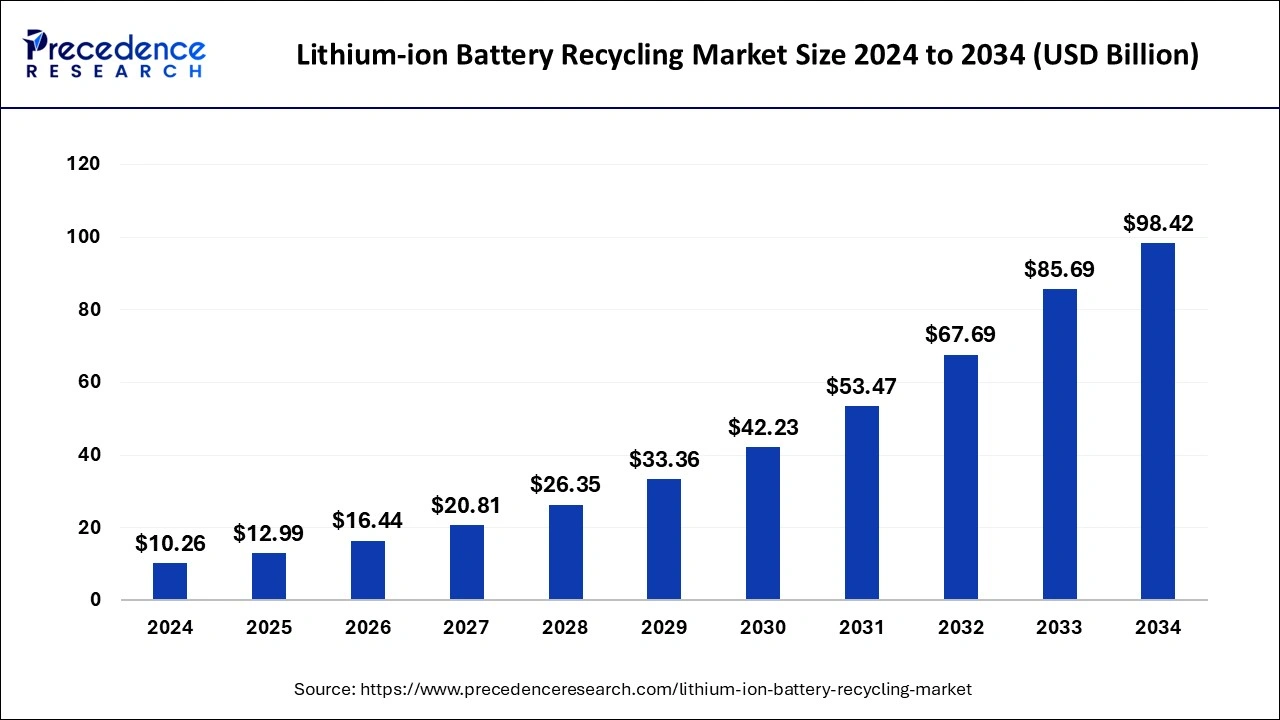
The global lithium-ion battery recycling market size was accounted for USD 10.26 billion in 2024, and is expected to reach around USD 98.42 billion by 2034, expanding at a CAGR of 25.37% from 2025 to 2034. The lithium-ion battery recycling market is driven by growing demand for electric vehicles.
Lithium-ion Battery Recycling Market Key Takeaways
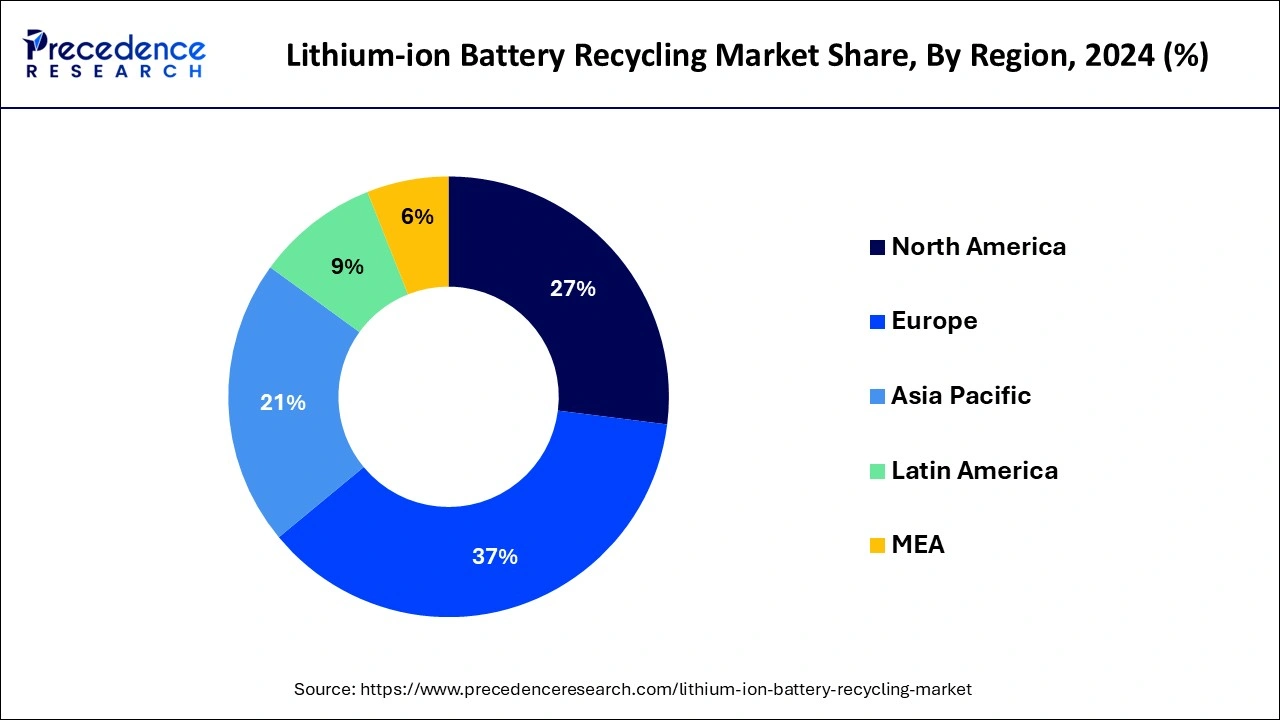
- In 2024, Europe dominated the market with 37% of revenue share in 2024.
- Asia-Pacific region is registering growth at a CAGR of 41% during the forecast period.
- By end user, the non-automotive segment accounted largest revenue share 63% in 2024 and is projected to grow at a CAGR of 39.5%.
- In 2024, the electronics segment generated a revenue share of about 68%.
- The hydrometallurgical process segment has garnered a market share of 65% in 2024.
- The electric vehicle segment is growing at a registered CAGR of 45% over the forecast period.
Integration of AI in the lithium-ion battery recycling industry
AI is revolutionizing the game in various industries, including lithium-ion battery recycling. Its robotic systems can detect and sort different types of batteries with high clarity.
Its models determine chemical compositions and optimize recovery methods to maximize the extraction of valuable metals such as cobalt, nickel, and lithium. This ensures that it gets the highest possible output from each recycled battery. By enhancing recycling efficiency, AI helps reduce the environmental footprint of battery disposal, contributing to a greener planet.
Europe Lithium-ion Battery Recycling Market Size and Growth 2025 to 2034
The Europe lithium-ion battery recycling market size was estimated at USD 3.74 billion in 2024 and is predicted to be worth around USD 37.15 billion by 2034, at a CAGR of 25.81% from 2025 to 2034.
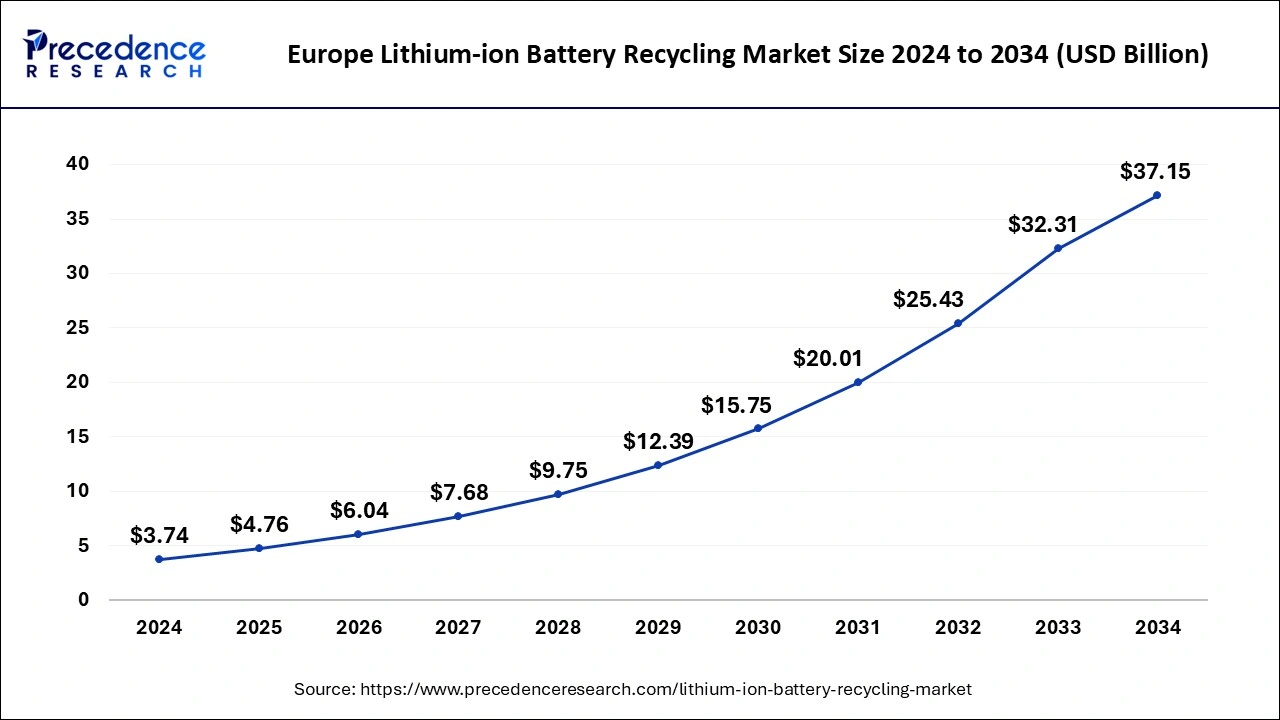
Europe dominated the global lithium-ion battery market with revenue share of 37% in 2024. While United States is anticipated to grow the fastest CAGR between 2025 and 2034. Among the biggest economies for recovering lithium-ion batteries is the United States. During the forecast timeframe, the industry of lithium-ion battery recycling is anticipated to develop as a result of the expansion of electrical automobiles in the region and regulatory laws regarding lithium-ion battery recovery. The marketplace for electrical automobiles in the region would be improved by rising investments from major participants in the industry, and by expanding infrastructures for electric cars, which will favorably affect the lithium-ion recycling programs.
North America is the fastest growing in the lithium-ion battery recycling market during the forecast period.
Major key players are formulating significant plans concerning the treatment of battery systems that have been established. Governments of North America offer tax credits, financial incentives, or subsidies to businesses engaged in responsible recycling activities. These incentives encourage compliance with regulations and boost the market's growth by making it economically attractive for companies to invest in recycling infrastructure and technologies.
Market Overview
Lithium-ion battery regeneration refers to the gathering of lithium-ion batteries from a variety of sources, such as automobiles, consumer goods, industrial equipment, and electronic devices, as well as the extraction of metal using recycling procedures. The world market estimate includes income from sales of such reclaimed elements or components, regardless of whether they are used in additional battery recovery and other uses that necessitate a secondary use. It is said that the majority of elements retrieved are simply used to make batteries.
The worldwide lithium-ion recycling market is anticipated to expand as a result of variables including governmental laws, environmental protection, and increasing understanding. Furthermore, inappropriate lithium-ion battery recycling global growth is anticipated to be hampered during the forecast timeframe by incorrect separating of hazardous lithium batteries, incorrect disassembly, and inappropriate shredding. The availability of coating materials to decrease the likelihood of flame as well as the beautiful appearance of cells are predicted to open up new development potential in the global marketplace.
Lithium-ion Battery Recycling Market Growth Factors
- There is a huge requirement for electric automobiles all over the world, together with subsidies offered by governments of different nations for rechargeable batteries. Due to worries about the ecological damage caused by automobiles running on traditional energy sources like gasoline and diesel, there has been a considerable increase in electric vehicle demand.
- Declining price of batteries used in electric vehicles. The resource recovery business is predicted to increase quickly due to the transport industry. Because of its highly efficient, extended lifespan, and low care requirements, lithium-ion batteries are becoming increasingly popular in portable electronics and electric cars, which is projected to benefit the sustainable packaging market.
- New techniques are also created to cut expenses and stop environmental contamination. ECOBAT has developed a mechanism for collecting used batteries. New techniques are also being explored to reduce costs and prevent environmental contamination.
Market Scope
| Report Coverage | Details |
| Market Size in 2025 | USD 12.99 Billion |
| Market Size by 2034 | USD 98.42 Billion |
| Growth Rate from 2025 to 2034 | CAGR of 25.37% |
| Base Year | 2024 |
| Forecast Period | 2025 to 2034 |
| Segments Covered | End User, Battery Components, Battery Chemistry, Recycling Process, and Source |
| Regions Covered | North America, Europe, Asia-Pacific, Latin America, and Middle East & Africa |
Market Dynamics
Key Market Drivers
Rising Interest in Electric Vehicles
The usage of renewable biofuels is becoming more prevalent in the automotive sector. The transport network is heavily dependent on oil as a resource, which is raising worries among economics and the environment alike. The use of electric cars is growing along with ecological sustainability. EDVs are being used more frequently, which is causing an increase in the demand for fuel cells, that are necessary for a constant energy supply. The industry for EVs is anticipated to expand as a result of variables like fuel efficiency, reduced emissions, and customer choice. Due to better battery tech as well as the minimal downtime needs of these fuel cells, the electric vehicle market is rising.
New techniques are being created to cut expenses and stop environmental pollution
By constructing new recycling facilities and collecting sites, businesses are trying to boost their level of competition. New techniques are being forced to cut expenses and stop environmental pollution. To collect the purpose of collecting used batteries, ECOBAT has created its collection mechanism. New techniques are also being explored to cut expenses and stop environmental contamination.
The escalating trend for personal electronics and lithium-ion batteries
The recycling business is predicted to increase quickly thanks to the transportation sector. Because of their highly efficient, extended lifespan, and low care requirements, fuel cells are becoming increasingly popular in portable electronics and electric cars, which is anticipated to have a beneficial effect on the market for goods produced.
Key Market Challenges
- Safety concerns about the shipment and storage of the used battery: Dangerous compounds found in used cells include chemicals & toxic substances like lead and zinc. Used cells retain some of their energy, thus increasing the risk of an unintentional release that could harm or harm both individuals and property. Larger lithium-based cells, like those employed in vehicle industries, may be mislabelled as storage batteries by regional battery producers. Due to such problems, state or federal authorities restrict the shipment and storage of expended cells.
- Due to the high expense of lithium recovery out of used lithium-ion batteries, recycle: The Institute for economics And finance (CEE) estimates that just 1-3 percent of lithium gets recovered worldwide from all usage. Furthermore, businesses like Umicore (Belgium), and Toxco (US) among others, are developing technology for the recovery of lithium using lithium-based cells. Furthermore, among the problems identified as industry obstacles include the massive price of recycling, the lack of suitable storage solutions for the collecting of used batteries, and the scarcity of recyclable materials.
Key Market Opportunities
Rising acceptance in novel applications, a drop in lithium-ion battery pricing, and recycling at the final moment are all anticipated outcomes of increased production
Modern lithium-ion batteries are made up of several parts that are offered at discounted prices. The costs of these cells are anticipated to significantly fall, according to recent advances and statements made by automakers and manufacturers of lithium-ion batteries. Costs are dropping as a result of innovations including mass production, decreasing unit cost, and the use of technologies to increase storage capacity. The industry for storage of renewable energies is predicted to expand as a result of falling lithium battery prices, and this industry is predicted to favor battery cells above all other rechargeables. The need for recovering used lithium-based batteries is then anticipated to rise as a result.
An increasing number of government recycling programs and R&D projects
There are many uses for lithium-ion batteries, and as additional development and research is done, more advanced qualities are now being created. To meet the increasing need for lithium-ion batteries used in electric mobility, healthcare gadgets, and communication system, businesses are new product manufacturing plants. New opportunities for the growth of the worldwide lithium-ion battery industry are being created by newly constructed factories and expanding research and development activities.
End Use Insights
The market for recovering lithium-ion batteries is expected to be dominated by the automotive industry. Due to significant advancements in the automotive industry that are directly related to lithium-ion batteries, such as a decrease in the cost of lithium-ion batteries and an increase in the efficiency of electric vehicles, the automotive industry now accounts for the largest segment of the global lithium-ion battery recycling market. These factors increased the demand for battery-powered cars, which boosted the lithium-ion battery recycling business.
Also, regulations and subsidies related to battery recycling by countries such as China and Germany have fuelled the market growth for lithium-ion battery recycling. This stays accredited to the rise in demand for second-life applications of lithium-ion batteries in consumer electronics devices such as laptops, digital cameras, smartphones, and others that do not require longer battery life as compared to electric vehicles and industrial applications.
Battery chemistry Insights
The lithium nickel manganese cobalt oxide (NMC) segment held the largest share of 41.20% in the 2024 global lithium-ion battery recycling market. The NMC oxide is a major cathode material in lithium-ion batteries, which needs expert recycling because of its transitional metals. The development targets on enhancing pyrometallurgical and hydrometallurgical processes for metal purity recovery. Alongside, it is discovering more hybrid methods, direct recycling, and a greener approach.
The lithium iron phosphate (LFP) segment is expected to grow at a CAGR of 9.80% during the forecast period. The LFP batteries are prominent for recycling initiatives due to the rising demand and use of energy storage and EV systems. This further fuels demand for effective and efficient recycling methods that conventionally extract precious metals such as iron and lithium.
Recycling process/technology Insights
The hydrometallurgical process (leaching) segment held the largest share of 38.60% in the 2024 global lithium-ion battery recycling market. The segment, especially the chemical leaching, is crucial in LIB recycling. The chemically based extraction of the cathode metals like Mn, Co, Li, and Ni from mechanically engineered processes' black mass, converting it into a soluble solution, requires development that improves leaching sustainability and efficiency.
The direct recycling/cathode-to-cathode segment is expected to grow at a CAGR of 11.50% during the forecast period. The segment's characterized role is to intervene in hydrometallurgical and energy-intensive pyrometallurgical processes. Further restoring the utilized cathode materials by different non-disruptive methods and via relithiation for reuse purposes. The development thus aims at relithiation techniques and improvement in impurity removal that will boost the segment.
Battery source/application Insights
The automotive batteries segment held the largest share of 61.70% in the 2024 global lithium-ion battery recycling market. The automotive batteries are essential in hybrid, electric, and plug-in electric vehicles (EVs). The rising demand and growth in the EV market have indirectly accelerated growth in this segment, clearly benefiting lithium-ion battery recycling. Following the approach for going greener and cleaner energy sources, the sustainable reach of the EVs has excellently elevated the segment's development and potential.
The energy storage systems (ESS) segment is expected to grow at a CAGR of 10.70% during the forecast period. The ESS is a fundamental source of end-of-life LIBs and their recycling pattern and techniques. At every stage of commercial, residential, and grid scale, the ESS has proven potential. The recycling of ESS controls mining dependency and pollution. Technological advancement and partnership interaction are paving the way for effective development and growth.
End-use/industry Insights
The automotive segment held the largest share of 57.40% in the 2024 global lithium-ion battery recycling market. The automotive industry's growth equals the use of automotive batteries. The segment is leading with its increasing sales of electric vehicles in the global EV market. Most of the key EV companies have integrated the battery recycling option or held it as an approach to promote sustainability worldwide. This strengthens the potential of lithium-ion battery recycling.
The energy and utilities segment is expected to grow at a CAGR of 10.20% during the forecast period. The energy and utilities are playing a pivotal role in investing best in recycling to protect domestic supply chains and reduce material cost and reliance on imports. The government policies and partnerships are forcing development in this segment, focusing on the extension of the LIB recycling potential globally.
Recycling type Insights
The post-consumer (end-of-life batteries) segment held the largest share of 68.90% in the 2024 global lithium-ion battery recycling market. The segment offers a reliable and popular source of essential materials such as cobalt, lithium, and nickel for helping to control environmental impact and accelerate the circular economy. With the expansion, the challenges have a developmental backup and a strong policy support to improve collection rates and explore green chemistry.
The pre-consumer (manufacturing scrap) segment is expected to grow at a CAGR of 9.60% during the forecast period. The segment provides a straight and quality source of crucial materials such as lithium, cobalt, and nickel that reduce carbon presence and dependency on mining. The scrap development is strengthened by excessive battery production, which leads to increased scrap and economically benefits massively, and promotes the direct recycling option.
Material recovered Insights
The cobalt segment held the largest share of 33.80% in the 2024 global lithium-ion battery recycling market. Cobalt is like the first choice in demand material. Though it is expensive, its recovery is crucial for alleviating supply risk. The recycling needs to have double the potential to settle for cobalt's future rising demands. The leveraging of collection rates and speedy technological advancement will fuel improvement, stability, and quality in the cobalt material.
The lithium segment is expected to grow at a CAGR of 11.10% during the forecast period. The lithium plays a crucial role in recycling by standing as a major recoverable element from the invested lithium-ion batteries (LIBs) that elevate growth in the market worldwide for recycling technologies such as hydrometallurgy. The development is driven by the heightening LIB demand from the electronics and electric vehicles market, which is immensely gaining traction in the segment and in LIB recycling.
Lithium-ion Battery Recycling Market Companies
- Accurec-Recycling GmbH (Germany)
- AkkuSer (Finland)
- American Manganese Inc. (Canada)
- American Zinc Recycling Corp (U.S.)
- Batrec Industrie AG (Switzerland)
- Battery Recycling Made Easy (BRME) (US)
- Contemporary Amperex Technology Co. Ltd (CATL) (China),
- DOWA ECO-SYSTEM Co., Ltd. (Japan)
- Duesenfeld GmbH (Germany)
- Ecobat (UK)
- Envirostream Australia Pty Ltd (Australia)
- Euro Dieuze Industrie (E.D.I.) (France)
- Fortum (Finland)
- GEM Co., Ltd (China)
- Glencore International AG (Switzerland)
- Lithion Recycling Inc. (Canada)
- Metal Conversion Technologies (MCT) (US)
- Neometals Ltd (Australia)
- OnTo Technology LLC (US)
- Raw Materials Company Inc. (RMC) (Canada)
- Redux GmbH (Germany)
- Redwood Materials, Inc. (US)
- Retriev Technologies Inc. (Canada)
- San Lan Technologies Co., Ltd (China)
- SITRASA (Mexico)
- SMC Recycling (US)
- SNAM (France)
- Sumitomo Metal Mining Co., Ltd. (Japan)
- Tata Chemicals Limited (India)
- TES (Singapore)
- Umicore (Belgium)
- uRecycle Group Oy (Finland)
Recent Developments
- In December 2024, Re-New-Able Technologies and Redivivus partnered to establish the state's first scalable lithium-ion battery recycling facility. This collaboration represents a critical step in addressing the growing challenges of lithium-ion battery waste, especially as electric vehicle adoption and renewable energy storage solutions expand.
- In April 2024, Green Li-ion declared the launch of its first commercial-scale installation to produce sustainable, battery-grade materials, the first of its kind in North America. The plant, located within an existing recycling facility, will make valuable battery-grade cathode and anode materials from concentrated components of spent batteries using Green Li-ion's patented multi-cathode-producing Green-hydro rejuvenation technology.
Segments covered in the report
By Battery Chemistry
- Lithium Iron Phosphate (LFP)
- Lithium Cobalt Oxide (LCO)
- Lithium Nickel Manganese Cobalt Oxide (NMC)
- Lithium Nickel Cobalt Aluminum Oxide (NCA)
- Lithium Manganese Oxide (LMO)
- Others (e.g., lithium-titanate)
By Recycling Process / Technology
- Pyrometallurgical Process (Smelting)
- Hydrometallurgical Process (Leaching)
- Mechanical/Physical Recycling
- Direct Recycling / Cathode-to-Cathode
- Hybrid Recycling Technologies
By Battery Source / Application
- Automotive Batteries
- Electric Vehicles (EVs)
- Hybrid Electric Vehicles (HEVs)
- Plug-in Hybrid Electric Vehicles (PHEVs)
- Consumer Electronics
- Smartphones
- Laptops/Tablets
- Power Tools
- Wearables
- Industrial Batteries
- UPS (Uninterrupted Power Supply)
- Forklifts
- Telecom Towers
- Energy Storage Systems (ESS)
- Grid-scale
- Residential
- Commercial
- Others
By End-Use/Industry
- Automotive
- Consumer Electronics
- Energy & Utilities
- Industrial/Manufacturing
- Telecommunications
- Others (e.g., defense, aerospace)
By Recycling Type
- Pre-consumer (Manufacturing Scrap)
- Post-consumer (End-of-life Batteries)
By Material Recovered
- Lithium
- Cobalt
- Nickel
- Manganese
- Aluminum
- Copper
- Graphite
- Plastics and Others
By Geography
- North America
- U.S.
- Canada
- Europe
- U.K.
- Germany
- France
- Asia-Pacific
- China
- India
- Japan
- South Korea
- Malaysia
- Philippines
- Latin America
- Brazil
- Rest of Latin America
- Middle East & Africa (MEA)
For inquiries regarding discounts, bulk purchases, or customization requests, please contact us at sales@precedenceresearch.com
Frequently Asked Questions





Ask For Sample
No cookie-cutter, only authentic analysis – take the 1st step to become a Precedence Research client