




List of Contents
Life Science Analytics Market Size and Forecast 2025 to 2034
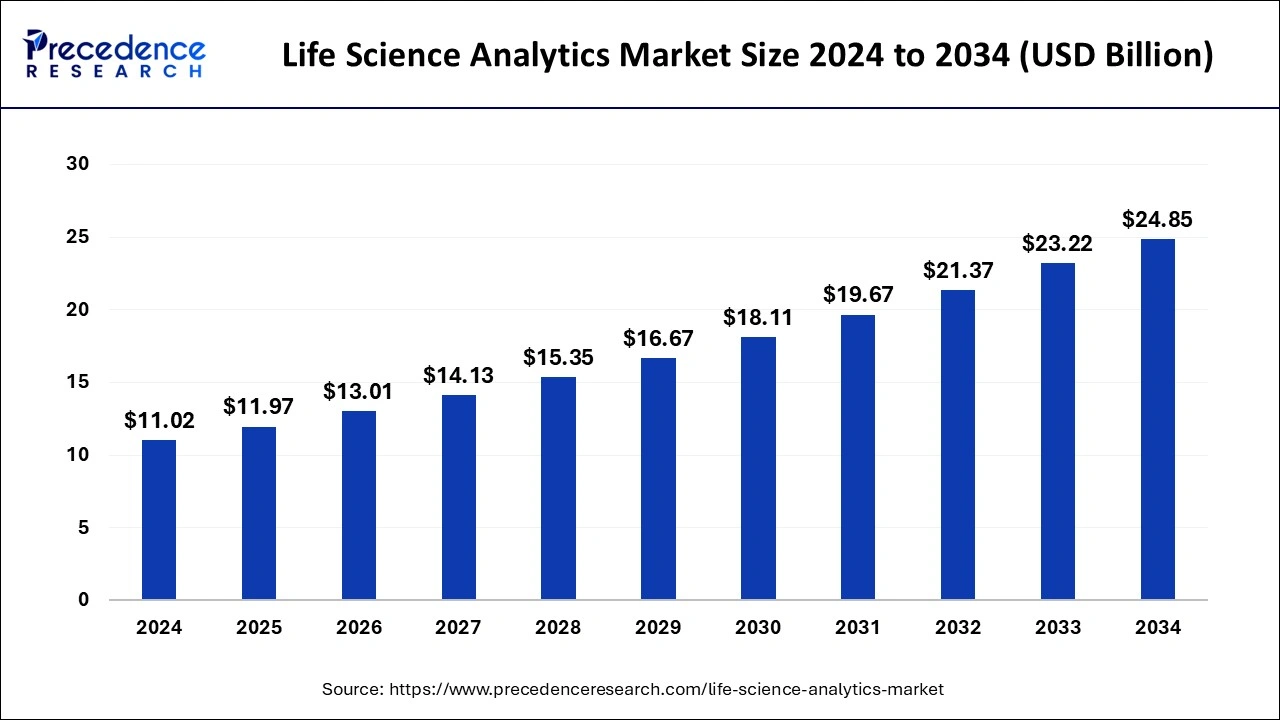
The global life science analytics market size was calculated at USD 11.02 billion in 2024 and is predicted to reach around USD 24.85 billion by 2034, expanding at a CAGR of 8.47% from 2025 to 2034. The rising healthcare and pharmaceutical industries due to chronic conditions and the geriatric population are driving the life science analytics market.
Life Science Analytics Market Key Takeaways
- North America has generated a revenue share of around 52.14% in 2024.
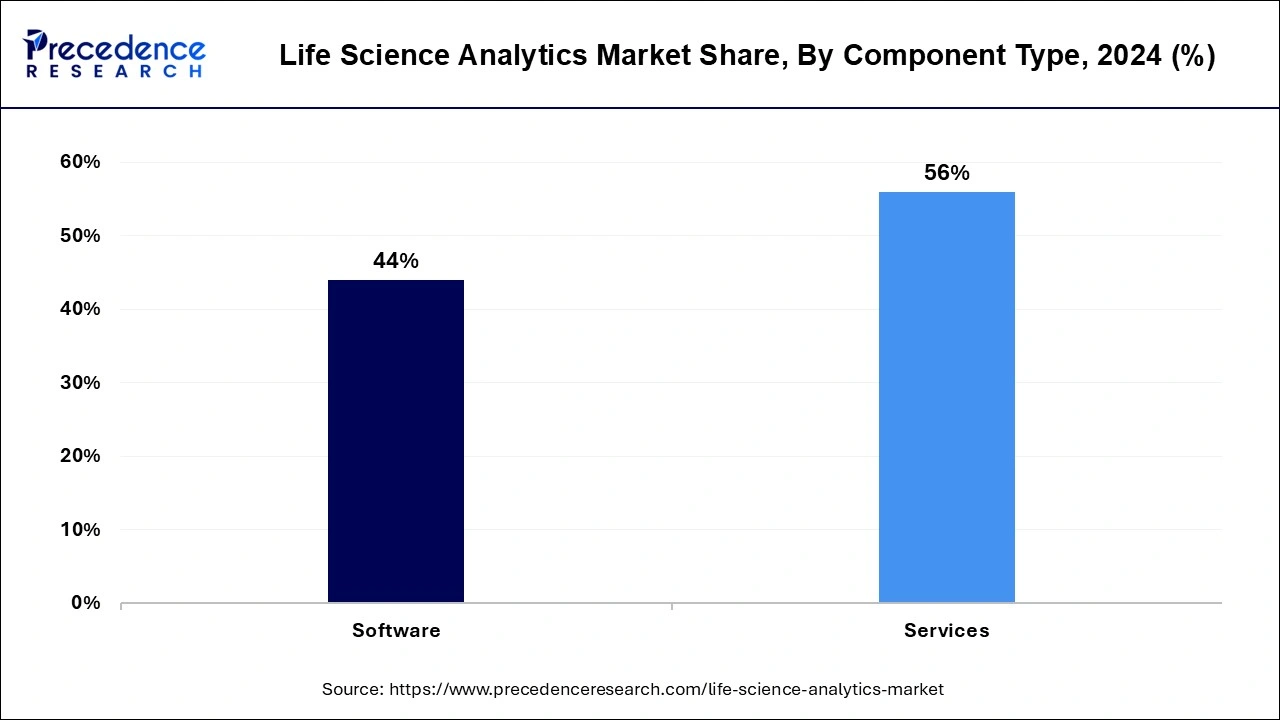
- By component, the services segment accounted the highest revenue share of 56% in 2024.
- By type, the descriptive analytics segment accounted for a revenue share of around 37% in 2024.
- By application, the sales and marketing segment has held a revenue share of 31.4% in 2024.
- By delivery, the on-demand delivery segment has accounted for a revenue share of around 50.5% in 2024.
- By end-user, the pharmaceutical segment has captured a revenue share of around 47% in 2024.
How is AI Impaction the Market?
Biotechnology, pharmaceutical, and healthcare research and development are being revolutionized by artificial intelligence (Al) in life science analytics, which uses machine learning (ML), deep learning, and data analytics. The healthcare and life sciences sectors stand to gain greatly from the application of AI to life science analytics, which might transform research, enhance patient outcomes, and optimize operations. As technology advances, it is expected that Al will further revolutionize data analysis and usage in these vital domains. AI is used in life science analytics to enhance healthcare outcomes and operational efficiency. Additionally, there is a lot of room for growth in the artificial intelligence market for life science analytics in the drug research and development sector.
U.S. Life Science Analytics Market Size and Growth 2025 to 2034
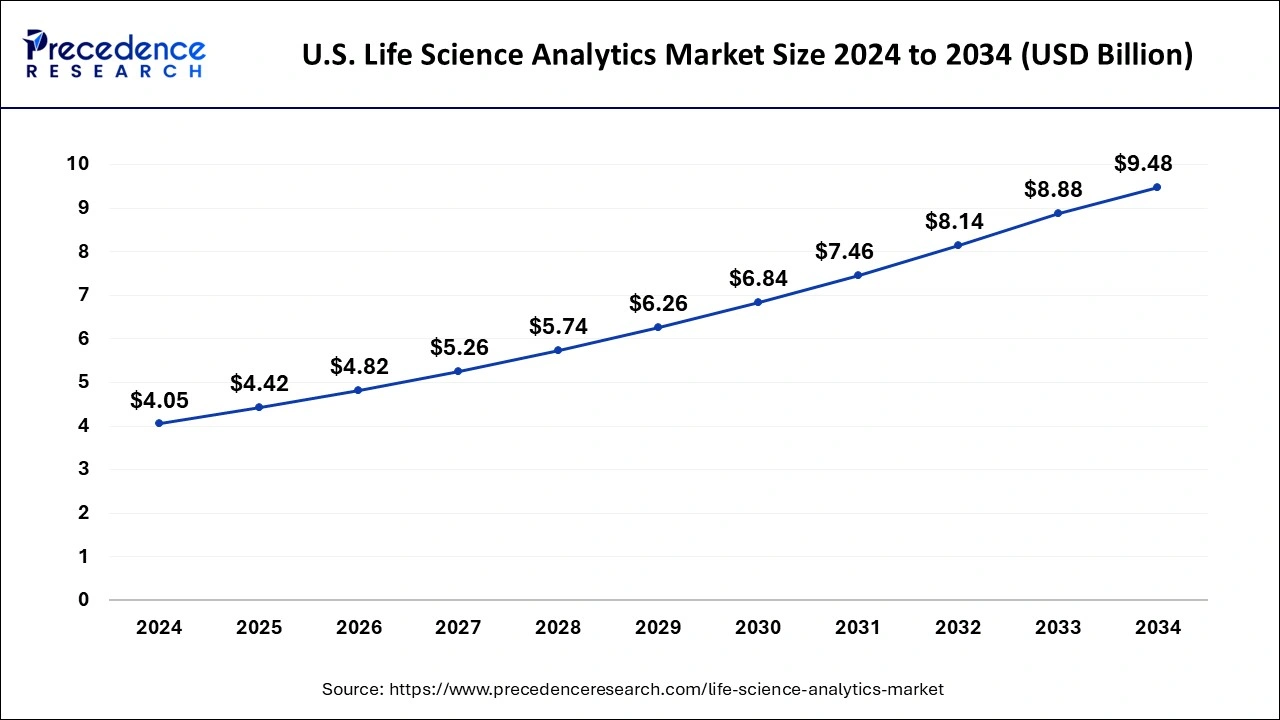
The U.S. life science analytics market size was exhibited at USD 4.05 billion in 2024 and is projected to be worth around USD 9.48 billion by 2034, growing at a CAGR of 8.88% from 2025 to 2034.
North America, Europe, Asia Pacific, Latin America and Middle East and Africa are the most common five region covered in the report of life science analytics market. North America is the appeared as dominant regional market among others. The North America region accounted largest revenue share of around 52.14%.
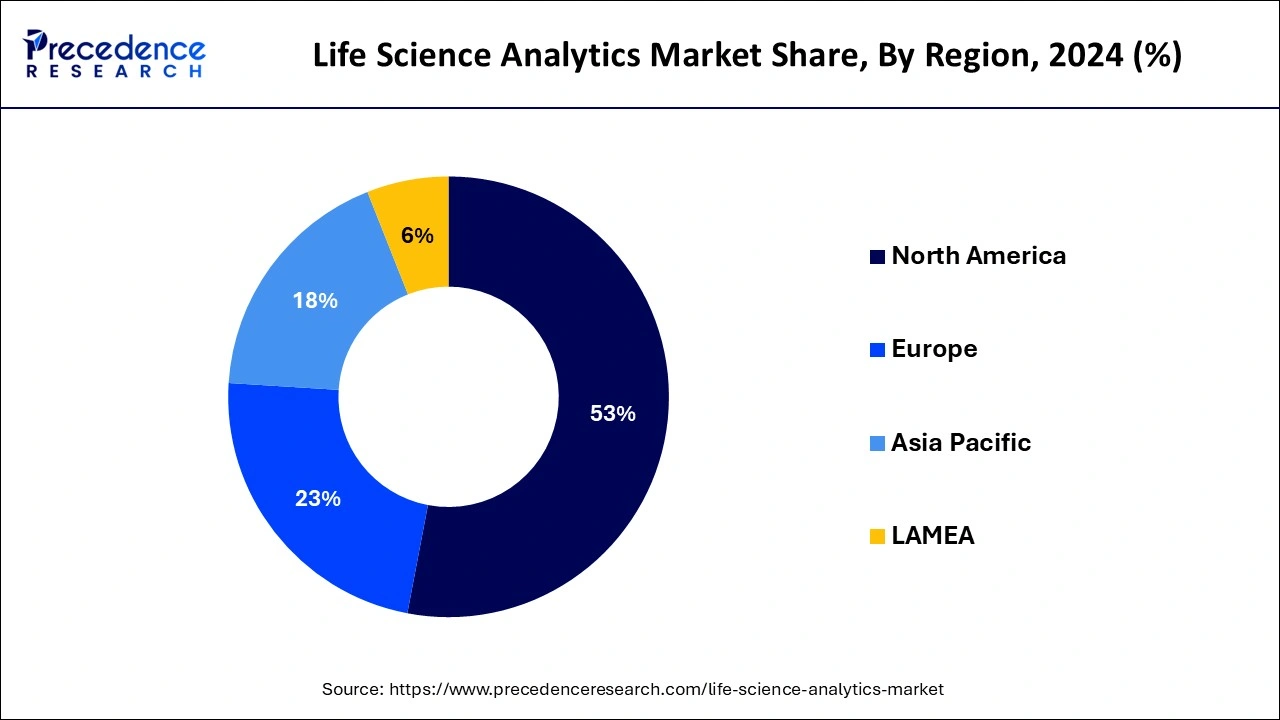
On the other hand, Asia Pacific is expanding at a CAGR of 10.5% over the forecast period. Major players of North America are looking towards the Asia Pacific for their future growth and development. Bulking loads of chronic disorders in the region like North America and Europe is also considered as one of the major driving factors which helps the growth of the global life science analytics market.
Market Overview
The way pharmaceutical and healthcare companies use data to spur innovation and enhance patient outcomes is being completely transformed by life science analytics. Businesses can now handle large datasets to speed up drug discovery, improve clinical trials, and allow precision medicine at scale thanks to sophisticated data analytics for the life sciences. Organizations that successfully handle this massive amount of data may turn unprocessed data into insightful knowledge that advances medication research, enhances clinical trials, and improves patient outcomes. This potential is further enhanced by the integration of analytics platforms with contemporary life sciences CRM systems, which offer a comprehensive understanding of the patient experience and market dynamics.
Life Science Analytics Market Growth Factors
- Technological advancements: Technical upgradation in the field of analytics in the healthcare segment is considered one of the major driving factors that promote the growth of the life science analytics market.
- Integration of big data: The rising penetration of big data usage in healthcare is also one of the prime factors for the life science care analytics segment.
- Investments by organizations: Data standardization coupled with firm investment in the field of data spending is further accelerating market growth.
- Rising burden of chronic disorders: The rising burden of chronic disorders and increasing workloads on the FDA and firms related to the drug approval process are some of the major reasons to support market growth.
- Rise in digitalization in healthcare: Data analytics has always been known for its dealing with mass quantities of information in various sectors. Increasing digitalization in hospitals and research centers are considered is the prime factor for the development of the life science analytics market.
- Rise in patients and their healthcare data: Countries like the United States, India, and China are experiencing huge amounts of patient data every day. Data-driven technology helps these countries to analyze healthcare data like patient records, treatment, inventory management, staff data, and all other queries at a much faster rate compared to the traditional method.
- Application of science analytics in various segments of healthcare: Some of the segments where life science analytics are very helpful are medical imaging, developing new therapies, smart staffing, reducing fraud, risk management, supply chain management, and others.
Market Scope
| Report Highlights | Details |
| Market Size in 2025 | USD 11.97 Billion |
| Market Size by 2034 | USD 24.85 Billion |
| Growth Rate from 2025 to 2034 | CAGR of 8.47% |
| Base Year | 2024 |
| Forecast Period | 2025 to 2034 |
| Segments Covered | Type, Component, Delivery Model, Application, and End Users |
| Regional Scope | North America, Europe, Asia Pacific, Latin America, Middle East & Africa (MEA) |
Type Insights
Different types of analytics assessed in this report are descriptive, predictive, diagnostic, discovery, and prescriptive. The descriptive segments held the majority of the market shares in the year 2024. Life science analytics always deals with the description methods to deals with the life sciences queries. For a better explanation and interpretations about the incidence and past trend data, the descriptive analytics provide overviews of the subjects. It is also observed that predictive health analytics proved to be more complex when compared with descriptive analytics. Most healthcare organizations aim to investigate the performance gap and allow the space for preparing the better strategies needed for the organization. Firm preference for descriptive analytics is due to its form or presentation like simple graphs with explanations. The discovery analytics used to discover or determine the different scientific facts. For instance, Centers for Medicare and Medicaid Services (CMS) used analytics to reduce hospital readmission rates.
The predictive analysis is registering growth at a CAGR of 9.2% over the forthcoming years.
Component Type Insights
Based on the type of component the market is fragmented into, software and services. In 2023, the services segment garnered for a revenue share of around 56%. Service provided by skilled professionals and cloud management services are costlier. These services are mostly provided by companies like Microsoft, clodera and others. The efficient running of the analytics services plays a major role in its execution. The services segment is poised to reach at a CAGR of 8.3% over the forecast period.
Application type Insights
By Application, the market is classified into research & development, supply chain optimization, clinical trials, sales & marketing, regulatory compliance, preclinical trials, and pharmacovigilance. The sales and marketing segment dominated the life science analytics market and garnered a revenue share of 31.4% in 2024.
Sales and marketing showed noticeable improvement in recent years and the same will grow at the considerable CAGR within the forecast period. Marketing campaigns and post-marketing surveys become important for the healthcare firm. Market surveillance is also assisted in boosting the life sciences analytics market. The research and development is expected to hit at a CAGR of 9.9% over the forecast period.
End-users type Insights
On the basis of end-users, the market is classified into pharmaceutical & biotechnology companies, medical device companies, research centers, and third-party administrators. The pharmaceutical and bio-technology are the biggest end-users both in terms of revenue generation and consumption volume. In the year 2023, the same segment held the maximum market share 47%. Life science analytics is used to accelerate the process of discovery and development of the drugs, to optimize the efficacy of clinical trials, to focus on a specific population of the patients, to see the effect of the drug, to analyze the patient behavioral activities over healthcare outcome, and to further manage the patient's safety and risk management. For instance, The Johnson and Johnson Company is looking for the data to assist the pharmaceutical and biotechnological firm for making decision-based process easier.
Biotechnology companies are anticipated to reach at a CAGR of 8.8% over the forthcoming years.
Life Science Analytics Market Companies
- SAS Institute Inc.
- Oracle Corporation
- Accenture
- IBM Corporation
- Cognizant, SCIO Health Analytics
- IQVIA
- Wipro
- Allscripts Healthcare Solutions
- Cerner Corporation
- MaxisIT
- Optum
- Microsoft
- Infosys Limited
- Cotiviti
- Others
Recent Developments
- In January 2025, with $7 million in investment, Prudentia Sciences, an AI-powered life sciences technology platform, announced today that the company will go public. In order to ensure that healthcare innovations meet their clinical development milestones, patient impact, and maximum commercial potential, the business wants to enable biopharma companies to expedite drug pipelines and optimize return on investment.
- In December 2024, to improve its AI infrastructure and grow in Ghana and Kenya, PBR Life Sciences, a healthcare data analytics startup, secured $1 million in pre-seed capital. Supported by investors such as Launch Africa, Microtraction, and Techstars, the money will help the organization fulfill its goal of offering data-driven insights to the pharmaceutical industry in Africa.
Segments Covered in the Report
By Type
- Descriptive Analytics
- Predictive Analytics
- Prescriptive Analytics
- Diagnostic Analytics
- Discovery Analytics
By Component Type
- Services
- Software
By Delivery Model
- On-premise model
- On-demand model
By Application Type
- Research & Development
- Preclinical Trials
- Clinical Trials
- Sales & Marketing
- Regulatory Compliance
- Supply Chain Optimization
- Pharmacovigilance
By End UsersType
- Pharmaceutical & Biotechnology Companies
- Medical Device Companies
- Research Centers
- Third-party Administrators
By Regional Outlook
- North America
- US.
- Canada
- Europe
- UK.
- Germany
- France
- Asia Pacific
- China
- India
- Japan
- Southeast Asia
- Middle East and Africa
- GCC
- North Africa
- South Africa
- Rest of MEA
For inquiries regarding discounts, bulk purchases, or customization requests, please contact us at sales@precedenceresearch.com
Frequently Asked Questions





Ask For Sample
No cookie-cutter, only authentic analysis – take the 1st step to become a Precedence Research client