




List of Contents
Lab Automation Market Size and Forecast 2025 to 2034
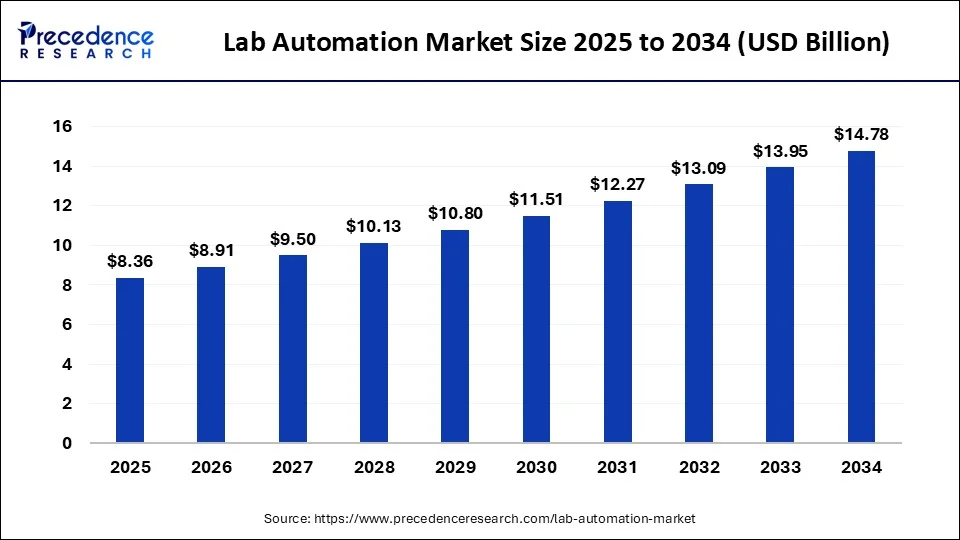
The global lab automation market size is calculated at USD 8.36 billion in 2025 and is predicted to increase from USD 8.91 billion in 2026 to approximately USD 14.78 billion by 2034, growing at a CAGR of 6.55% from 2025 to 2034. The North America lab automation market size reached USD 2.79 billion in 2024.
Lab Automation MarketKey Takeaways
- In terms of revenue, the market is valued at $8.36 billion in 2025.
- It is projected to reach $14.78 billion by 2034.
- The market is expected to grow at a CAGR of 6.55% from 2025 to 2034.
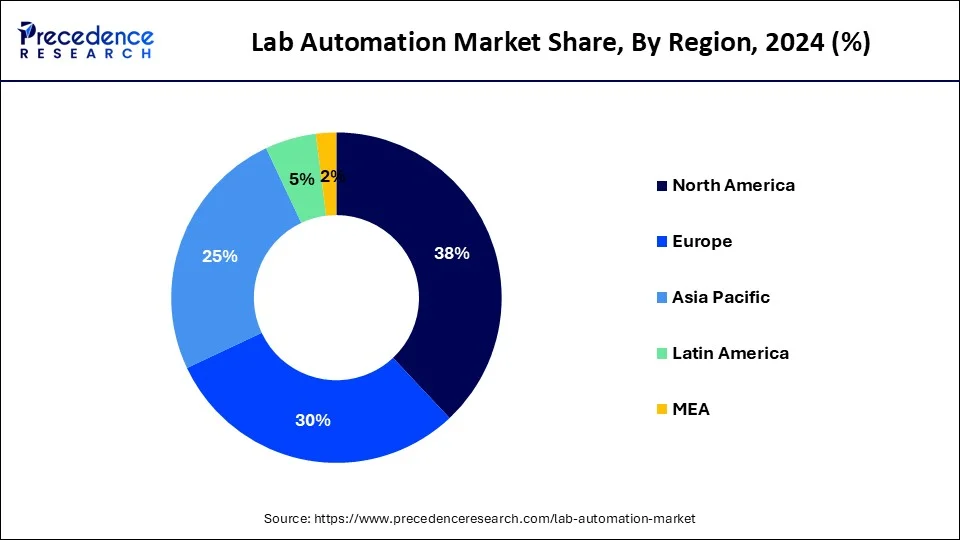
- North America has held the highest revenue share of 38% in 2024.
- Asia-Pacific is estimated to expand at the fastest CAGR during the forecast period.
- By Process, the continuous flow segment has held the highest revenue share in 2024.
- By Automation Type, the modular automation system segment held the major market share in 2024.
- By End-Use, the clinical chemistry analysis segment had the major market in 2024.
U.S. Lab Automation Market Size and Growth 2025 to 2034
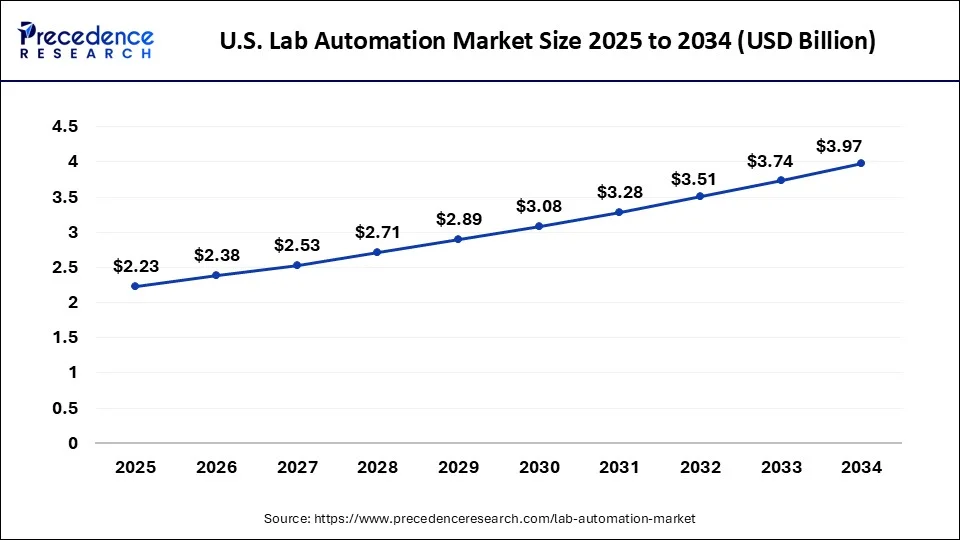
The U.S. lab automation market size is valued at USD 2.23 billion in 2025 and is expected to be worth around USD 3.97 billion by 2034, at a CAGR of 7% from 2025 to 2034.
North America has held the largest revenue share in 2024. The North America lab automation market thrives as a dynamic sector in the laboratory technology and life sciences landscape. This region comprises economic powerhouses, namely the United States and Canada, which lead the way in technological innovation and research-driven industries. Their contributions significantly fuel the growth and development of lab automation. With well-established infrastructure including research institutions, healthcare facilities, pharmaceutical companies, biotechnology firms, and clinical laboratories, North America increasingly relies on lab automation solutions to enhance productivity, accuracy, and efficiency.
Lab automation has become increasingly popular in North America due to various factors. These include the continuous focus on drug discovery and development, the rising demand for personalized medicine, and the necessity for speedy and dependable diagnostic testing. Among these factors, the pharmaceutical sector stands out as a major driving force, constantly exploring avenues to expedite the drug development pipeline.
Currently, North America is dominating the lab automation market. North America's growing pharmaceutical and biotechnological companies are adopting advanced technology in the production and other operational processes. The government's support and incentives to these companies are encouraging innovation in the regional market of the region.
The Asia-Pacific lab automation market is experiencing remarkable growth and transformation. The region comprising countries like China, India, Japan, South Korea, and Australia has gained significant recognition in global scientific research, pharmaceuticals, biotechnology, and healthcare. This demonstrates the increasing prominence of this region in these fields. Each of these countries significantly contributes to the expansion of lab automation technologies. Moreover, the Asia-Pacific region features a flourishing pharmaceutical industry that heavily invests in drug discovery, development, and production. Consequently, there is a rising adoption of lab automation systems to streamline processes and enhance research efficiency.
Technological innovation and research collaborations further shape the Asia-Pacific Lab Automation Market. Government initiatives, academic institutions, and industry partnerships are driving advancements in automation and robotics. This progress becomes particularly evident in countries like Japan and South Korea. As these regions go through economic growth and invest in cutting-edge technologies, the Asia-Pacific lab automation market is projected to witness significant expansion.
How is North America Leading the Lab Automation Market?
North America is the main player in the worldwide lab automation market owing to its excellent healthcare system, government backing, and massive investments in R&D for biotech and pharma. The region's increasing focus on precision medicine and digital transformation of life sciences is pushing forward the adoption of automation in labs, thus offering researchers and diagnostics the benefits of better efficiency, reproducibility, and scalability.
United States Lab Automation Market Trends:
The U.S. market is the leading force behind the regional growth, with a strong push given by the need for higher throughput, accuracy, and reproducibility through automation in laboratories. On the one hand, there is a growing demand for faster and more accurate diagnostics, while on the other hand, there is a workforce shortage; together, these factors are prompting labs to adopt robotics and AI-based systems in order to manage large sample volumes and complex testing flows with lower human involvement.
What are the Driving Factors of the Lab Automation Market in Europe?
The lab automation market in Europe is slowly but surely moving ahead, the driving forces being research investments and compliance with the constantly changing healthcare standards. The area has placed priority on the interoperability and standardization of laboratory processes. The increasing emphasis on open automation systems, the joint projects between academia and industry, and regulatory reforms are all working together to support technological modernization and sustainable laboratory operations.
Germany Lab Automation Market Trends:
Germany is the place where laboratory automation is mainly located, and the use of cutting-edge technologies in hospitals, research facilities, and diagnostic centers is continuously expanding. The partnership between public and private entities is making the innovation possible, while the country's concentration on precision diagnostics and process optimization is leading to a laboratory environment that is efficient and technology-oriented.
How is Asia-Pacific Performing in the Lab Automation Market?
The Asia-Pacific region is experiencing a surge in laboratory automation, which has been a resulting factor of industrialization, the flourishing pharmaceutical sector, and the technological modernization in healthcare at an ever-increasing pace. In this wake, the governments and private sectors in the region are pouring money into automation so as to be able to reinforce diagnostics, biomedicine, and research capabilities, thus opening up large areas for system integration and the use of robots in laboratories.
China Lab Automation Market Trends:
China's market positions the entire region significantly, as the country pays particular attention to the development of biotechnology and healthcare. Such growing R&D investments have led to broad area automation due to not only infrastructure improvements but also the digital transformation of the whole laboratory operations. The increasing need for precision in diagnostics and for faster results has led to innovations in automated laboratory platforms and data-driven management systems.
Market Overview
The lab automation market encompasses a wide range of automated systems, instruments, software, and workflows. The purpose of this solution is to streamline and enhance laboratory processes, data management, and experimentation in various scientific domains. These encompass pharmaceuticals, biotechnology, clinical diagnostics, academic research, and healthcare. The key goal of lab automation solutions is to reduce human intervention while improving accuracy, increasing throughput, and optimizing resource utilization.
The lab automation market comprises several essential components such as robotic systems, liquid handling devices, automated analyzers, sample preparation equipment. Additionally, there are integrated software platforms that enable seamless control and monitoring of laboratory operations. With advancements in robotics AI & data analytics technology fields are boosting the lab automation market by revolutionizing research and development practices. Ultimately it enables faster drug discovery procedures alongside diagnostic testing methodologies for genomics and personalized medicine.
The lab automation industry is currently evolving significantly. In particular, the integration of advanced technologies such as Internet of Things, lab microfluidics and chip devices have led to significant transformation in this sector. By presenting new solutions to improve effectiveness, reproducibility and scaling, this convergence has a fundamental influence on the pursuit of science. As laboratories across different sectors increasingly acknowledge the advantages of automation, the lab automation market is projected to experience substantial growth in the future. Its role will be instrumental in driving advancements in scientific discovery and healthcare solutions.
How is AI Contributing to the Lab Automation Market?
AI is revolutionizing the lab automation market by providing new features such as predictive analytics, workflow optimization, and intelligent process control. The data accuracy is improved, manual intervention is minimized, and real-time decision-making is facilitated through the use of machine learning algorithms. AI, along with robotics, is taking care of the repetitive tasks, and this leads to research being fast-tracked, human error being minimized, and advanced applications like genomic sequencing and precision diagnostics being more widely used in different laboratory environments.
Technological Advancement
Technological advancements in the lab automation market feature IoT, robotics, connectivity, and miniaturization. Internet of Things (IoT) and connectivity in the market contribute to monitoring, data sharing between systems, and lab instruments. This technology utilizes time and improves lab workflow management. The robotic system automates tasks, reducing the workload of lab staff. High-throughput screening technology analyzes vast data and infinite samples. Miniaturization and microfluidics are the devices used to enhance lab practices effectively and efficiently. AI and machine learning use algorithms in lab automation to recognize patterns and analyze data. It helps to predict business outcomes and enable appropriate data interpretation. Data analytics provides valuable insights with the processed lab data. These technologies mark a positive impact on the overall healthcare sector.
Lab Automation Market Growth Factors
The demand for improved efficiency and productivity in research and development is growing across various industries, such as pharmaceuticals, biotechnology, and healthcare. Lab automation systems offer a solution by significantly reducing manual labor, minimizing errors, and speeding up experimental processes. This increased efficiency leads to quicker results, cost reduction, and enhanced competitiveness. Consequently, organizations seeking an advantage in a highly competitive landscape find automation to be an appealing option.
Furthermore, the lab automation market, in particular the robotics and artificial intelligence markets, is benefiting from technological progress. The development of more sophisticated and flexible laboratory automation systems has been facilitated by these remarkable developments. Robotic platforms are now capable of handling intricate tasks like high-throughput screening, sample preparation, and even conducting experiments themselves. Additionally, AI algorithms enable optimized workflows, predictive analytics, and real-time adaptability to changing experimental conditions. These extensive capabilities elevate lab automation systems' adaptability across a broad spectrum of laboratory applications.
Therefore, the lab automation market is witnessing continuous growth. The growth observed can be attributed to the increasing demands for efficiency, data management, technological advancements, and breakthroughs in scientific disciplines. As laboratories strive for enhanced capabilities and competitiveness, lab automation solutions are poised to play a crucial role in shaping the future of research and development across multiple industries.
Market Outlook
- Industry Growth Overview: The market is experiencing a rapid expansion, the main driving factors being the need for more automation, setting higher efficiency goals, and the use of AI and robotics together in labs for better performance.
- Sustainability Trends: The focus is on reducing energy consumption, improving resource efficiency, and the use of eco-friendly materials in the design of automation infrastructure and systems.
- Global Expansion: North America continues to be the leader, while Asia-Pacific is experiencing a quicker adoption of automation; the latter is a result of higher investments in healthcare research and increased awareness of automation.
- Major Investors: Big companies like Thermo Fisher, Danaher, Agilent, and Roche are among the main players that promote innovation through their R&D projects and purchasing of shares in smaller companies (through partnerships).
- Startup Ecosystem: The market is gradually being populated by startups that are working on developing easy-to-use modular automation systems that will not only make the laboratory processes easier but also facilitate their access worldwide.
Market Scope
| Report Coverage | Details |
| Market Size by 2034 | USD 14.78 Billion |
| Market Size in 2025 | USD 8.36 Billion |
| Market Size in 2026 | USD 8.91 Billion |
| Growth Rate from 2025 to 2034 | CAGR of 6.55% |
| Largest Market | North America |
| Base Year | 2024 |
| Forecast Period | 2025 to 2034 |
| Segments Covered | Process, Automation Type, End-User, and Region |
| Regions Covered | North America, Europe, Asia-Pacific, Latin America, and Middle East & Africa |
Market Dynamics
Drivers
Data management challenges
In today's research and laboratory environments, the generation of vast volumes of data has become a common occurrence. This is primarily due to advancements in high-throughput technologies, omics sciences, and complex experimentation. These datasets hold immense potential for groundbreaking discoveries and innovations.
However, the manual management, processing, and analysis of such data proves to be time-consuming and prone to errors, thereby creating a bottleneck in the research process itself. To tackle these challenges head-on, lab automation systems equipped with powerful software and algorithms offer an effective solution. These systems seamlessly integrate with various laboratory instruments, allowing for real-time data collection and standardized formats that guarantee consistency and accuracy.
In addition, the utilization of lab automation systems has a remarkable impact on the speed of research. Without constant manual intervention, researchers can conduct experiments on a large scale, enabling quicker data generation and facilitating faster insights and decision-making. This is especially crucial in fields such as genomics, drug discovery, and clinical diagnostics where timely results hold significant importance for patient care and scientific progress.
Therefore, the challenges of managing data in modern laboratories are continuously expanding. These challenges have become a key driver behind the growth of the lab automation market. By addressing issues related to data volume, quality, and efficiency, lab automation systems allow researchers to fully utilize their data's potential. This ultimately leads to faster scientific discoveries and innovations across various industries. As research generates unprecedented amounts of data, the demand for effective data management solutions through lab automation is anticipated to grow even further in the future.
Restraints
Lack of skilled workforce
The demand for skilled personnel who can design, operate, maintain, and troubleshoot increasingly complex and technologically advanced laboratory automation systems has grown alongside their rapid development. However, a notable scarcity of individuals with expertise in robotics, software programming, and automation-specific knowledge poses challenges in various regions and industries. This dearth of skilled labor hinders the seamless adoption and effective utilization of cutting-edge automation technology. Laboratories investing in such technology may struggle to maximize its benefits without personnel capable of harnessing its full potential.
Furthermore, this skill gap can result in operational inefficiencies, increased downtime due to technical issues, and a diminished return on investment. Researchers and laboratory staff who lack sufficient training in working with automation systems may exhibit resistance towards their adoption or utilize them sub-optimally. This resistance or sub-optimal use can lead to a diminished impact on scientific productivity and innovation. The lack of skilled workforce poses a significant challenge for the lab automation market. This challenge has the potential to hinder its growth and broader adoption.
As automation technology continues to advance and play a more integral role in laboratory operations, it becomes crucial to take measures in cultivating a workforce equipped with the necessary skills and knowledge. Only then can we fully leverage the innovative systems' true potential. Overcoming this restraint is essential in realizing the promised benefits of efficiency, accuracy, and productivity that lab automation offers.
Opportunities
Biotechnology advancements
Biotechnology has seen a remarkable shift due to the advancements in genomics, proteomics, cell biology, and molecular biology. This progress has resulted in a greater need for sophisticated laboratory equipment and biotechnology-related items. At the forefront of this transformation are lab automation systems. These systems provide a solution to the growing complexity and scale of experiments in biotechnology.
Lab automation systems empower researchers to handle large volumes of biological samples, perform high-throughput assays, and conduct precise liquid handling with unparalleled accuracy and consistency. Achieving such precision manually poses considerable challenges. In the field of genomics specifically, automating DNA sequencing, library preparation, and next-generation sequencing workflows has substantially expedited progress in genomic research as well as personalized medicine. High-throughput screening and automated cell culture systems are now essential in drug discovery and bioprocessing.
They enable rapid compound testing and large-scale production of biopharmaceuticals. Additionally, automation has streamlined complex procedures like protein purification and analysis. As a result, research in proteomics and structural biology has advanced significantly, leading to a deeper understanding of proteins and their functions.
Biotechnology is continuously evolving, driving the demand for lab automation solutions. These solutions must be capable of handling diverse biological assays while ensuring data integrity and enhancing research reproducibility. Moreover, the integration of biotechnology with data analytics and artificial intelligence introduces exciting possibilities for automation providers. They can now develop integrated systems that not only generate data but also assist in its interpretation and analysis.
The synergistic relationship between biotechnology and lab automation positions the latter as a crucial catalyst for advancements in this field. It opens doors to groundbreaking discoveries, novel therapies, and personalized medicine applications that will shape the future of healthcare and life sciences. As the biotech industry pushes forward scientific knowledge boundaries and explores new therapeutic possibilities, this synergy will continue to drive innovation and fuel market growth.
Process Insights
According to the process, the continuous flow sector has held the major revenue share in 2024. The lab automation market has introduced a groundbreaking approach called continuous flow segment, revolutionizing laboratory processes. This innovative method offers significant advantages in terms of efficiency, precision, and scalability. Unlike traditional batch processing, continuous flow systems allow for uninterrupted and sequential execution of experiments or assays. Essentially, samples move continuously through different stages of the process.
This approach has gained widespread recognition within various applications including chemical synthesis, drug discovery, and clinical diagnostics. Continuous flow systems excel at maximizing resource utilization, minimizing waste generation, and optimizing reaction conditions. Take chemical synthesis for example; microfluidic-based continuous flow platforms enable precise control over reaction parameters leading to improved product yields and reduced reaction times. In pharmaceutical research, the rapid development of new drug candidates is essential.
Automation Type Insights
The modular automation system segment held the largest market share the market in 2024. Modular systems possess a key characteristic: flexibility. This feature allows laboratories to customize and reconfigure their automation setups based on specific research needs and workflows. These systems are composed of individual, interchangeable modules or components that can be easily integrated or expanded upon. As a result, they are exceptionally well-suited for laboratories with evolving requirements or those seeking to optimize existing workflows.
Furthermore, modular automation offers enhanced versatility, enabling researchers to perform a wide range of tasks within a single integrated system—ranging from sample preparation to data analysis. Such adaptability holds particular value in research environments where experiments may vary significantly in complexity and scope. By configuring their automation system accordingly, scientists gain the advantage of automating routine and repetitive tasks, thereby freeing up valuable time for more intricate and creative aspects of their work.
End-Use Insights
In 2024, the clinical chemistry analysis sector had the highest market share on the basis of the end-user. The field of clinical chemistry analysis entails a wide array of automated systems. These specialized systems are designed to perform clinical chemistry tests, immunoassays, and biochemical analyses with remarkable precision, speed, and accuracy. By automating key processes like sample preparation, reagent handling, mixing, incubation, and result reporting, these systems significantly reduce manual labor requirements while enhancing the reliability of test results.
Their vital role in medical diagnostics lies in providing crucial information about a patient's overall health, organ function, and disease markers. Clinical chemistry analysis systems are particularly valuable for measuring biomarkers, electrolytes enzymes hormones metabolites. This capability greatly aids in diagnosing and monitoring conditions such as diabetes liver disease cardiovascular disorders infectious diseases. The automation of clinical chemistry testing has two significant benefits. This technology enhances testing efficiency, resulting in higher throughput. Additionally, it reduces the likelihood of human error, which ultimately improves patient care and facilitates more accurate treatment decisions.
Value Chain Analysis
- R&D: The department dealing with innovative and experimental drug research and development through the focus of discovering and inventing new drugs or therapies.
- Clinical Trials and Regulatory Approvals: The steps that involve testing new drugs on human subjects based on safety and efficacy, and obtaining government approvals.
- Formulation and Final Dosage Preparation: The process of turning the active ingredients into the form of the final product that is then used by patients or laboratories.
- Packaging and Serialization: The steps that involve sending the product through secure packaging, making sure that it is properly labeled, and assigning serial numbers for traceability.
- Distribution to Hospitals, Pharmacies: The logistics manage the delivery of cosmetics and other products to hospitals and pharmacies in an effective manner.
Lab Automation Market Companies
- F. Hoffmann-La Roche Ltd.
- Hamilton Company
- Tecan Trading AG
- BMG LABTECH GmbH
- Aurora Biomed Inc.
- Hudson Robotics
- Eppendorf SE
- Agilent Technologies, Inc.
- Danaher
- Thermo Fisher Scientific, Inc.
- Siemens Healthcare GmbH
- PerkinElmer Inc.
- QIAGEN
Recent Developments
- In May 2025, Trilobio, the company building the fully automated robotic lab-in-a-box for biologists, announced it had raised investment of USD 8 million. The investment is a contribution to the lab automation market. (Source - https://www.news-medical.net)
- In January 2025, ABB robotics introduced the ‘Lab of the future' at SLAS 2025. It's an integration between ABB robots and instruments from industry leaders. The company showcased two live robotic automation demos and a discussion with industry leaders. (Source - https://new.abb.com)
- In January 2025, ABB and Agilent Technologies collaborated to advance laboratory automation. The solution is beneficial for the lab staff to improve workflow and other operations. (Source - https://new.abb.com)
- Avida Biomed which is a life science firm at an early stage of development has created high-performance target-enrichment procedures with unique features for clinical researchers utilizing next-generation sequencing techniques to explore cancer was acquired by Agilent Technologies.
- Becton Dickinson AG has introduced a completely automated, high-throughput molecular diagnostic platform for labs in the United States.
Segments Covered in the Report
By Process
- Discrete Processing
- Continuous Flow
By Automation Type
- OEM
- Aftermarket
By End-User
- Modular Automation Systems
- Total Automation Systems
By Region
- North America
- Europe
- Asia-Pacific
- Latin America
- Middle East and Africa
For inquiries regarding discounts, bulk purchases, or customization requests, please contact us at sales@precedenceresearch.com
Frequently Asked Questions





Ask For Sample
No cookie-cutter, only authentic analysis – take the 1st step to become a Precedence Research client