




List of Contents


What is Energy Harvesting System Market Size?
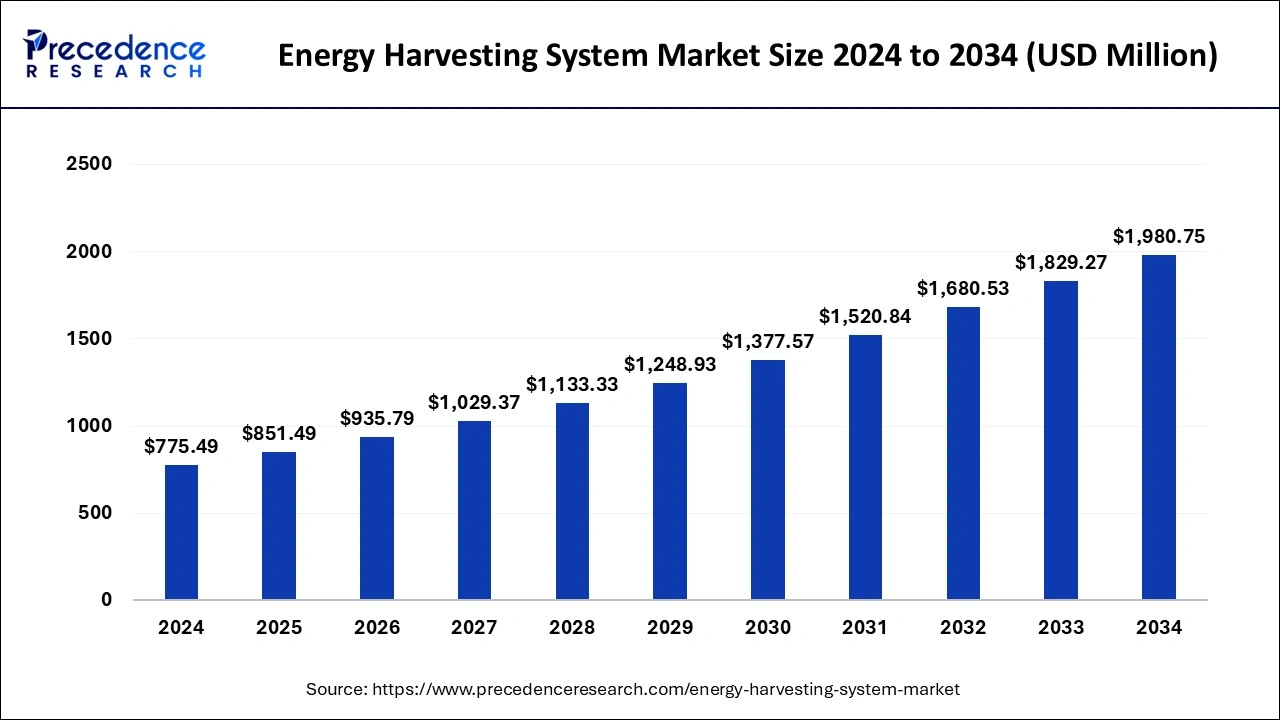
The global energy harvesting system market size is accounted for at USD 851.49 million in 2025 and is expected to hit USD 1,980.75 million by 2034, growing at a CAGR of 9.83% from 2025 to 2034.
Market Highlights
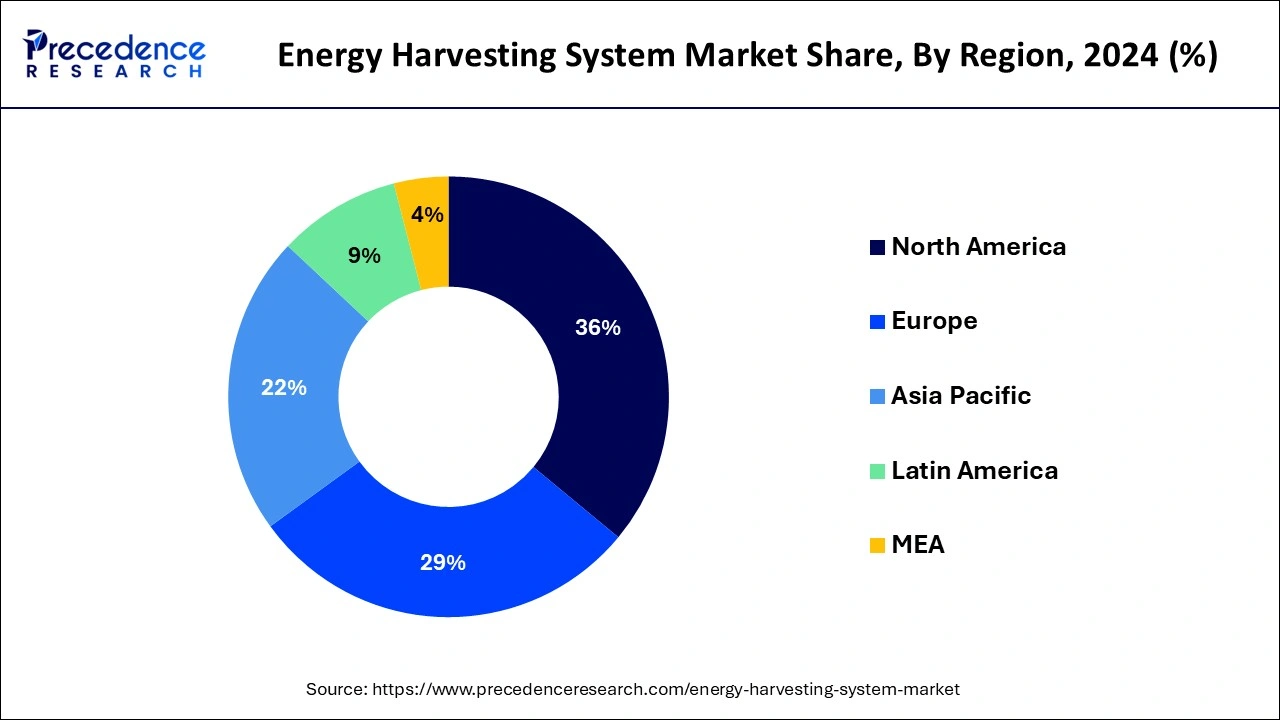
- North America led the global market with the highest market share of 36% in 2024.
- By technology, the Vibration energy harvesting segment registered the maximum market share of 33% in 2024.
- By component, the Sensors segment generated over 35% of revenue share in 2024.
- By application, the industrial segment has held the largest market share of 31% in 2024.
Market Size and Forecast
- Market Size in 2025: USD 851.49 Million
- Market Size in 2026: USD 935.79 Million
- Forecasted Market Size by 2034: USD 1,980.75 Million
- CAGR (2025-2034): 9.83%
- Largest Market in 2024: North America
- Fastest Growing Market: Asia Pacific
What is the Energy Harvesting System Market?
The energy harvesting system is the process of producing usable energy electrical energy by capturing the energy from one or more renewable energy sources. Energy harvesting is very important solution in order to power the IoT that are installed in accessible areas and require battery maintenance. In places where there are no power sources, energy harvesting is a very important tool in such cases. It helps in making the inaccessible devices self sufficient by capturing the energy from the Renewable sources. The devices used for harvesting the energy are known as the energy harvesting system.
How is AI contributing to the Energy Harvesting System Market?
AI is the driving force in the energy harvesting system market through its ability to optimize energy capture, storage, and distribution with predictive analytics. The machine learning-based methods predict the availability of renewable energy, control the fluctuations in the grid, and make sure that the system is working efficiently. The maintenance is made by AI in such a way that it reduces both the downtime and cost inefficiencies.
Energy Harvesting System Market Growth Factors
Globally, the market is growing for durable systems that are power efficient and safe, which require very less maintenance. There is a rise in the adoption of wireless sensor networks due to automation in the houses and the green technology that is adopted by the various nations. There is wastage of the environmental energy. The systems that help in capturing this energy and converting it to electrical energy are a boon. Various research and development activities in the energy harvesting system is leading to the growth of this market. Supportive government policies and increased awareness about the environment. Also, the reduction in the emission of the greenhouse gases has helped in rising the demand for such technologies. An increasing trend of using renewable resources across many nations has created a need for improvement in this technology. In order to supplement the primary source of power to reduce the power interruptions and to increase the reliability of an electronic system, this technology is a boon.
Europe and USA are the major hubs for energy harvesting system market. The accurate impact of COVID-19 cannot be estimated. But there has been a disruption due to the shortage of semiconductors. The key application area for energy harvesting is building and home automation. The various climatic changes and changing rainfall patterns are increasing the demand for energy harvesting systems. Self powered wireless sensors are introduced by EnOcean to integrate the energy harvesting solutions. In order to decline the carbon footprints various nations are explaining the positive impact of this technology. Energy harvesting schemes will be introduced in smart cities in order to conserve energy and reduce the dependency on the service provider. Hong Kong is promoting the use of renewable energy by installing the harvesting devices on the roofs of the buildings.
Market Outlook
- Industry Growth Overview: The market grows with the support of increased IoT and smart environments applications, as well as ongoing improvements to ultra-low-power electronics and energy capture technologies.
- Sustainability Trends:The circular innovation strategy aims at waste minimization, renewables incorporation, and green designs for next-generation autonomous systems.
- Global Expansion: Increased international partnership and regulatory convergence are the two main forces ushering in the era of smart and decentralized energy ecosystems that are global in nature.
- Major Investors: Energy-efficient materials, AI-ready systems, and long-term sustainability innovation are the areas where investors are focusing their attention.
- Startup Ecosystem: Small companies are the ones who lead the way in developing adaptive materials, micro-energy devices, and machine-learning-powered energy optimization technologies that will become the basis of future smart infrastructures.
Market Scope
| Report Coverage | Details |
| Market Size in 2025 | USD 851.49 Million |
| Market Size in 2026 | USD 935.79 Million |
| Market Size by 2034 | USD 1,980.75 Million |
| Growth Rate from 2025 to 2034 | CAGR of 9.83% |
| Largest Market | North America |
| Base Year | 2024 |
| Forecast Period | 2025 to 2034 |
| Segments Covered | By Technology, By Components, By Application, By Vibration Technology, by End-use System, and By Energy Source and Region |
| Regions Covered | North America, Europe, Asia-Pacific, Latin America, and Middle East & Africa |
Market Dynamics
Market Drivers
AVAILABILITY OF R&D FUNDS THROUGH ORGANIZATIONS AND INVESTORS
R&D for energy harvesting devices has been on a rise owing to the requirement of innovative solutions to power wireless sensors and low power electronics. Further, the presence of funds through associations such as the U.S. Department of Energy and the European Commission results to enhance the development of innovative technologies.
For instance, European Commission under its Horizon 2020 is funding a project on “Metamaterial Enabled Vibration Energy Harvesting”. The project has commenced in January 2021 and is expected to end by December 2024. The aim of this project is to eliminate the requirement of batteries to power wireless sensors in the future.
In addition, new startups are also able to raise funds from investors to progress innovative product development.
- In January 2021, Barbara IoT, a Spain-based startup company, closed a round of over USD 469.46 thousand (Euro 400k) to develop its operating system for industrial IoT
- In May 2019, Cybus, a startup company based in Germany, announced that it had secured funding from btov Partners for implementation of its industrial Internet of Things (IIoT)
Availability of funds for innovative technologies through organizations and investors aids to fast track the process of new product development. Further, it also provides a better opportunity for new product developers to enter the market with their innovative products. These factors have resulted to drive the market for the development of innovative energy harvesting systems which will result to further boost the growth of energy harvesting systems in the forecast period.
Market Restraint
LOW POWER CAPACITY COUPLED WITH HIGH COST
Energy harvesting system are costly, since they perform tasks such as analysis of real-time information, setting up energy scavenging devices, and other integrating equipment. Thus, to gather real-time information, the deployment and servicing of associated infrastructure such as advanced metering systems, smart devices, sensors, transducers, and communication infrastructure are necessary. This is leading to the increasing need for transformation of the infrastructure of utilities, which is expected to drive subsequent investment while hampering market growth over the projection period.
The technology and infrastructure necessary for energy harvesting is still expensive as its R&D involves high costs. The need for large investments and longer payback periods prove to be a major challenge for the market.
Market Opportunities
Some of the emerging energy harvesting solutions under developed or which are recently launched which have a high growth potential are as follows:
- MEDICAL DEVICES Research has resulted in the development of medical devices such as pacemakers that utilize energy harvesting technology in form of reverberation of heartbeats and it is then converted into electrical power to either run a pacemaker or an implanted defibrillator. Further, research is also going on to utilize body heat and movement of the body to power implantable devices.
- FITNESS DEVICES A piezoelectric energy harvesting device is under development that would be attached to the knee which can result in generating power as per walk or during running on the treadmill which can be utilized to charge portable devices such as mobile phones.
- INDUSTRY AND ENVIRONMENT MONITORY Wireless sensors can be powered through energy harvesting technologies such as thermal and vibration sources. These solutions can aid in industrial operations monitoring such as faults and other losses or inconsistency in the system during operation.
- SMART WATCH MATRIX PowerWatch is one of the world's first smartwatches that does not require charging as per conventional manner through wired chargers. It is powered by body heat by use of advanced thermoelectric technology.
- HOME AND BUILDING AUTOMATION Some of the emerging home and building automation energy harvesting devices include smart light switches, door/window sensors, occupancy sensor, key card switch, and room thermostat.
Segment Insights
TechnologyInsights
The vibration technology segment accounted for the largest revenue share of around 33% in 2024. During the forecast period, the light energy harvesting segment is expected to generate larger income. A lot of companies are engaged in the production of solar energy based products.
The market for the light energy harvesting segment is rising due to the manufacturing of solar based products along with the increasing efficiency of the photovoltaic cells. The naturally and easily available source of energy is the solar energy, which can be easily converted into electricity. The second largest share of the market will be held by the vibration energy harvesting system, due to the use of piezoelectric devices in various applications in the sector of transportation and industry.
Components Insights
The sensor component segment accounted revenue share of 35% in 2024. The Transducer segment has had a larger market share until now and it is expected to grow during the forecast. The energy harvesting transducer segment is driving the demand of the global market. It is due to the growth in usage of electromechanical transducers to harvest vibration energy.
In energy harvesting system, transducers are primarily used to convert ambient mechanical (vibration) energy into electric energy. Transducers are designed using various technologies such as piezoelectric, photovoltaic, radio frequency, electromagnetic, and thermoelectric. Piezoelectric transducers are commonly placed under the pavements of roads and railways. These transducers convert the vibrations created by the automobiles passing over the transducer into electricity. Solid state thermoelectric transducers are also used in industrial gas pipelines or steam pipeline distribution systems, from which plenty of thermal energy can be harvested. These applications are anticipated to drive the demand for transducers in energy harvesting systems over the forecast period.
Application Insights
The industrial segment hit the largest revenue share of around 31% in 2024. The home automation and building market is anticipated to grow during the forecast. Home automation does not require hard wiring. As there is no disposal of batteries that minimizes the maintenance and the environmental impact to use of energy harvesting systems. In wearable watches, which comes under the domain of consumer electronics is also a very good opportunity. It will help in monitoring the activity of the person and also to manage the health.
The home and building automation segment was the second largest market in 2024. Factors such as the proliferation of the urban population, growing application of IoT components in automation, rising demand for power-efficient, safe, and durable systems for homes & buildings, snowballing trend for renewable energy integration, and penetration of energy harvesting systems in building and home automation applications have gained significant pace. The market is also witnessing the installation and implementation of sensor-based technologies in commercial spaces to achieve energy-efficient power systems, which is anticipated to drive the demand for energy harvesting systems in home and building automation. Companies in the marketspace are focusing on strategic alliances to develop innovative products for home and building automation applications. For instance, WiSilica and EnOcean GmbH agreed to jointly develop self-powered switches and sensors based on IoT solutions for smart energy management for residential and commercial buildings. Such initiatives are anticipated to drive the demand for energy harvesting systems for home and building automation in the near future.
Regional Insights
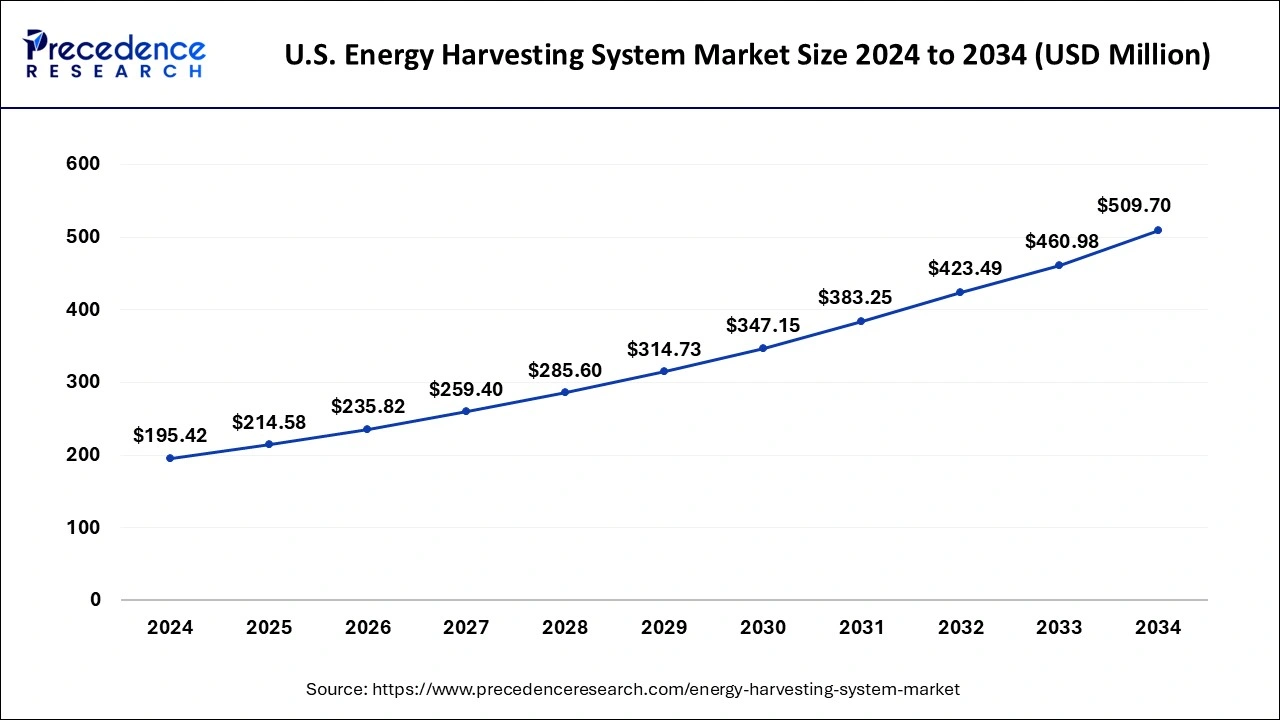
U.S. Energy Harvesting System Market Size and Forecast 2025 To 2034
The U.S. energy harvesting system market size is valued at USD 214.58 million in 2025 and is predicted to reach USD 509.70 million by 2034 with a CAGR of 10.06% between 2025 and 2034.
How is North America Leading in the Energy Harvesting System Market?
North America is the leading place in the energy harvesting system market, thanks to its digital innovation and government programs that promote the use of renewable energy. The region is well-equipped with smart grid infrastructure and tech companies doing R&D together. The use of intelligent sensors and connected devices is widespread, thus making the integration across residential, industrial, and commercial applications much stronger, creating a sustainable and energy-efficient ecosystem.
United States Energy Harvesting System Market Trends:
The United States is at the forefront of employing AI-assisted energy harvesting systems in smart cities, healthcare, and factory automation. The country's strong startup culture and technology ecosystem are conducive to innovations in micro-energy systems and autonomous sensors. Industry partners work together to create self-powered IoT devices and decentralized power cells, which in turn, make the country a leader in responsive, renewable, and energy-efficient technologies.
What are the Driving Factors of the Energy Harvesting System Market in Europe?
The market of Europe heavily relies on eco-friendly innovation, government support for green energy, and ongoing material research in the area of advanced materials. The application of AI in the region improves the management of renewable resources and the analytics prediction for the storage and distribution of energy. Governments are so much into eco-friendly technologies and decentralization of networks
Germany Energy Harvesting System Market Trends:
Germany is at the top of the hill when it comes to the energy harvesting market with its application of smart automation, industrial IoT, and sustainable design. The use of AI in the country helps in energy forecasting and system calibration to ensure that they run at their maximum efficiency. Besides, Germany's technical know-how together with its renewable energy.
How is Asia-Pacific Performing in the Energy Harvesting System Market?
Asia-Pacific is growing quickly, and its major contributors are industrial automation, smart device expansion, and digital infrastructure development. The integration of AI helps in the efficient use of renewable resources and in the management of power in real-time. The strong collaboration between the public and private sectors is one of the main drivers of innovation in self-powered IoT.
China Energy Harvesting System Market Trends:
AI-powered efficiency and extensive renewable integration drive the development of China's energy harvesting ecosystem. The country values smart manufacturing, self-sufficient infrastructure, and sensor networks that do not need batteries. Besides, the material discovery and intelligent system architecture accelerate performance in IoT and industrial sectors. Through the combination of automation and AI-driven predictive analytics, China is not only transforming but also leading the way in energy technology advancements.
Value Chain Analysis
- Resource Extraction: Sourcing raw energy materials such as minerals, wind, and solar resources.
Key Players: Exxon Mobil, Chevron, NTPC - Power Generation: Turning raw resources into electricity via renewable and hybrid systems.
Key Players: NTPC, Adani Power, Tata Power - Distribution Network Management: Overseeing the network that supplies the energy produced to the consumers most efficiently.
Key Players: Siemens, ABB, Power Grid Corporation of India - Energy Storage Systems: Storing and capturing the energy harvested in order to balance the cycles of demand and supply.
Key Players: Tesla, CATL, Exide Industries - Grid Maintenance and Energy Harvesting System Monitoring: Sustainable operational reliability through continuous AI-enabled oversight, ensuring efficiency and safety.
Key players: Siemens, GE Vernova, Grid Controller of India Limited
Energy Harvesting System Market Companies
- ABB
- Linear technology
- Convergence wireless
- Cymbet
- EnOcean
- Fujitsu
- Honeywell
Recent Developments
- In September 2025, Maxell, Ltd. will begin selling power modules and energy harvesting evaluation kits in September, using all-solid-state batteries PSB401010H. (Source:https://www.businesswire.com)
- In April 2025, Asahi Kasei Microdevices launched the AP4413 series of ultra-low current PMICs for energy harvesting battery charging, consuming 52 nA and featuring four battery type variants.(Source:https://www.asahi-kasei.com)
Segments Covered in the Report
By Technology
- Light energy harvesting
- Vibration energy harvesting
- Frequency energy harvesting
- Thermal energy harvesting
- Radio frequency energy harvesting
By Components
- Power Management Integrated Circuits
- Storage system
- Transducers
- Sensors
- Others
By Application
- Industrial Application
- Building and Home Automation
- Consumer Electronics
- Security
- Transportation
- Others
By Vibration Technology
- Piezoelectric
- Electromagnetic
- Electrostatic
- Electrodynamic
By End-use System
- Wireless switching system
- Wireless HVAC system
- Wireless sensing and telematics system
- Tire pressure monitoring system
- Asset tracking system
- Remote health monitoring system
- Regenerative energy harvesting system
By Energy Source
- Solar Energy
- Thermal Energy
- RF Energy
By Region
- North America
- Europe
- Asia-Pacific
- Latin America
- Middle East & Africa
For inquiries regarding discounts, bulk purchases, or customization requests, please contact us at sales@precedenceresearch.com
Frequently Asked Questions





Ask For Sample
No cookie-cutter, only authentic analysis – take the 1st step to become a Precedence Research client