




List of Contents
What is the Brewing Ingredients Market Size?
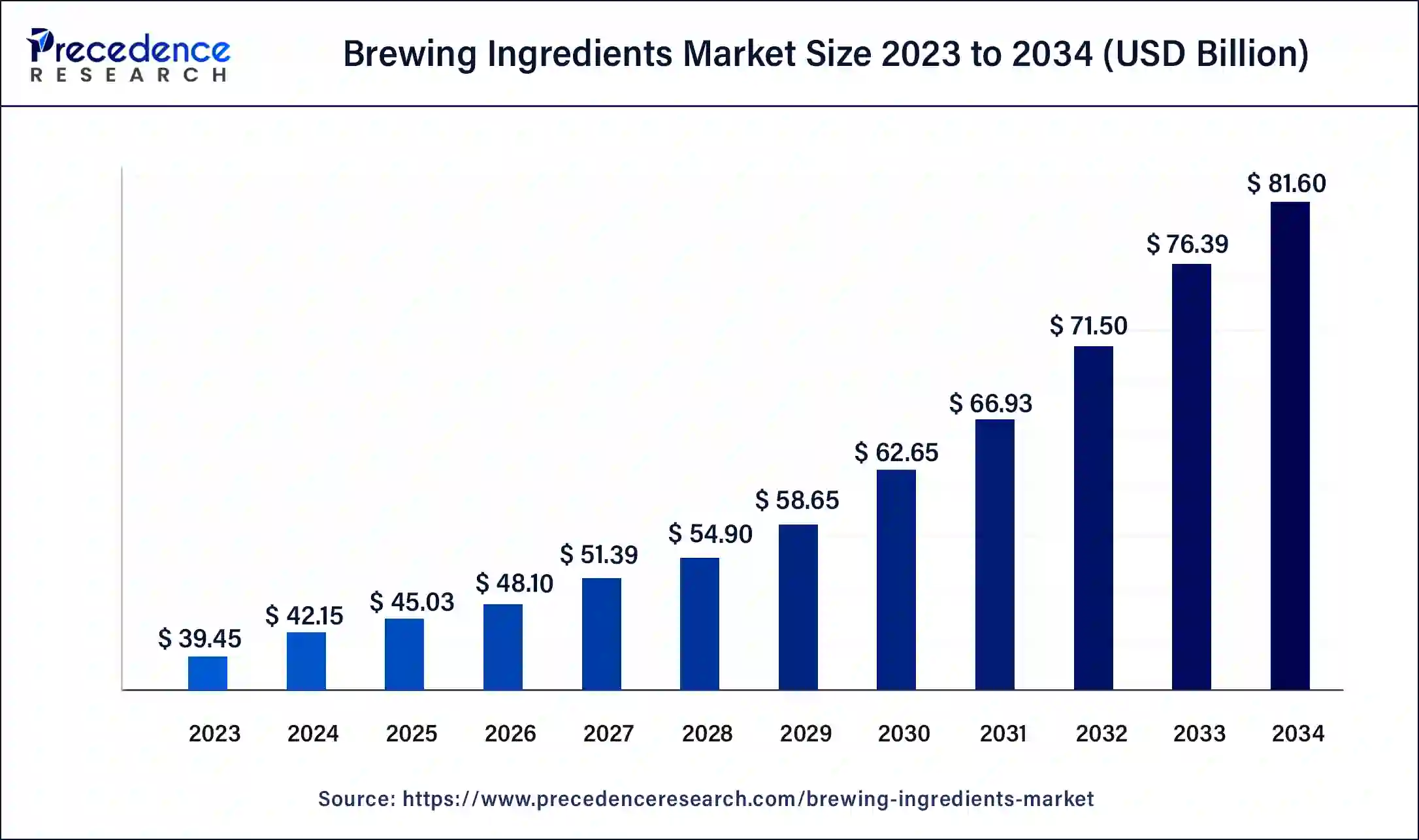
The global brewing ingredients market size is calculated at USD 45.03 billion in 2025 and is predicted to increase from USD 48.10 billion in 2026 to approximately USD 81.60 billion by 2034, expanding at a CAGR of 6.83% from 2025 to 2034. The benefits of brewing ingredients include natural antibacterial properties that help to preserve beer, flavor & aroma, bitterness, etc. contributing to the growth of the market.
Brewing Ingredients Market Key Takeaways
- In terms of revenue, the global brewing ingredients market was valued at USD 42.15 billion in 2024.
- It is projected to reach USD 81.6 billion by 2034.
- The market is expected to grow at a CAGR of 6.83% from 2025 to 2034.
- Asia Pacific dominated the brewing ingredients market in 2024.
- North America is estimated to be significantly growing during the forecast period of 2025-2034.
- By source, the malt extract segment dominated the market in 2024.
- By source, the beer yeast segment is expected to be the fastest-growing during the forecast period.
- By brewery size, the macro brewery segment dominated the market in 2024.
- By brewery size, the craft brewery segment is estimated to be the fastest-growing during the forecast period.
- By form, the dry segment dominated the brewing ingredients market in 20234 and is expected to grow at the fastest rate during the forecast period.
- By form, the liquid segment is anticipated to grow significantly during the forecast period.
What are Brewing Ingredients?
The brewing ingredients market refers to the services that provide brewing ingredients, which is an important component of the worldwide beverage industry, providing important components for beer production. It includes many sources of hops, beer additives, malt extract, yeast, grains, water, starch/sugar sources, including cereals or pseudo cereals, and others. The benefits of beer ingredients include the preservation of natural antibacterial properties that help preserve beer and the addition of flavors and aromas that may be herbal, piney, citrusy, or floral, depending on the hop variety.
What are the Growth Factors of the Brewing Ingredients Market?
- The benefits of brewing ingredients include the natural antibacterial properties of ingredients that help to preserve beer.
- Adding flavors and aromas that may be herbal, piney, citrusy, or floral, depending on the hop variety and bitterness, which balances the sweetness of the malt.
- Beer yeast plays an important role in the beer brewing process, which is helpful for the conversion of sugars into alcohol and carbon dioxide, which helps the growth of the brewing ingredients market.
- Because it retains husk at the time of threshing, barley use is the best choice. These help the growth of the market.
How is AI changing the Brewing Ingredients?
The AI used in brewing ingredients can help the growth of the brewing ingredients market. There are many ways to use AI in the brewing process, including recipe generation and ingredient selection based on the required flavor profile, beer style, and other criteria. AI can be used to generate unique, creative new label designs that match the personality and style of the beer and beer name generator. AI can be used to check the quality of beer by analyzing data like bitterness, alcohol content, and pH level. AI can also be used in BeerSmith analysis & automation, hop research, food pairing, and brewing calculations.
Brewing Ingredients Market Outlook:
- Industry Growth Overview: The brewing ingredients market is anticipated to develop in a steady manner between 2025 and 2030, largely driven by increased craft beverage production, new premium formulations, and growing demand for distinctive malt and hops with flavor. Strongest growth is forecasted in Asia-Pacific and North America, as breweries expand capacity and explore high-value specialty ingredients.
- Global Expansion: Key suppliers to the brewing, beverage, and food industries are expanding into Southeast Asia, Eastern Europe, and LATAM to accommodate growing brewery counts and local sourcing requirements. Companies are opening or adapting prior maltings, hop processing units, and yeast labs in proximity to growing market economies to reduce logistics costs and freshness expectations.
- Major Investors: Private equity and strategic investors are becoming more active due to healthy margins, stability, and alignment with premium beverage trends. Investment activity has focused on specialty hops, precision fermentation startups, and custom-engineered yeast platforms designed for high alcohol tolerance and consistency.
- Startup Ecosystem: The startup ecosystem is starting to gain traction in the bio-engineered yeast space, precision fermentation hops space, and sustainable malt alternatives. Companies across the United States, Europe, and India are successfully attracting VC investment with clean, scalable ingredient solutions aimed at reducing land use, water use, and variability of traditional crop-based inputs.
Market Scope
| Report Coverage | Details |
| Market Size by 2034 | USD 81.60 Billion |
| Market Size in 2025 | USD 45.03 Billion |
| Market Size in 2026 | USD 48.10 Billion |
| Market Growth Rate from 2025 to 2034 | CAGR of 6.83% |
| Largest Market | Asia Pacific |
| Base Year | 2024 |
| Forecast Period | 2025 to 2034 |
| Segments Covered | Source, Brewery Size, Form, and Regions |
| Regions Covered | North America, Europe, Asia-Pacific, Latin America, and the Middle East & Africa |
Market Dynamics
Driver
Rising beer consumption
The rising beer consumption is due to its many potential health benefits that contribute to the growth of the brewing ingredients market. The health benefits of beer include it flushes out toxins from the body, promotes longevity, delays aging has positive effects on the hair and skin, helps to cure insomnia and promote sleep, helps to increase vitamin B levels, helps in the development of healthier and denser bones, helps to reduce the risk of developing kidney stones, minimizes the risk of diabetes, helps to improve eyesight by preventing mitochondrial damage, helps to boost mental health, minimizes the risk of cancer, it helps to improve cholesterol levels, helps in reducing weight, and good for the heart.
- In April 2024, an investment of NT $ 13.5 billion over the next five years in Taiwan was announced by Dutch brewing company Heineken N.V.
Restraint
Downsides of brewing ingredients
The downsides of brewing ingredients can hamper the growth of the brewing ingredients market. Technical issues include products using various microorganism strains. It may create many challenges, including different fermenting time lengths, unused higher carbohydrate levels, etc., which can restrict the growth of the market.
Opportunity
Brewing technology innovations
Brewing technology innovations include vacuum separation, theologized yeast, which is a technology that was developed to improve beer aroma, and mash filtration technology, which is used to reduce the amount of water necessary to brew beer. Printing labels directly on bottles, also called bottle tattooing, IoT/AI solutions in breweries, meura technologies, Wonderware MES, and self-pour systems, which help smaller venues pour and store draft beer without large kegs.
- In July 2024, in Whitefield, Bengaluru, its launch was announced by Maize & Malt Brewery. This costly destination offers a unique blend of global cuisine and Anglo-Indian, cutting-edge beer in various entertainment spaces for a truly unparalleled experience. The Malt and Maize beverage program characteristics signature cocktails inspired by regional flavors.
Source Insights
The malt extract segment dominated the brewing ingredients market in 2024. The malt extract is associated with many potential health benefits. The benefits of malt extract benefits include improving bone health, supplying our body with B vitamins and antioxidants, reducing antinutrients, and boosting mood. Malt extract may help to improve heart health by reducing cardiovascular disease risks and lowering cholesterol levels. Malt extract contains soluble fibers which can support a healthy digestive system and promote regularity. It is a good source of carbohydrates that provide energy and performance for the body. It can be used to regulate blood glucose levels, helps to minimize diabetes concerns, and has cancer-fighting capabilities. It helps to enhance mental health and differentantioxidants, which helps the market's growth.
- In September 2022, the PlantMalt Clean Label Ingredients was launched by MunTon. The PlantMalt is a new line of powdered, liquid, and grain malt extract used in plant-based foods and beverages for meat alternatives. PlantMalt was developed to help manufacturers obtain succulent flavors, colors, texture, and mouthfeel of meat alternatives.
The beer yeast segment is expected to be the fastest-growing during the forecast period. The beer yeast plays an important role in the brewing process, which leads to the growth of the brewing ingredients market. The benefits of beer yeast include its efficiency in preventing diarrhea. It is also used to treat other digestive tract disorders, including lactose intolerance, clostridium difficile colitis, irritable bowel syndrome, traveler's syndrome, and diarrhea caused by antibiotics. Beer yeast may provide energy and can help to maintain healthy hair, skin, mouth, and eyes.
It can be effective at improving the immune system and supporting the nervous system. Beer yeast is a nutritional supplement and may strengthen the immune system and improve energy levels. It is rich in magnesium, zinc, iron, potassium, selenium, protein, and chromium. It is also a great source of B vitamins, including biotin, folic acid, pyridoxine, pantothenic acid, niacin, riboflavin, and thiamine.
- In November 2023, a SafeAle W-68, an active dry yeast, a world-renowned strain, was launched by Fermentis. It is used for German style and Flavorful wheat beers.
Brewery Size Insights
The macro brewery segment dominated the brewing ingredients market in 2024. Macro breweries are large breweries that produce above 6 million gallons of beer each year. This beer is mass-produced. It is more affordable than microbeers. The characteristics of macro breweries include large-scale production capabilities, a focus on quality control and consistency, and extensive distribution networks. Macro brewery also tends to have a wide range of beer styles in their portfolio, including specialty brews, ales, and larger popular beers. The cost of a macro brewery is much less than that of a craft brewery.
- In April 2024, from its modest beginning in Downtown Burlington, the low-daily brewery or microbrewery was reaching for a macro brewery or a bigger regional impact with a new distribution deal into Milwaukee and beyond.
The craft brewery segment is estimated to be the fastest-growing during the forecast period. The health benefits of craft breweries include it helps to lower cholesterol levels, reduced risks of Alzheimer's Disease, enhanced cognitive function, lowered risk of kidney stones, boosted immune systems, improved gut health, decreased risk of type-2 diabetes, reduced stress, and boosted mood, strengthen bones, reduces inflammation, and protects against cardiovascular disease (CVD).
The business benefits of craft breweries include advantages from the passionate and dedicated customer base, participation in an experience-based economy, growing tourism, potential for high-profit margins, encourage brand identity and creative expression, support sustainability appeal and local sourcing, capitalizing on rising craft brewery demand, offer high quality, unique artisanal products, encouraging strong community ties and loyalty, etc. contribute to the growth of the brewing ingredients market.
- In July 2024, a Flying Monkey-A Belgium Style Craft Beer in Hyderabad was launched by a leading brewing company, American Brew Crafts Private Limited (ABCL).
Form Insights
The dry segment dominated the brewing ingredients market in 2024 and is expected to grow at the fastest rate during the forecast period. Dry brewing ingredients, including dry yeast, are generally more affordable than liquid strains. Dry yeast has a higher number of cells in each package than liquid yeast. Dry yeast also has a longer shelf life at room temperature. The need for wort oxygenation is eliminated or reduced. Dry yeast is user-friendly and very convenient, and very few strains are available.
- In February 2023, White Labs announced dry yeast for its product line.
The liquid segment is anticipated to grow significantly during the forecast period. Liquid forms of brewing ingredients include liquid yeast, which is a live yeast cell culture suspended in a liquid form. It comes in smack packs or vials and needs refrigeration to maintain viability. The liquid yeast shines and offers brewers an exceptional level of complexity and diversity. The liquid yeast strains are available in unique flavor profiles, and they open the exploration world of possibilities for brewers. These factors help to the growth of the brewing ingredients market.
- In February 2023, Bluestone launched the home brewing liquid yeasts.
Regional Insights
Asia Pacific dominated the brewing ingredients market in 2024. India and China are the leading countries for the growth of the market in the Asia Pacific region. The rising population's drinking preference is constantly shifting towards an alcoholic culture. The growing market and increasing population demand for brewing ingredients. There is demand for various beers with different ABVs and different flavors, which is driving the growth of the market in the Asia Pacific region.
- In March 2024, a new beer named Queenfisher via its KingFisher brand was launched by Heineken's United Breweries Limited (UBL) in India.
North America is estimated to be significantly growing during the forecast period of 2024-2033. The increase in brewery development and the unique beer introduction contribute to the growth of the brewing ingredients market in the North American region. The North American region's increasing demand for flavored beers, cutting-edge brewing practices, and increasing craft beer industries are driving the market's growth.
- In June 2024, the Real American Beer was launched by Hulk Hogan. The new brand ‘is bringing America together, one beer at a time,' said WWE Hall of Fame wrestler, whose real name is Terry Bollea.
Why did China dominate the Asia-Pacific brewing ingredients market?
China dominated the Asia-Pacific region due to its expansive brewery landscape, robust consumer demand for mass and craft beer, and easy access to raw materials. Manufacturers in China invested in the quality of local malts, hop varieties, and yeast strains. Rising urban incomes and an increase in demand for premium beverages significantly contributed to the growth of the craft beer market. In addition, China developed strong support for craft beer through access to robust distribution networks and restructured export markets.
Why did the U.S. dominate the North American brewing ingredients market?
The U.S. was the leader in the North American region due to its craft beer activity, supporting a broad demand for premium ingredients. Local farms produced specialty hops, a range of malt varieties, and various yeast strains that produced high efficiency activity. Breweries also invested in the process of experimentation, leading to high demand for new flavors and blends. Additionally, the U.S. gained various markets through strong exports, improved processing technology, and consumer interest in healthy, low-calorie, and sustainable ingredients across regional categories of beer.
Why did Europe grow at a stable rate in the brewing ingredients market?
Europe shall experience stable growth in the brewing ingredients market due to an established beer culture, a strong participation of craft breweries, and sophisticated farming supporting ingredient demand. Europe focused on ingredient research as well, especially with specialty malts, aromatic hops, and top-quality yeast strains commonly used. Further, sustainable rules were urging businesses to incorporate organic and low-impact ingredients. Growth opportunities stemmed from premium ingredients for export, the growing interest in alcohol-free beer, and craft breweries, bolstered by tourism. Several countries pursued investments for updated processing facilities, which enabled Europe to maintain its leadership in quality for brewing ingredients worldwide.
Germany Brewing Ingredients Market Trends
Germany led the European brewing ingredients market, attributed to its long tradition of beer, strong hop farms, and quality laws for ingredient use. German maltsters and hop growers produced a resource of high-purity ingredients supplied globally. Breweries began using several beer styles with unique flavors while maintaining prominence amidst traditional styles, creating a demand for premium malts and yeast strains. The demand for German hops in the export markets also remained high. Additionally, efficient farming, modern brewing systems, and increasing global demand for German beer all contributed to Germany's market presence regardless of the competition levels.
What made Latin America grow rapidly in the brewing ingredients market?
Latin America experienced growth due to increased demand for ingredients generated by urban population growth, additional craft breweries, and expanded beer variety. Local farms increased malt barley production while breweries began to import specialty hops and yeast in order to increase flavor quality. Countries identified opportunities in tourism-oriented breweries, flavored beer, and premium brands. Additionally, growth in investments in agriculture, improving logistics, and consumer interest in local and regional craft beer all contributed to the region's ability to optimize its ingredient supply chain.
Brazil Brewing Ingredients Market Trends
Brazil continued to lead the region due to its significant beer culture, substantial domestic consumer base, and a growing interest in craft breweries and flavor. Malt producers ramped production, and breweries actively sourced new hop and yeast cultivars for flavor development. Brazil is also working to invest in farming projects to lessen reliance on imports.
What made the Middle East & Africa region grow steadily in the brewing ingredients market?
The Middle East & Africa regional market experienced steady growth because of the increase in demand for non-alcoholic beer, improvements in food processing areas, and new microbreweries opening up in tourism-driven locations. In parallel, imports of malt, hops, and yeast increased as breweries upgraded their quality. The premium segment of beverages provided the greatest scope, followed by flavored malt beverages, as well as new retail areas.
South Africa Brewing Ingredients Market Trends
South Africa took the lead at the regional market level primarily due to its brewery network being the strongest in the region, with solid agriculture and rising interest in the craft beer category. The recent improvements made to locally malted, imported hops, and yeast for additional flavor offerings all contributed to positive industry shifts. Breweries experimented with fruit-infused and African botanical blends, which also helped boost demand for brewing ingredients.
Popular Canadian Beer Brands
- Kokanee
- Labatt
- Molson Canadian
- Sleeman
- Moosehead Breweries
- Amsterdam Brewery
- Alexander Keith's
- Mill Street Brewery
- Container Brewing
- Steam Whistle Brewing
- Unibroue
- Collective Arts
- Dieu Du Ciel
- Bellwoods Brewery
Brewing Ingredients Market Companies
- Boston Beer Company (U.S.)
- ASAHI GROUP HOLDINGS LTD. (Japan)
- Carlsberg Breweries A/S (Denmark)
- Diamalteria Italiana Srl (Italy)
- Heineken N.V. (Netherlands)
- BSG CraftBrewing (U.S.)
- Muntons plc (U.K.)
- The Soufflet Group (France)
- GrainCorp. (Australia)
- Briess Malt & Ingredients (U.S.)
- Simpsons Malt (U.K.)
- Maltexco (Chile)
- Lesaffre (France)
- Viking Malt (Finland)
- Lallemand Inc. (Canada)
- Rahr Corporation (U.S.)
- Malteurope (France)
- BOORTMALT (Belgium)
Recent Developments
- In November 2023, a Silver Draught Beer, offering a premium, smooth-tasting beverage modified for social occasions, was launched by Heineken United Breweries in India.
- In April 2024, the first limited edition Fresh Hop IPA was launched by Jack Black. The addition of hop for aroma, flavor, and freshness.
Segments Covered in the Report
By Source
- Malt Extract
- Adjucts/Grains
- Hops
- Beer Yeast
- Beer Additives
By Brewery Size
- Macro Brewery
- Craft Brewery
By Form
- Dry
- Liquid
By Geography
- North America
- Asia Pacific
- Europe
- Latin America
- Middle East & Africa
For inquiries regarding discounts, bulk purchases, or customization requests, please contact us at sales@precedenceresearch.com
Frequently Asked Questions





Ask For Sample
No cookie-cutter, only authentic analysis – take the 1st step to become a Precedence Research client