




List of Contents
Artificial Organs and Bionics Market Size and Forecast 2025 to 2034
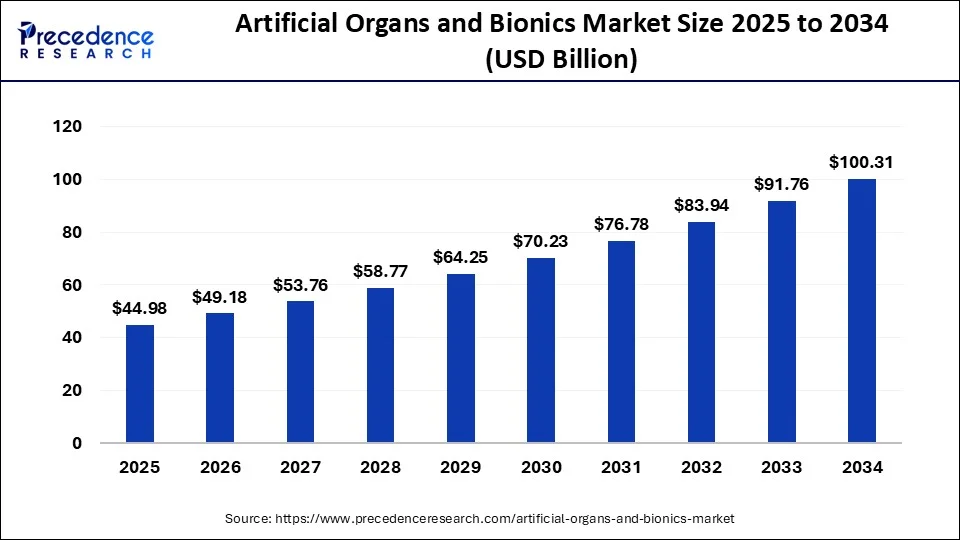
The global artificial organs and bionics market size is projected to be worth around USD 100.31 billion by 2034 from USD 41.15 billion in 2024, at a CAGR of 9.32% from 2025 to 2034. The North America artificial organs and bionics market size reached USD 19.34 billion in 2024. The key drivers of the artificial organs and bionics market are the increasing number of transplants and the rising number of people waiting for donors.
Artificial Organs and Bionics Market Key Takeaways
- The global artificial organs and bionics market was valued at USD 41.15 billion in 2024.
- It is projected to reach USD 100.31 billion by 2034.
- The artificial organs and bionics market is expected to grow at a CAGR of 9.32% from 2025 to 2034.
- North America dominated the artificial organs and bionics market with the largest market share 47% in 2024.
- Asia Pacific is anticipated to grow at a double digit CAGR of 11.13% during the forecast period.
- By product, the artificial organs segment contributed more than 71% of market share in 2024.
- By product, the artificial bionics segment is anticipated to expand at a solid CAGR of 10.72% over the forecast period.
- By technology, the mechanical segment accounted for the largest market share of 68% in 2024.
- By technology, the electronic segment is projected to grow at a notable CAGR of 9.92% during the projected period.
How Artificial Intelligence Can Improve the Organ Transplant Market
Artificial intelligence is majorly contributing to healthcare research with its wider applications in 3D printing technology. 3D-printed organ models provide high performance efficacy. The predictions of suitable organs, probability of organ rejection, organ donor-recipient matching are possible applications of AI in organ transplantation. The monitoring of immunosuppressant functioning is an AI-enabled approach before post-treatment care.
Machine learning helps optimize the printing parameters along with the classification of materials, functions, and products in 3D bioprinting technology. Machine learning has proven successful in detecting defects and running quality control and lowering of costs. Real-time data processing and data extraction are done by machine learning for implementation in clinical research technologies.
- In January 2024, Ekso Bionics announced the launch of GaitCoach Software which is equipped with robotics and offers a high-throughput user experience to patients as an exciting exoskeleton technology solution.
U.S. Artificial Organs and Bionics Market Size and Growth 2025 to 2034
The U.S. artificial organs and bionics market size was exhibited at USD 16.44 billion in 2024 and is projected to be worth around USD 40.74 billion by 2034, poised to grow at a CAGR of 9.50% from 2025 to 2034.
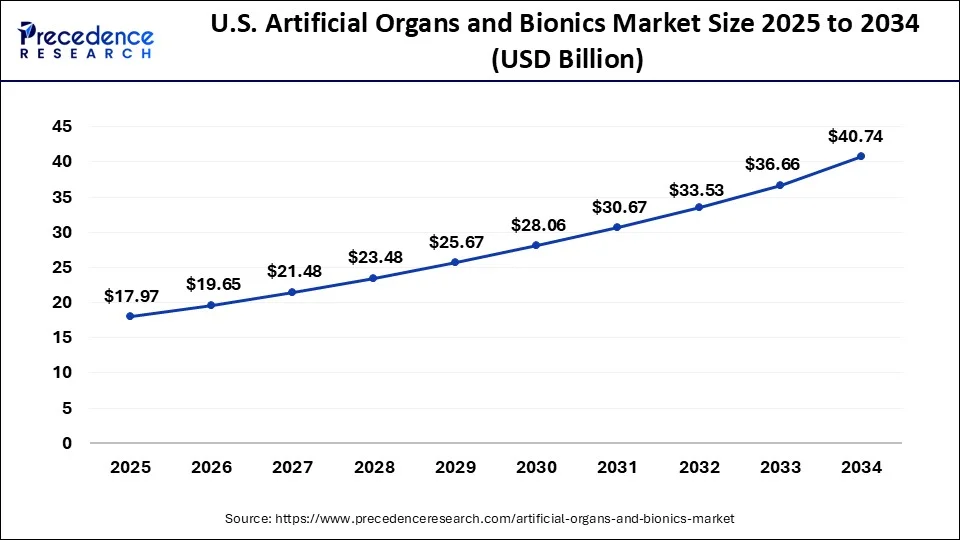
North America dominated the artificial organs and bionics market in 2024. This dominance can be attributed to the rising number of transplantations and the growing incidence of organ failures. Additionally, the presence of a well-developed healthcare infrastructure and major biotechnology and medical device companies, such as Zimmer, Arthrex, Medtronic, Novartis AG, and Stryker, play a significant role.
Over the past five years, the U.S. has seen a substantial increase in donor numbers. One of the key drivers of the artificial organs and bionics market in the U.S. is the escalating demand for kidney donations.
- In February 2024, a group of scientists demonstrated the potential of 3D ice printing for creating blood-vessel-like structures. Feimo Yang, a graduate student in the labs of Philip LeDuc and Burak Ozdoganlar at Carnegie Mellon University (PA, U.S.), will be presenting this research at the 68th Biophysical Society Annual Meeting.
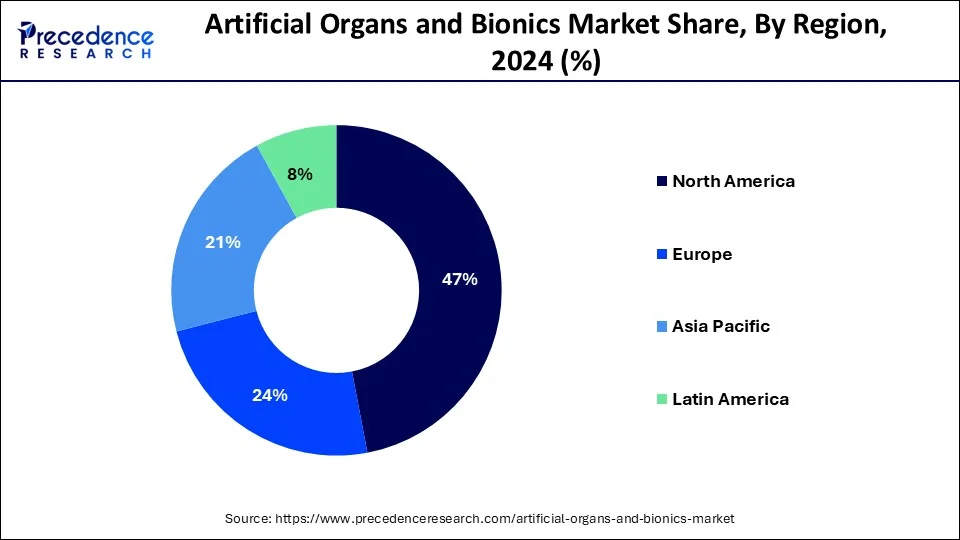
Asia Pacific is anticipated to artificial organs and bionics market the fastest growth in the market during the forecast period. The region, comprising emerging economies like Japan, China, and India, boasts substantial populations and a high prevalence of chronic diseases. This surge in chronic ailments is expected to drive the demand for transplants soon.
Medical tourism is flourishing in these technologically advanced countries, which offer a variety of state-of-the-art surgical procedures. The affordability of surgical treatments in this region attracts numerous international patients seeking medical care. Therefore, the rise in medical tourism, combined with the prevalence of chronic diseases, can lead to organ failure; this has driven the growth of the artificial organs and bionics market in Asia Pacific.
- In July 2023, Indian Institute of Technology Madras scientists at the Robert Bosch Centre for Data Science and Artificial Intelligence (RBC-DSAI) developed a computational approach called ‘MultiCens' to understand the interactions between genes that are responsible for inter-organ communication within the body. Communication among cells in different tissues and organs is pivotal to multicellular life.
Market Overview
Bionic implants and artificial organs are engineered medical devices worn externally or implanted in the body. These devices are manufactured artificially to replace or improve the function of natural organs. An artificial organ is a man-made device or tissue that is implanted or integrated into a person to interact with living tissue. It substitutes a natural organ, replicating or augmenting its function to help the patient resume normal life as quickly as possible. The replaced function does not always need to be linked to life support, though it frequently is. Bionics, also known as biologically inspired engineering, involves studying and developing engineering systems and modern technology based on principles derived from biological and natural systems.
Artificial Organs and Bionics Market Trends
Living Donation Trends
| Age Range | Number of Living Donors in 2023 | Percentage Increase Over 2022 |
| 18 to 34 | 1,736 | 1.1% |
| 35 to 49 | 2,720 | 7.9% |
| 50 and older | 2,495 | 12.1% |
Deceased Donation Trends
| Category | Number of Deceased Donors in 2023 | Percentage of Total Donors | Percentage Increase Over the Past Three Years |
| Percentage Increase Over the Past Three Years | 5,896 | 36% | 40.7% |
| Age 50 or Older | 6,884 | 42% | Not specified |
| Age Range 50 to 64 | 5,393 | Not specified | 16% over 2022 |
Artificial Organs and Bionics Market Growth Factors
- Development in healthcare centers and the availability of advanced artificial support systems are expected to drive the artificial organs and bionics market growth.
- The increasing global geriatric population is primarily creating demand for organ implants, which can further fuel the artificial organs and bionics market growth.
- Rising life expectancy and growing demand for organ donors are propelling the demand for artificial devices, which is likely to contribute to the artificial organs and bionics market expansion.
Market Scope
| Report Coverage | Details |
| Market Size by 2034 | USD 100.31 Billion |
| Market Size in 2025 | USD 44.98 Billion |
| Market Size in 2024 | USD 41.15 Billion |
| Market Growth Rate from 2025 to 2034 | CAGR of 9.32% |
| Largest Market | North America |
| Base Year | 2024 |
| Forecast Period | 2025 to 2034 |
| Segments Covered | Product, Technology, and Regions |
| Regions Covered | North America, Europe, Asia-Pacific, Latin America and Middle East & Africa |
Market Dynamics
Driver
Improved mobility and quality of life
Compared to a socket prosthesis, an Osseo-integrated prosthesis offers numerous advantages for individuals who have lost an arm or a leg. For example, walking becomes much easier due to the Osseo-integrated prosthesis connection, which provides greater stability and allows for a full range of joint movement.
Unlike socket prostheses, an Osseo-integrated prosthesis does not cause pain or damage to the skin when worn. Moreover, this type of prosthesis is directly attached to the bone, which can lead to a phenomenon known as natural Osseo-perception, where patients feel that their prosthesis is a part of their own body. This innovative approach significantly enhances the quality of life for amputees and has been widely adopted by numerous artificial organ and bionics manufacturers globally in recent years.
- In July 2023, Parkview and Ortho NorthEast launched the osseointegration program. The program is the first of its kind in Indiana, using advanced bone-anchored prosthesis technology to transform the quality of life for individuals with lower extremity amputations.
Restraint
Ethical and regulatory challenges
Ethical concerns and intricate regulatory frameworks can present significant obstacles to the artificial organs and bionics market expansion. Upholding patient safety, privacy, and ethical standards while developing innovative technologies can delay the rollout of new products and treatments. Thus, it can hamper the growth of the artificial organs and bionics market during the forecast period.
Opportunity
Artificial organ technologies
Artificial organ technologies have now been leveraged in therapeutic areas. The future focus should not solely be on developing replacement organs but also on utilizing artificial organ technologies for therapeutic or preventive medicine. By aggressively applying technologies such as organ-on-chip, the progression to early end-stage organ failure can be prevented, which reduces the demand for artificial hearts, kidneys, orthopedic implants, and other implantable artificial organs. Furthermore, 3D bioprinting technology is expected to address the issue of organ shortages in the future. These factors can create opportunities for the artificial organs and bionics market.
- In April 2024, United Therapeutics Corporation, a public benefit corporation, announced the world's first successful transplant of a UThymoKidney.The first living recipient of a UThymoKidney, in conjunction with a heart pump implant, is recovering after a successful transplant. This transplant represents several historic firsts for transplantation.
Product Insights
The artificial organs segment was the leader in the global artificial organs and bionics market in 2024. Several factors, such as body size, blood type, distance from the donor, and illness severity, are considered while waiting for organ transplants. Meeting the unmet demand is a challenge that has prompted manufacturers to develop bio-lungs, artificial pancreas, and wearable artificial kidneys. The demand for kidney, heart, lung, and liver transplants is fueling the growth of this segment. Additionally, the increasing need for cochlear implants and brain bionics is also contributing to this segment's growth.
- In January 2024, OrganOx and eGenesis advanced in a porcine liver replacement trial. Researchers were able to keep the pig-derived liver replacement healthy and alive in the body of a donor for more than 72 hours, maintaining constant functionality. The artificial liver is connected to OrganOx's extracorporeal liver cross-circulation (ELC) device to enable circulation of the donor's blood through the porcine liver.
The artificial bionics segment is anticipated to grow at a faster rate in the artificial organs and bionics market over the forecast period. This can be attributed to the rising demand for cochlear implants, vision enhancements, and exoskeletons. The market expansion for artificial organs, bionics, and implants is further supported by favorable reimbursement policies and the rapid FDA approval process for implants, which facilitates faster commercialization. The device uses a cortical prosthesis to substitute the visual nerves in visually impaired individuals and is equipped with a camera, a brain implant, and a computer.
Technology Insights
The mechanical segment accounted for the largest share of the artificial organs and bionics market in 2024. The primary factors driving this growth of the segments are the increasing incidence of organ failure and the affordability of mechanical bionics. Mechanical artificial heart valves, which have a significantly longer lifespan compared to other options, are in high demand. Additionally, expedited FDA approvals and favorable reimbursement policies are contributing to market expansion. The extended durability of mechanical artificial heart valves, along with quick regulatory approvals and supportive reimbursement frameworks, is further fueling the demand.
- In September 2023, the Human Organ Atlas Hub (HOAHub) launched the first beamtime experiments beginning at the European Synchrotron (ESRF). a project spearheaded by UCL Mechanical Engineering's Professor Peter Lee and Dr Claire Walsh, based on the use of the Extremely Brilliant Source at the ESRF. The technology enables whole intact organs to be examined at multiple scales all the way down to the cellular level.
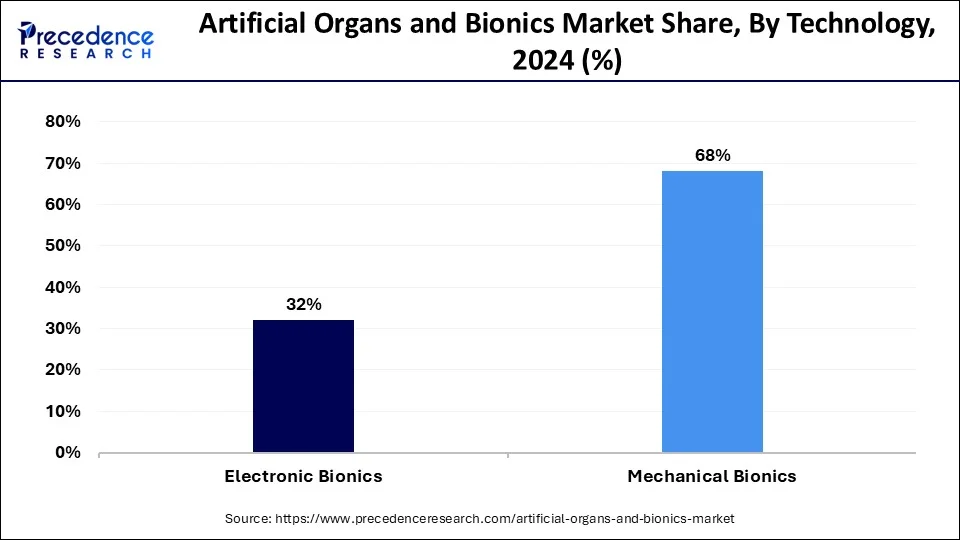
The electronic segment is anticipated to grow at the fastest rate in the artificial organs and bionics market during the projected period. The growing number of road accidents, the increasing prevalence of amputees, and the birth of individuals without limbs are anticipated to drive the demand for electronic bionics. In many developing nations, logistical and financial challenges remain substantial. Sensory electric technologies enable mobility in these artificial organs. Machine learning, smart wearables, and element modeling contribute to achieving this mobility. For numerous disabled individuals, the only available option is to acquire prosthetics such as artificial hands, arms, and legs. These prosthetics often incorporate battery-powered and myoelectric-controlled electronic systems that facilitate nerve movement through sensors.
Artificial Organs and Bionics Market Companies
- Medtronic Plc.
- Boston Scientific Corporation
- Zimmer Biomet
- Edwards Lifesciences Corporation
- Jarvik Heart, Inc
- Cochlear Ltd.
- SynCardia Systems, LLC
- Berlin Heart
- Ekso Bionics
- ABIOMED
RecentDevelopments
- In May 2024, Medtronic Plc. acquired Aortix, a company specializing in advanced circulatory support technologies, to expand its portfolio in artificial organ systems. This acquisition is expected to enhance Medtronic's capabilities in providing innovative solutions for patients with severe cardiac conditions.
- In March 2024, Boston Scientific Corporation launched the Alaris bionic limb, an advanced prosthetic arm with integrated sensors and AI-driven movement capabilities. The new product aims to provide enhanced mobility and functionality for amputees, reflecting Boston Scientific's commitment to innovation in bionics.
- In June 2023, IVIVA Medical, a biotech startup that develops living therapeutics to cure patients with organ failure, was awarded a Phase 2 KidneyX Prize by the Kidney Innovation Accelerator, a public-private collaboration between the American Society of Nephrology (ASN) and the U.S. Department of Health and Human Services (HHS), for its work designing a fully implantable bioartificial kidney using 3D printing.
Segments Covered in the Report
By Product
- Artificial Organs
- Kidney
- Heart
- Lungs
- Liver
- Pancreas
- Artificial Bionics
- Cochlear Implant
- Exoskeleton
- Bionic Limbs
- Vision Bionics
- Brain Bionics
By Technology
- Mechanical Bionics
- Electronic Bionics
By Geography
- North America
- Asia Pacific
- Europe
- Latin America
- Middle East & Africa
For inquiries regarding discounts, bulk purchases, or customization requests, please contact us at sales@precedenceresearch.com
Frequently Asked Questions





Ask For Sample
No cookie-cutter, only authentic analysis – take the 1st step to become a Precedence Research client