




List of Contents
What is the Airport Robots Market Size?
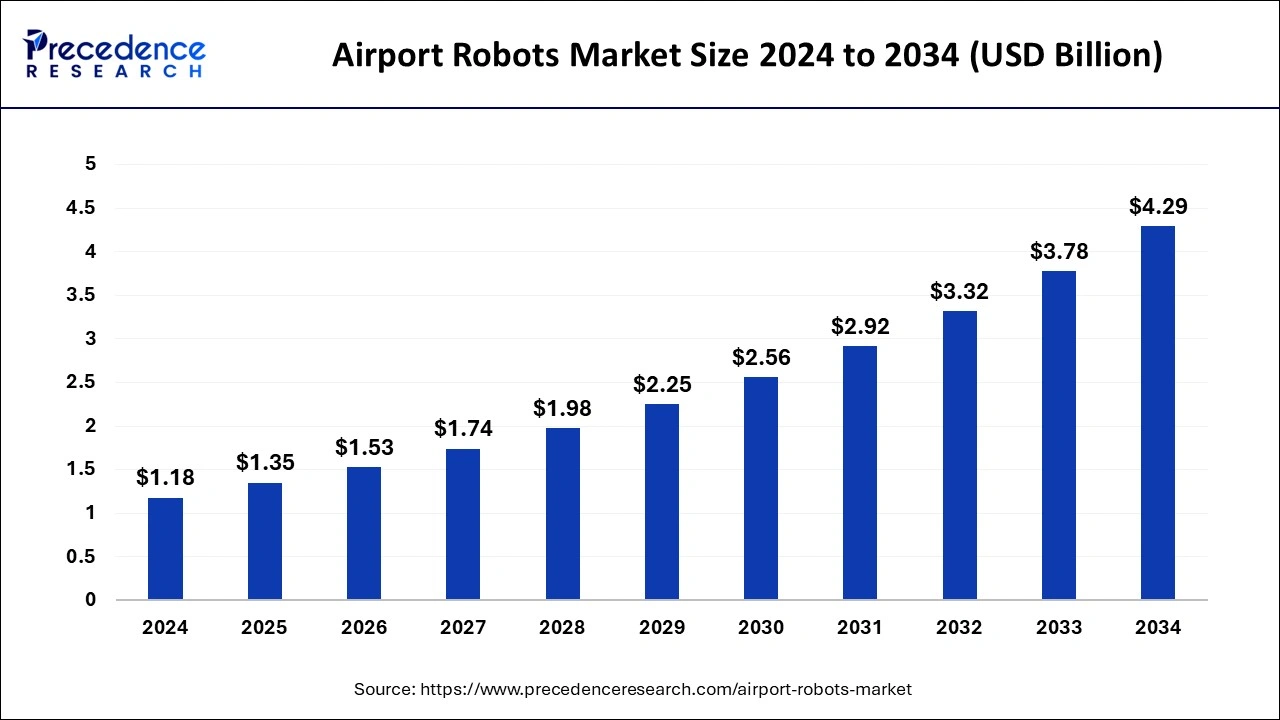
The global airport robots market size is accounted at USD 1.35 billion in 2025 and predicted to increase from USD 1.53 billion in 2026 to approximately USD 4.29 billion by 2034, expanding at a CAGR of 13.76% from 2025 to 2034. Robotic technology at airports offers efficient operations, streamlines processes, enhances security, and improves customer experience, which contributes to the growth of the airport robots market.
Airport Robots Market Key Takeaways
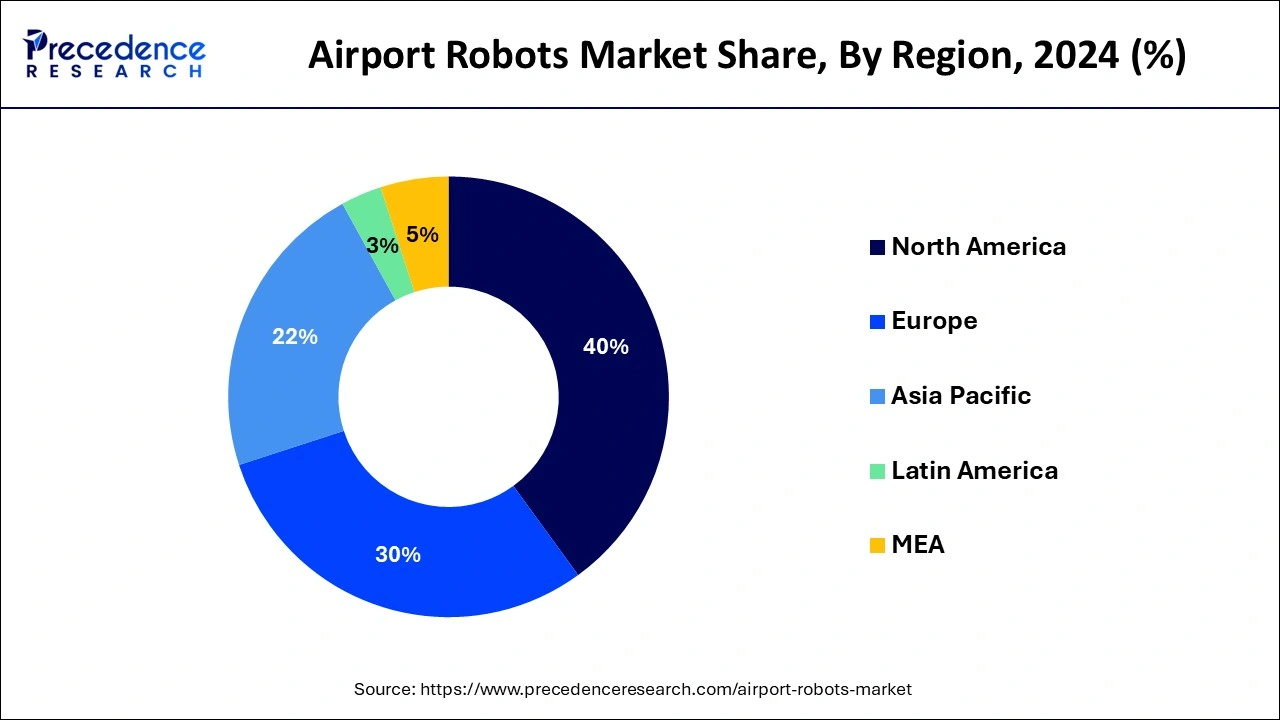
- North America dominated the global airport robots market with the largest market share of 40% in 2024.
- Asia Pacific is observed to host the fastest-growing during the forecast period.
- By type, the non-humanoid segment generated the major share in 2024.
- By type, the humanoid segment is projected to expand rapidly over the coming years.
- By application, the terminal segment captured the biggest market share in 2024.
- By application, the landside segment will show significant growth during the forecast period.
- By end-user, the airport security segment contributed the highest share in 2024.
- By end-user, the passenger guidance segment is expected to grow at the fastest CAGR during the forecast period.
How is Artificial Intelligence (AI) changing the Airport Robots Market?
Airport robots are used for passengers' safety to carry out their health checks; with the help of built-in cameras, sensors, and algorithms, they have the ability to measure pulse rate and detect high body temperature, heart rate, and stress level. AI-powered robots enhance security procedures by performing tasks such as facial recognition and self-service check-ins. The airport robots market with artificial intelligence detects prohibited items that are restricted at airports, including knives, firearms, and ammunition at the security checkpoint.
- In August 2024, Moxy Bengaluru Airport Prestige Tech Cloud launched its innovative approach to futuristic hospitality with the introduction of an advanced autonomous mobile robot set to join the property. These AI-powered robots enhance the guest experience by offering welcoming, refreshing cocktails and delivering room service through model 3D perception RGBD cameras and IoT connectivity.
From Check-In to Clean Up: Robots redefining airport efficiency
Robotic systems are airports in a novel implementation, which has a crucial role to play in the construction and maintenance of the airport infrastructure. They are primarily used for staffing airport check-in desks, carrying out security protocols, cleaning and delivering food to passengers. With growing technological advancement and economic pressure, such as operational costs, airport robots embrace technology, which leads to reduced labor costs and improved profitability. The rising digital transformation at the airport is gaining momentum, converging existing systems with automation and robotics, which results in more efficiency, security, and passenger-centric performance.
- According to Air Transport IT insights, more than half of global airlines and 32% of airports are looking for partners to enhance their robotic involvements. As per a report by SITA's Air Transport IT Insights 2023, 18% of airlines have planned to incorporate major robotics and autonomous machine programs until 2026.
The global airport robots market is witnessing an automation renaissance. Once confined to futuristic concepts, robots are now becoming indispensable in airport ecosystems, from passenger guidance and security screening to cleaning and baggage handling. As airports face rising passenger volumes and staff shortages, robotics ensures precision, speed, and 24/7 operational reliability.
Modern robots integrate AI, machine vision, and natural language processing to interact seamlessly with travellers. They not only streamline logistics but also elevate passenger experience through contactless assistance. The market's growth reflects aviation's shift toward intelligent, data-driven operations powered by robotics innovation.
Market Key Trends
The airport robots market is experiencing a surge in innovation as global aviation authorities seek to modernize the passenger experience and boost operational efficiency. With the continuous emphasis on contactless travel, especially post-pandemic, there has been increased deployment of robots for cleaning, sanitization, information dissemination, and security monitoring. One of the key trends is the use of AI-powered customer service robots, which provide real-time flight updates, multilingual support, and passenger guidance. Additionally, baggage handling and cargo transport robots are streamlining logistics and minimizing human error. Facial recognition integration, autonomous navigation, and touch-free interactions are at the forefront, making airports smarter and more secure while reducing human dependency and enhancing passenger trust.
Airport Robots Market Growth Factors
- Robots at the airport hold the potential for revenue opportunities by providing commercial features such as advertising and customer interaction based on passenger demographics, location, and destination.
- Robots at airports offer seamless navigation to travelers and autonomously handle luggage with precision. Additionally, robots operate tirelessly all the time, and they are free from the constraints of human fatigue, which ultimately improves efficiency, precision, and safety.
- The airport robots market boosts security by incorporating tasks such as detection, surveillance, and threat assessment.
- A cleaning robot at the airport increases hygiene and maintains an adequate atmosphere around. These robots have built-in advanced sensors and cleaning equipment to sanitize the airport, including restrooms, waiting rooms, and dining.
Market Outlook
- Industry Growth Overview: The industry is expanding at a steady pace as airports embrace automation to stay competitive. Growth is driven by technological convergence of AI, IoT, and advanced sensors. Robotics streamlines key airport functions such as cargo handling, surveillance, and cleaning. The market benefits from supportive government policies on aviation modernization. Partnerships between airport authorities and robotics firms create rapid adoption channels. The demand for autonomous, cost-efficient, and hygienic solutions ensures robust industry evolution.
- Global Expansion: Airport robotics is spreading globally as aviation authorities recognize its efficiency benefits. Early adopters in Asia and North America inspire installations across Europe, the Middle East, and Latin America. Cross-continental partnerships fuel product localization and technical training. Manufacturers are scaling production to meet regional customization needs. The rise of smart airports globally is tightly linked to robotics integration. As aviation rebounds, global expansion of robotic operations becomes both strategic and inevitable.
- Sustainability Trends: Sustainability goals are deeply embedded in airport robotics innovation. Robots optimize energy use by automating cleaning and lighting processes efficiently. They reduce waste through precision resource management and predictive maintenance. Integration with renewable power sources and smart grids enhances carbon efficiency. Robotics also contributes to reducing human-related emissions through optimized workflow planning. Green robotics thus becomes a vital component of sustainable aviation infrastructure.
- Startup Ecosystem: Startups are transforming the airport robotics landscape through agile innovation. They specialize in niche areas such as AI-based navigation, multilingual interaction, and UV-disinfection systems. New ventures partner with airports to pilot robotic service platforms and autonomous carriers. Investment in aviation-focused robotics startups is rising as airports seek scalable, intelligent solutions. Startups play a crucial role in developing modular, upgradable robotic architectures. Their flexibility and innovation speed keep the market dynamic and future-focused.
Market Scope
| Report Coverage | Details |
| Market Size by 2026 | USD 1.53 Billion |
| Market Size in 2025 | USD 1.35 Billion |
| Market Size in 2034 | USD 4.29 Billion |
| Market Growth Rate from 2025 to 2034 | CAGR of 13.76% |
| Dominating Region | North America |
| Fastest Growing Region | Asia Pacific |
| Base Year | 2024 |
| Forecast Period | 2025 to 2034 |
| Segments Covered | Type, Application, End-user, and Regions |
| Regions Covered | North America, Europe, Asia-Pacific, Latin America, and Middle East & Africa |
Market Dynamics
Driver
Leverage Economy
The broad utility of robotics in various industries has shown a positive impact on the business and employees. The economy drives better productivity by investing in machines, computers, robotics, and other items that offer optimized output for the airport robots market. Economists anticipate that technological advancement toward robots and automation will significantly impact the labor market. Automation is expected to increase labor productivity, which will ultimately increase economic growth and create more jobs. Robots have the potential to reduce human-causing errors; the embedded sensors help detect potential problems, control processes, enhance safety, and ensure proper functioning. Moreover, it improves operational accuracy, increases productivity, and enhances worker safety.
Restraint
Threatening Employment
There is no denying the fact that robotics is proving to be gradually dangerous for employees. Robots are replacing jobs significantly, and this is threatening low-skilled workers and middle-skilled professionals. The airport robots market has an adverse effect on employment due to its labor-saving nature.
- Research found that every robot is capable of working as 1,000 workers in the U.S., which declines wages by 0.42%, and the employment-to-population ratio goes down by 0.2%. To date, 400,000 jobs have been lost by the implementation of robots in all industries.
Opportunity
Gaming and entertainment
The facility of gaming and entertainment for the passengers at the airport is expected to be witnessed in the coming future. In the airport robots market A robot can be used as a performer or complement human performers. Deep learning (DL) technology facilities in training robotics with interactive entertainment to identify and analyze main decision events in games.
With the help of image recognition, action analysis, and rule matching, a robot can monitor the real-time game process and act as a referee. The airport robots market products are bound to revolutionize the future of gaming and entertainment through the implementation of artificial intelligence, advanced robotics, and creative programming, which will expand its way to another level.
Type Insights
The non-humanoid segment generated the major share of the airport robots market in 2024. As non-humanoid robots increase productivity and safety while reducing labor costs, they contribute to the rising market growth. A non-humanoid robot is designed to do repetitive tasks at the airport, such as cleaning, self-driving the passengers, security checking, scanning boarding passes, and identifications. The non-humanoid robot is proven to improve the operation efficiency of the airport.
The humanoid segment is projected to expand rapidly in the airport robots market over the coming years. Humanoid robots are becoming useful in many countries with rising labor shortages. Humanoids are useful in reinventing work, including supporting and complementing workers. The future expansion of this segment is anticipated as humanoid robots are more or less designed to mimic humans, which can help passengers with personal assistance, caregiving, entertainment, search and rescue operations, healthcare, and many more.
Application Insights
The terminal segment captured the biggest airport robots market share in 2024. The dominance of this segment is credited to the requirement of a robot at the terminal to improve efficiency. The robot ensures the airport terminal is clean and frees up human staff for other important tasks. Several key players and specialists are using robots for runway maintenance and construction of terminal buildings. Some airports are facilitated with autonomous AI robots that help passengers with visible disabilities or immobility.
- In June 2024, Chhatrapati Shivaji Maharaj International Airport Mumbai deployed two units of these Scrubber Dryer Robots at Terminal 2 in collaboration with its technology partners. These robots provide dynamic cleaning, with adaptable cleaning modes based on the floor type and dirt levels.
The landside segment will show significant growth in the airport robots market during the forecast period. The expansion of this segment is observed owing to the robots with the built-in features of biometric capabilities, which scan passenger identities for verification, enhance security, and reduce the waiting period. AI-powered robots in the car parking outside the airport, managing the parking, keeping a record of parking time, and easing the payment process.
End-user Insights
The airport security segment contributed the highest share of the airport robots market in 2024. The dominance of this segment is noticed as an advanced robotic system enhances security by automating the screening process and maintaining stringent security standards and protocols. The security robots in the airport are embedded with high-definition cameras that feature facial recognition software that relays pictures to the security station for analysis. Some AI-based robots are equipped with software algorithms that use artificial intelligence to automatically detect items that are restricted at the airport.
- In December 2024, the Odisha police initiated a process to procure robots for surveillance and patrolling of small airports to enhance airport security. The robots feature high-resolution cameras with thermal and infrared capabilities, enabling monitoring and detecting issues that are not visible to humans.
The passenger guidance segment is expected to grow at the fastest CAGR in the airport robots market during the forecast period. The growth of this segment is expected as robots in airports are making it convenient, stress-free, and improving passenger experience. A robot scans the passengers' boarding passes and navigates them to their departure gate. A multi-lingual robot helps passenger with their queries in the desired language.
- In March 2024, JEEVES, a service robot, was introduced at Munich Airport, which offers self-driving shopping – a snack box. It offers a selection of chilled soft drinks and snacks that can be purchased via various cashless payments. This improves logistics but also researches passenger acceptance and creates added value for the passenger travel experience.
Regional Insights
U.S. Airport Robots Market Size and Growth 2025 to 2034
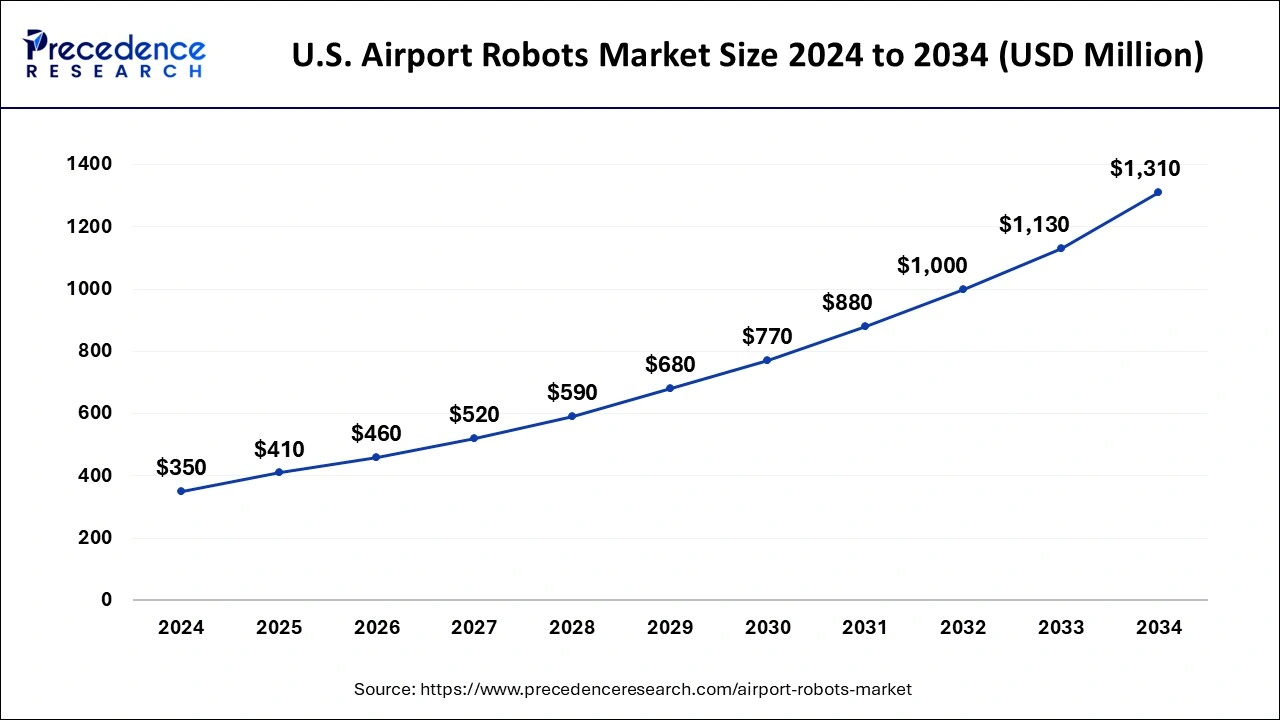
The U.S. airport robots market size is exhibited at USD 410 million in 2025 and is expected to be worth around USD 1,310 million by 2034, growing at a CAGR of 14.10% from 2025 to 2034.
Are Smart Robots Elevating Airport Experiences Across North America?
North America dominated the global airport robots market in 2024. The dominance of this region is due to the expanding research and development in robotics and the increasing adoption of robots at airports for passengers' safety, convenience, and better experience. A fully autonomous delivery robot is commonly seen at airports in North America, and it is used for delivering food, beverages, and lifestyle items within the airport premises. This initiative encourages ordering with contactless delivery. Another demand for robots in the United States is for airport security.
- In February 2024, Texas's San Antonio airport introduced an autonomous security robot, K5, which includes 360-degree eye-level video streaming, people detection during restricted hours, thermal anomaly detection, and license plate recognition.
North America remains the dominant region in the airport robots market, with the United States and Canada at the forefront. These countries benefit from strong government funding and a proactive approach towards integrating smart technologies into public infrastructure. In the U.S., federal and state-level transportation departments are supporting airport automation through grants and pilot projects. The Federal Aviation Administration (FAA) has introduced modernisation roadmaps that emphasise AI and robotics in airport safety and passenger management.
Canada, on the other hand, has taken significant strides in deploying robotic solutions for sanitation and concierge services, particularly in large international airports such as Toronto Pearson. Collaborations between local airports and tech startups are also fostering the deployment of autonomous mobile robots for surveillance and cleaning. These initiatives reflect a clear governmental vision to position North America.
Is Asia Pacific Building the Airports of Tomorrow Today?
Asia Pacific is observed to host the fastest-growing airport robots market during the forecast period. The growth of this region is due to the adequate cleaning and disinfection facilities provided at Asia Pacific airports. Additionally, these robots are capable of cleaning canals and removing rainwater. The robots tailored for repetitive tasks ultimately enhance the operational efficiency within the airport terminal. COVID-19 has made a significant impact on maintaining sanitation at the airport premises. As airport authorities have deployed autonomous robots, there has been an impressive reduction in the spread of viruses and other infectious diseases.
- A robot offers environmental and sustainability advantages compared to the traditional way of cleaning. It saves 50% of electricity and approximately 20% of water usage, along with reducing chemical consumption required for cleaning purposes.
Asia Pacific stands out as the fastest-growing region in the airport robots market, driven by the rapid expansion of air travel, urbanisation, and government-backed digital transformation efforts. Countries such as China, Japan, South Korea, India, and Singapore are leading the charge with aggressive infrastructure investments in smart airports. These nations are integrating robotics as part of broader strategies to enhance airport capacity, efficiency, and passenger satisfaction.
Asia Pacific airports are capitalising on cost-effective manufacturing and homegrown robotics talent, allowing for quicker adaptation of AI-driven robots for tasks like thermal screening, cleaning, luggage transport, and check-in assistance. Furthermore, high passenger traffic in the region creates an ideal environment for pilot testing and large-scale deployment of service robots.
Can Robotics Lead the Way Toward Seamless Passenger Journeys in Europe?
European airports emphasize digital transformation and sustainability, making robotics a natural fit. Robots assist with passenger check-ins, document scanning, and cleaning under eco-efficient protocols. Automation supports both green initiatives and operational optimization. EU-funded projects promote AI-driven mobility and robot-assisted security processes. European manufacturers collaborate with airport authorities to develop robots that align with safety and accessibility standards. As Europe redefines post-pandemic travel, robotics emerges as a cornerstone of smarter, cleaner, and safer airport operations.
Germany Airport Robots Market Trends
Germany's market is experiencing significant growth, driven by rising passenger volumes and the need for automation in baggage handling, cleaning, security, and passenger assistance. High labor costs and efficiency demands are accelerating the adoption of robotic solutions across major airports. The country's strong robotics infrastructure and expertise support the rapid deployment of advanced autonomous systems.
Will MEA's Smart City Vision Transform Its Airports Through Robotics?
The Middle East & Africa are embracing automation as part of broader smart infrastructure initiatives. Major airports are integrating service robots to enhance passenger engagement and safety monitoring. Robots assist in cleaning, security, and information delivery vital in managing growing passenger traffic. The focus is on improving turnaround times and operational reliability. Robotics aligns with MEA's ambition to position itself as a technology-driven travel hub. Increasing collaboration between robotics firms and airport authorities signals an era of AI-assisted aviation infrastructure.
The UAE Airport Robots Market Trends
In the UAE, Dubai and Abu Dhabi airports deploy robots for cleaning, baggage assistance, and traveller information. Saudi Arabia's Vision 2030 prioritizes smart mobility and automation across its new airport projects. Qatar's Hamad International Airport experiments with autonomous security and service units. South Africa explores cleaning and logistics robots in major terminals. Egypt and Morocco are gradually introducing automation in airport modernization programs. Together, these nations anchor MEA's journey toward a connected, automated, and futuristic airport ecosystem.
Market Value Chain Analysis
- Raw Material: Core materials include lightweight aluminum, carbon fiber, and reinforced polymers for structural stability. Electronic components, sensors, batteries, cameras, and processors form the robotic intelligence base. Durable and eco-friendly materials reduce maintenance needs and carbon footprint.
- Technological Shift: Technology is redefining how robots perform and interact in airport environments. Advances in AI enable predictive navigation, facial recognition, and adaptive learning. Robotics integrates with airport management systems to synchronize operations in real time.
| Robot Types | Functions |
| Delivery robots | Delivering foods and other items to passengers |
| Cleaning robots | Mopping and sanitizing the premises. |
| Security and Screening Robots | Scanning for hazardous objects and performing passport checks. |
| Passenger assistance robots | Providing information, acting as language translators, and guiding passengers. |
Top Companies
- Vanderlande Industries: A leading global partner for future-proof logistic process automation. The company provides integrated solutions, innovative systems, e.g., for baggage handling, sortation, packing, intelligent software, and life-cycle services for the warehousing, airports, and parcel sectors.
Siemens Logistics: A provider of innovative solutions for airport logistics, including baggage and cargo handling systems, as well as high-end software for digitizing logistics processes and related maintenance and services. - Pteris Global: An integrated solutions provider of airport facility equipment, including baggage handling systems, air cargo systems, and express courier handling systems. They offer design, manufacturing, installation, and maintenance services.
- Avidbots: A robotics company focused on autonomous cleaning. Its primary product is Neo, an AI-driven, autonomous floor-scrubbing robot for large commercial and industrial spaces, supported by cloud software Avidbots Command Center and customer service programs.
- ABB Robotics: A leading supplier of robotics and machine automation solutions, offering a comprehensive portfolio including industrial robots, collaborative robots, autonomous mobile robots (AMRs), controllers, software, and application-specific solutions for a wide range of industries automotive, electronics, logistics, etc.
- KUKA: A leading European manufacturer of industrial robots and automation and system engineering solutions. The company operates through segments like Robotics, Systems, and Swisslog, providing a wide range of robots for applications such as welding, assembly, and material handling.
Airport Robots Market Companies
- SITA
- ICM
- Vanderlande Industries
- Siemens Logistics
- Pteris Global
- Avidbots
- SoftBank
- Hitachi
- ABB Robotics
- KUKA
Latest Announcements by Industry Leaders
- In December 2024, Nicole Hogg, Portfolio Director of Baggage at SITA, said: "Our partnership with IDEMIA is so crucial. By integrating computer vision into baggage processing, we are tackling faced challenges. Together, we're setting a new standard for how the industry handles baggage, reducing mishandling and delivering a smoother, more secure journey for everyone involved."
Recent updates on Airport Robots Market
Robotics Innovation streamlines airport operations
- On 22 February 2025, Airport operations and passenger services underwent a radical change with the introduction of AI and robotics. Advanced sensor facial recognition and multilingual airport robots are improving passenger engagement, security, and navigation. Efficiency and the traveler experience have greatly increased as a result, particularly at major global hubs.
Growing automation demand boosts deployment of service robots
- By April 2025, the deployment of service robots across terminals has increased because of the growing demand for contactless services and operational automation. Robots are now frequently employed in high-traffic areas for cleaning baggage, handling information assistance, and disinfection. The market is expanding because of airport operators investing in robotics to increase scalability and safety due to labor shortages and an increase in international air travel.
Recent Developments
- In May 2025, Bangalore International Airport Limited (BIAL), which operates Kempegowda International Airport Bengaluru, partnered with KPMG in India to harness the transformative capabilities of generative AI (GenAI). This partnership aims to redefine airport operations, enhance efficiency, and establish new global benchmarks in aviation by leveraging pioneering GenAI models within a flexible and adaptable architecture.
- On 15 March 2025, LG Electronics expanded its CLOi GuideBot service across major South Korean and Japanese airports. The robots help travelers with directions, flight updates, and emergency communication, and are equipped with AI-powered language processing and obstacle avoidance.
- In February 2025, SITA and SoftBank Robotics launched an upgraded version of their Pepper robot for customer service at airport check-ins and immigration counters. The robot now features improved voice recognition and integrates with real-time airport systems.
- In March 2025, Munich Airport introduced a fleet of autonomous cleaning robots in collaboration with Gaussian Robotics. These robots are powered by AI navigation systems and operate 24/7, reducing manual labor costs and enhancing cleanliness standards.
- In April 2025, Indira Gandhi International Airport deployed humanoid robots for the first time to assist travelers with real-time flight information, baggage directions, and multilingual support, making a first in India's airport sector.
- In December 2024, Thiruvananthapuram International Airport, managed by Adani Airport Holding Limited (AAHL), launched intelligent cleaning robots to redefine the passenger experience at the airport. The SD 45 combo robot can run for up to 8 Hours on a single charge. It is remotely operated using smartphones or tablets. It is able to scrub, dry, and dry mob on the terminal and forecourt.
- In August 2024, A&K Robotics, a mobility robot developer, launched new self-driving robotic pods at Vancouver International Airport (YVR). The pods are designed to provide passengers with varying mobility and guidance needs, as well as passengers who need assistance at the airport. These pods utilize an intelligent navigation system that helps to connect with people having mobility challenges to provide a full airport experience including accessing shops, restaurants, restrooms, and other amenities.
Segments Covered in the Report
By Type
- Humanoid
- Non-Humanoid
By Application
- Landside
- Terminal
By End-user
- Airport Security
- Boarding Pass Scanning
- Airport Baggage System
- Passenger Guidance
- Others
By Geography
- North America
- Asia Pacific
- Europe
- Latin America
- Middle East and Africa
For inquiries regarding discounts, bulk purchases, or customization requests, please contact us at sales@precedenceresearch.com
Frequently Asked Questions





Ask For Sample
No cookie-cutter, only authentic analysis – take the 1st step to become a Precedence Research client