




List of Contents
What is the 3D Printing in Healthcare Market Size?
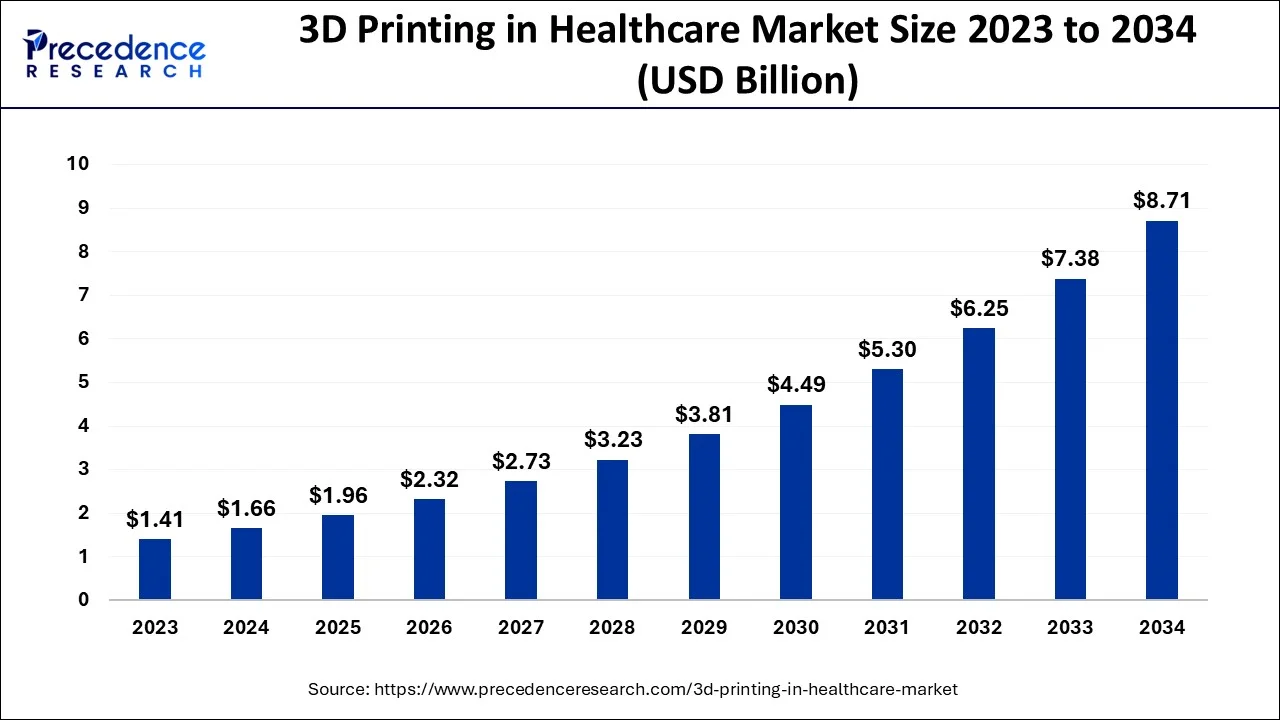
The global 3D printing in healthcare market size is valued at USD 1.96 billion in 2025 and is predicted to increase from USD 2.32 billion in 2026 to approximately USD 8.71 billion by 2034, expanding at a CAGR of 18.03% from 2025 to 2034.
3D Printing in Healthcare Market Key Takeaways
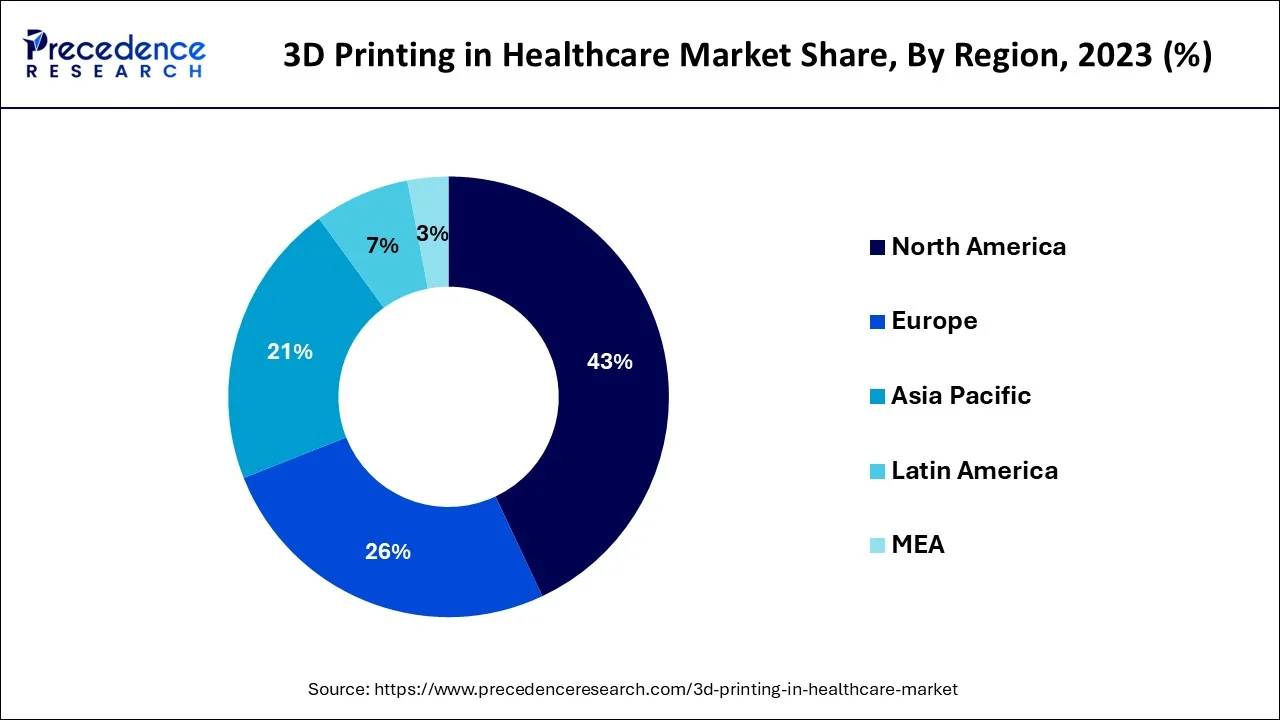
- North America dominated the global market with the largest market share of 43% in 2024.
- Asia-Pacific is expected to grow at a CAGR of 21.8% over the forecast period 2024 to 2034.
- By component type, the system segment generated 51% revenue share in 2024. However, the materials segment is registering growth at a CAGR of 18.06% over the forecast period.
- By technology, the droplet deposition segment held a 29% revenue share in 2024.
- By application, the external wearable devices segment accounted for 38.7% market share in 2024.
- By end user, the medical & surgical centers segment exhibited a revenue share of around 45% in 2024. However, the academic institutions segment is growing at a CAGR of 21.6% between 2025 to 2034.
How is AI transforming 3D printing in healthcare?
The process of 3D printing includes the manufacturing of objects that are dimensionally solid which are mainly used in the health care sector and is known in the name of additive manufacturing. Additive processes are put into use with a view to achieve 3D printed objects. Multiple layers are laid on each other in a successive manner to create an object while using the additive process for manufacturing. The layouts present themselves as very thin sliced layers in the form of a cross section obtained from the object. Customized medical devices and equipments that are utilized in the healthcare sector are manufactured with the help of this process. The rapidly increasing demand for personalized health care facilities which are provided by the use of customized medical equipments according to the requirement of the patient has emerged as a major growth factor for the 3D printing technology.
Many other advantages provided by this advanced technology as compared to the other traditional patterns which are utilized by decreasing the risks that are involved in operative procedures. The chances of sepsis can be controlled to a great extent by using these advanced technologies while performing the complex procedures which increases the success rate to a great extent. The exposure of the individual to anesthesia can be reduced to a great extent by using these advanced technologies for performing complex surgical procedures. A high cost associated with the use of advanced 3D printing technology has challenged the growth of the market to a great extent.
The outbreak of the pandemic had a considerable impact on the growth of the 3D printing in healthcare market. The implication of global lock down restricted mode imposed by the government hampered the growth of the market to a great extent. This step was taken to prevent the further spread of infection and control the rate of mortality. The health care sector suffered a tremendous loss during this period When the hospitals were given strict guidelines to entertain only emergency and unavoidable cases with a view to prevent the chances of cross infection in between the infected patients and the medical staff. The huge number of patients who were infected during the course of the pandemic had hampered the growth of the market to a great extent.
AI in the Market
Healthcare professionals can deliver treatment that is safer, faster, and more cost-effective as real-time tracking reduces production errors and the resulting waste to a minimum. Machine learning paired with imaging systems is enhancing anatomical modelling at a finer level than ever before, enabling the development of patient-specific implants and prosthetics. AI also allows the customisation of drugs through advanced delivery mechanisms and dose optimisation. Advanced AI models benefit tissue engineering and regenerative medicine through improved scaffold designs and precise cell placements. They also enable personalized treatments and foster innovation while increasing precision. In addition, machine learning algorithms can be used in tandem with imaging systems to construct anatomical models and can even be used to design patient-specific implants and prostheses.
3D Printing in Healthcare Market Growth Factors
The rapid advancements in the field of technology which has been made by the key market players emerges as a major growth factor for the 3D printing in healthcare market. The use of personalization and customization in the field of medicine has attracted the potential consumers to take advantage of the advanced technologies that have been used in the healthcare sector. The extensive research and development programs which are conducted by the key market players with a view to introduce modern technology into the market has helped the growth phase of the market to a great extent.
The advanced health care facilities which are provided by the government in many parts of the world has encouraged the people to opt for such advanced technologies. The extensive use of 3D printing technology in the pharmaceutical sector has also emerged as a major opportunity for the growth of the market.
The recent collaborations and deals which have taken place in the healthcare sector has boosted the scope for 3D printing technology to a great extent and is foreseen to experience a tremendous growth during the future as well.
- Increasing investments made by key market players for introducing modern technology into the market.
- Increasing awareness among the people regarding the availability of customized services in the healthcare sector.
- The extensive research and development programs carried out by the key market players.
- Rapid increase in the number of chronic diseases prevalent in the society.
- Increasing disposable income which enables the people to opt for modern treatment options.
- The healthcare sector is noticing positive impacts as multiple key investors increase funding in modern technologies.
- The market is expanding due to an increase in awareness and demand for customized healthcare solutions.
- The advanced 3D applications of the industry are being unlocked due to cutting-edge 3D printing applications as a result of advanced R&D initiatives.
- The increasing number of chronic diseases is increasing the need for custom implants, drugs, and prosthetics.
- The increase in disposable income allows patients to seek advanced personalized treatment options.
Market Outlook
- Industry Growth Overview:
The 3D printing in healthcare market is growing, driven by increasing demand for personalized medical products like prosthetics, implants, and surgical tools. 3D printing enables the creation of customized devices tailored to individual patient anatomy, leading to improved results. - Global Expansion:
The market is expanding as applications in creating patient-centric surgical guides, prosthetics, and implants, as well as development in bio-printing tissues and organs. North America is dominant in the market due to the presence of a strong ecosystem of technology providers and material suppliers. - Major investors:
Major investors in 3D printing in healthcare include venture capitalists such as Bpifrance and Katana Capital for particular companies, as well as large corporations and venture funds.
Market Scope
| Report Coverage | Details |
| Market Size in 2026 | USD 2.32 Billion |
| Market Size in 2025 | USD 1.96 Billion |
| Market Size by 2034 | USD 8.71 Billion |
| Growth Rate from 2024 to 2034 | CAGR of 18.03% |
| Base Year | 2024 |
| Forecast Period | 2025 to 2034 |
| Segments Covered | Component, Technology, Application, End User and Region |
| Regions Covered | North America, Europe, Asia-Pacific, Latin America and Middle East & Africa |
Market Dynamics
Market Drivers
- Technological advancements- The rapid advancements which have been experienced in the medical sector has boosted the demand for 3D printing techniques which provide a better analysis and study regarding the disease conditions and help the physician to opt for a suitable line of treatment.
- Investment for research and development- The huge amount of investment made by the key market players with a view to introduce modern technology into the market to attract the potential consumers has emerged as a major driving force for the growth of the market.
- Huge client base- A huge client base is available for the 3D printing technology which provides better results by analyzing the entire condition and helps in choosing a correct line of treatment.
- Customized services provided to the consumer- The use of personalized and customized health care products has attracted the potential consumers by providing a flawless treatment experience. The increasing trend of using customized products in the healthcare sector has boosted the market for 3D printing to a great extent.
- Application in the field of biomedical- The biomedical sector has also made use of 3D printing technology to obtain maximum precision and accuracy with the results produced.
Market Challenges
- The high cost of the procedure- the high cost associated with the use of modern technologies and 3D printing techniques has emerged as a major challenge for the growth of the market. The total cost of treatment is boosted tremendously by the use of modern equipments.
- Fluctuating reimbursement policies- The reimbursement policies which are provided by the insurance companies keep fluctuating in terms of their rules and regulations which makes it very uncertain for the consumer to opt for advanced treatment options and techniques. The high cost associated with the treatment options requires a backup in the form of reimbursement facilities to make the treatment options affordable for the patients.
- Patent and copyright concerns- increasing trend of copyright and patent has challenged the growth of the market to a great extent.
- Lack of skilled professionals- lack of availability of skilled professionals who can manage the modern devices and equipment has emerged as a major challenging factor for the growth of the market during the forecast period. our ability offers skilled technician becomes very important to obtain the correct output and results which will further decide the line of treatment for the patient.
Market Opportunities
- Increasing application in the pharmaceutical sector- the use of 3D printing technology in the pharmaceutical sector has helped the market to achieve new heights and achieved a considerable growth over the period of time.
- Facilities of bioprinting organs and tissues- they were ability of bioprinting technology which is used for the body tissues and organs has emerged as a major opportunity for the growth of the 3D printing in healthcare market.
Component Insights
On the basis of component, the segment of system has emerged as the largest market due to its increasing demand in the healthcare sector. The rapid advancements in the field of technology which has been experienced in the form of full color 3D printing and multi material use has boosted the demand for advanced technologies in the market.
The advanced equipments that have been used in the healthcare sector are now portable and can be carried to remote places which increases the scope for the health care services. The requirement for a flawless service in the healthcare sector it's very important with a view to carry out the entire process without obstacles and obtain the desired results after the procedure.
Technology Insights
On the basis of technology, the segment of droplet deposition has emerged as the fastest growing market as far as technology is concerned. The increasing demand of droplet deposition technique has boosted the size of the market to a great extent. The property of chemical endurance which is presented by the 3D printing technology has emerged as a major attraction for the potential consumers. These materials can withstand a very high temperature and hence they emerge as extremely durable products in the market. The increasing demand for advanced technologies among the people has boosted the size of the market to a great extent and is foreseen to continue in a similar fashion during the future as well.
End User Insights
On the basis of end user, the segment of surgical and medical centers has emerged as the largest market and it's foreseen to maintain its position during the future as well. The huge number of people who opt for surgical procedures has boosted the demand for modern technology in this sector. the use of modern technology such as 3D printing in the field of surgery has helped the medical fraternity to obtain better results in a shorter period of time. This has reduced the number of complications that arise during the surgical procedure and hence improves the quality of the entire process. The recent collaborations which have taken place in the healthcare sector has boosted the demand for use of advanced techniques in the operative procedures.
Application Insights
On the basis of application, the segment of external wearable devices has emerged as a major market due to its increasing demand among potential consumers. The rules and regulations pertaining to the 3D printers have been relaxed considerably which has emerged as a major opportunity for the market. The market of 3D printing in healthcare experience is a boost with the increasing acceptance among the people.
Regional Insights
U.S. 3D Printing in Healthcare Market Size and Growth 2025 to 2034
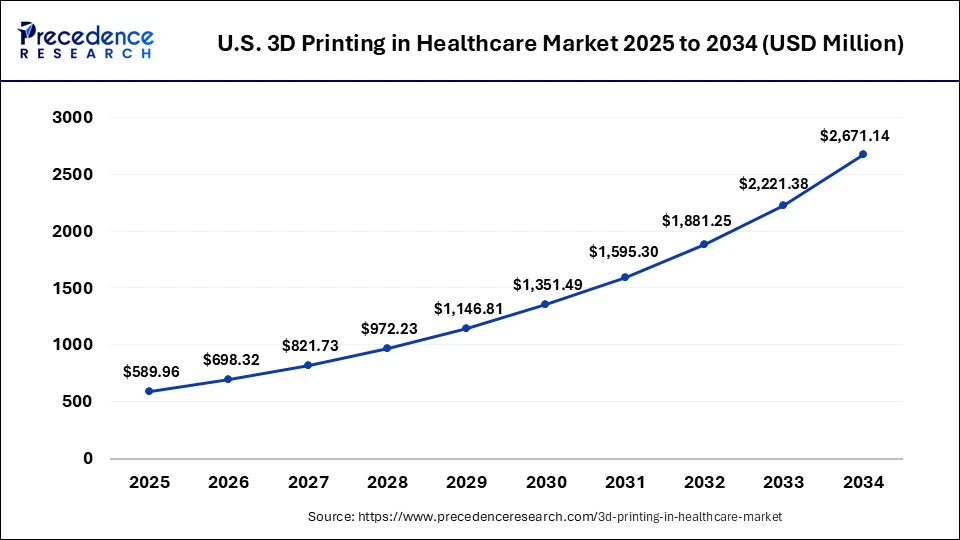
The U.S. 3D printing in healthcare market size is evaluated at USD 589.96 million in 2025 and is predicted to be worth around USD 2,671.14 million by 2034, rising at a CAGR of 18.25% from 2025 to 2034.
The region of North America has emerged as the largest market for this advanced technology and is foreseen to maintain its position during the forecast period. The rapid advancements in the healthcare sector brought about by the government has boosted the size of the market to a great extent. Increasing awareness among the people regarding the available options has also helped the market to record a considerable revenue over the period of time. The huge number of operative procedures that are carried out in this region has also emerged as a major growth factor for the 3D printing in healthcare market.
US: Rapid industrialization and infrastructure growth
In the United States, the presence of recent healthcare infrastructure, growing R&D investment, and a favorable government guideline, which drives the acceptance of 3D printing for customized medical care models, implants, and prosthetics. Hospitals and research centers have widely adopted 3D printing to create patient-specific medical devices and surgical planning tools.
Asia Pacific: Strong manufacturing hub and favorable government initiatives
Asia Pacific is the fastest growing market in the forecast period as 3D printing allows for the creation of patient-specific implants, prosthetics, and surgical guides that offer better anatomical fit and function, improving surgical outcomes and reducing recovery times. Rising healthcare expenditures and the rapid expansion and modernization of healthcare infrastructure make advanced technologies.
India: Technological advancements
India has a growing number of novel med-tech startups, such as Anatomiz3D, Osteo3D, and major research institutions like the IITs, intended to advance 3D printing applications in medicine, incorporating research in the bioprinting of tissues and organs. The Indian government supports the growth of this sector through programs such as "Make in India" and the National Strategy on Additive Manufacturing, which contribute to the growth of the market.
Europe: Growing innovation in green technology
Europe is significantly growing in the market due to an increasing adoption of modern medical technologies, a strong manufacturing base, and the increasing demand for customized products such as implants, which adhere to stringent quality and safety standards, contributing to the growth of the market.
UK: Technological and regulatory advantages
The UK hosts specialized hospitals and leading university research centers dedicated to biomedical engineering and additive manufacturing. The government supports this by promoting innovation and collaboration within the sector. Additionally, the MHRA has established a dedicated, approved pathway for hospitals to produce specific medical devices.
3D Printing in Healthcare Market- Value Chain Analysis
- R&D:
It includes R&D processes are digitize patient data or create a digital model, then use CAD software to design the object, and lastly use additive manufacturing to produce it.
Key Players: Jotun A/S, and Hempel A/S - Clinical trials:
Clinical trials for 3D printing in medical care contribute by using customized medical devices, anatomical models, and personalized medicines to test their safety, efficacy, and patient acceptance.
Key Players: The Sherwin-Williams Company and BASF SE - Patient Services:
Patient services using 3D printing in healthcare involve manufacturing customized, patient-centric devices and models to enhance medical care planning, offering targeted prosthetics and implants, and allowing customized pharmaceuticals.
Key Players: Akzo Nobel N.V. and PPG Industries, Inc.
Top Vendors in the 3D Printing in Healthcare Market & Their Offerings
|
Company |
Headquarters |
Key Strengths |
Latest Info (2025) |
|
Formlabs Inc. |
United States |
Accessibility and affordability |
Formlabs is the largest supplier of desktop stereolithography (SLA) and selective laser sintering (SLS) 3D printers in the world. |
|
PPG Industries, Inc. |
Massachusetts |
Strong brand reputation |
GE Renewable Energy inaugurates a 3D printing service that researches more effective ways to produce towers for wind turbines. |
|
3D Systems Corporation |
Carolina |
Comprehensive solutions portfolio |
3D Systems offers comprehensive products and services, containing 3D printers, print materials, software, on-demand printing services, and healthcare |
|
Exone Company |
United States |
Material flexibility |
ExOne is a global leader in additive manufacturing technology, providing industrial 3D printing systems and services. |
|
Materialise NV |
Belgium |
Diverse industrial applications |
It is well-known for its 3D printing software and healthcare solutions |
3D Printing in Healthcare Market Companies
- Formlabs Inc.
- General Electric,
- 3D Systems Corporation
- Exone Company
- Materialise NV
- Oxferd Performance Materials, Inc.
- SLM Solutions Group AG
- Organovo Holdings, Inc.
- Proto Labs
- Stratasys Ltd
Leaders Announcements
- In September 2024, Aakash Healthcare Super Speciality Hospital in Dwarka has opened an Advanced 3D Printing Lab in partnership with Stratasys. The facility features the Stratasys Digital Anatomy 3D Printer, which aims to transform orthopaedic practices at the hospital by enabling the creation of precise anatomical models tailored to each patient's unique anatomy. This development is positioned as part of the hospital's broader effort to elevate the standard of care for patients. (Source: https://www.expresshealthcare.in)
- In September 2024, APL, a leading contract development and manufacturing organization (CDMO), has announced a partnership with CurifyLabs, a Finnish health tech company specializing in personalized medicine manufacturing solutions. This collaboration aims to enhance the administration of medicines to children and critically ill patients using innovative 3D printing technology. (Source:https://pharmatimes.com)
Recent Development
- In August 2025, OIC International, Medi Mold, and AddUp partnered to establish an advanced orthopaedic implant manufacturing facility in India's Andhra Pradesh Medtech Zone, powered by 3D printing and precision engineering. (Source: https://www.expresshealthcare.in)
- In July 2025, OIC International, Medi Mold, and AddUp partnered to establish an advanced orthopaedic implant manufacturing facility in India's Andhra Pradesh Medtech Zone, powered by 3D printing and precision engineering. (Source: https://3dprintingindustry.com)
- In June 2024, 3D printer manufacturer Stratasys has announced the launch of its new J5 Digital Anatomy 3D printer for the medical market. The new 3D printer is targeted at hospitals, medical device manufacturers and research institutions. According to Stratasys, J5 Digital Anatomy seeks to improve patient outcomes, increase the efficiency of operating procedures and accelerate the market availability of anatomical products. (Source: https://orthofeed.com)
- In November 2024, Sparsh Hospitals has launched an advanced on-site 3D printing lab at its Infantry Road facility. The lab introduces cutting-edge 3D printing technology that is expected to revolutionize orthopedic and personalized medical care. To provide patient-specific surgical solutions that enable surgeons to plan and perform surgeries with unprecedented accuracy. (Source:https://www.voxelmatters.com)
- In June 2024, Atrium Health Wake Forest Baptist and Ricoh USA, Inc. announced the Ricoh 3D for Healthcare Innovation Studio, a first-of-its-kind manufacturing facility, located in One Technology Place in Winston-Salem's Innovation Quarter. Isaac Perry, head of life sciences and ecosystem development for the Innovation Quarter and Greater Winston-Salem, Inc. said “The Ricoh 3D for Healthcare Innovation Studio is an incredible value-add to what is a growing community of life sciences companies and resources here” (Source: https://newsroom.wakehealth.edu)
Segments Covered in the Report
By Component
- System
- Materials
- Polymers
- Photopolymers
- Thermoplastics
- Metals & Alloys
- Ceramics
- Others
- Polymers
- Services
By Technology
- Droplet Deposition
- Fused Filament Fabrication (FFF) Technology
- Low-temperature Deposition Manufacturing (LDM)
- Multiphase Jet Solidification (MJS)
- Photopolymerization
- Stereolithography (SLA)
- Continuous Liquid Interface Production (CLIP)
- Two-photon Polymerization (2PP)
- Laser Beam Melting
- Selective Laser Sintering (SLS)
- Selective Laser Melting (SLM)
- Direct Metal Laser Sintering (DMLS)
- Electronic Beam Melting (EBM)
- Laminated Object Manufacturing
- Others
- Color Jet Printing
- MultiJet Printing
By Application
- External Wearable Devices
- Hearing Aids
- Prosthesis & Orthotics
- Dental Products
- Clinical Study Devices
- Drug Testing
- Anatomical Models
- Implants
- Surgical Guides
- Cranio-maxillofacial Implants
- Orthopedic Implants
- Tissue Engineering
By End User
- Medical & Surgical Centers
- Pharmaceutical & Biotechnology Companies
- Academic Institutions
By Region
- North America
- Europe
- Asia-Pacific
- Latin America
- Middle East and Africa
For inquiries regarding discounts, bulk purchases, or customization requests, please contact us at sales@precedenceresearch.com
Frequently Asked Questions





Ask For Sample
No cookie-cutter, only authentic analysis – take the 1st step to become a Precedence Research client